楊洲周延 Toyohara Chikanobu (1838–1912)
幻灯写心竞 寄席
Rakugo Theatre, from the series Collection of Magic Lantern
1890
木版画 | 纵绘大判 | 37cm x 25.3cm
Woodblock-print | Oban-tate-e | 37cm x 25.3cm
早期版次;颜色鲜艳;品相非常好
Fine impression, color and condition.
$1,200
The Meiji era was a time of ferment and change in Japan, as Western influences seeped into many aspects of culture. Society’s norms were slowly changing. Among the shifting views was that of a woman’s role in society. To be sure, change came slowly, and still does, but in this series – Collection of Magic Lantern -- Chikanobu did something highly unusual.
While women had been treated as little more than pretty dolls or sexual playthings in Ukiyoe, here the artist gives his female subjects hopes and dreams equaling, even rivalling, those of men.
The Magic Lantern – also known as a “Slide Lantern” -- was an early projection device that illuminated interchangeable slides within a wooden box. A precursor to the slide projector, as well as movies, it was a hit at the time. In this series, the powerful graphic device of a large circle in the upper center is, we believe, meant to capture the main subject’s inner thoughts.
A well-dressed woman who has just alighted from a rickshaw seems to be thinking of a performance occurring inside the Raguko Theater. Raguko was an art form of narrative and comic storytelling, and up until this time, it was exclusively the domain of male performers. Yes, women were allowed minor subsidiary roles, such as juggling, but one imagines that was hardly satisfactory to someone with big dreams of being a star.
We see in the daydream circle, on a traditional raised platform, the Rakugo himself, and the musician accompanying him on a samisen. We can tell the Rakugo by his fan, which was used as a prop during the performance to represent many items. While Rakugo stories were usually comic, the two men here do look rather serious.
Does our heroine long to be up there on the stage herself, telling a funny tale? Perhaps. Other wonderful designs from this series depict women who want to enter politics or who, at the very least, want to escape domestic chores by engaging in unusual activities, such as riding an elephant.
Chickanobu also placed this print at a time of historical change by rendering a rickshaw – the use of which had only recently been imported from China – and a traditional Japanese umbrella, which had long been in use. Old meets new. And dreams never die.
Interested in purchasing?
Please contact us.
楊洲周延 Toyohara Chikanobu (1838–1912)
幻灯写心竞 寄席
Rakugo Theatre, from the series Collection of Magic Lantern
1890
木版画 | 纵绘大判 | 37cm x 25.3cm
Woodblock-print | Oban-tate-e | 37cm x 25.3cm
早期版次;颜色鲜艳;品相非常好
Fine impression, color and condition.
$1,200
The Meiji era was a time of ferment and change in Japan, as Western influences seeped into many aspects of culture. Society’s norms were slowly changing. Among the shifting views was that of a woman’s role in society. To be sure, change came slowly, and still does, but in this series – Collection of Magic Lantern -- Chikanobu did something highly unusual.
While women had been treated as little more than pretty dolls or sexual playthings in Ukiyoe, here the artist gives his female subjects hopes and dreams equaling, even rivalling, those of men.
The Magic Lantern – also known as a “Slide Lantern” -- was an early projection device that illuminated interchangeable slides within a wooden box. A precursor to the slide projector, as well as movies, it was a hit at the time. In this series, the powerful graphic device of a large circle in the upper center is, we believe, meant to capture the main subject’s inner thoughts.
A well-dressed woman who has just alighted from a rickshaw seems to be thinking of a performance occurring inside the Raguko Theater. Raguko was an art form of narrative and comic storytelling, and up until this time, it was exclusively the domain of male performers. Yes, women were allowed minor subsidiary roles, such as juggling, but one imagines that was hardly satisfactory to someone with big dreams of being a star.
We see in the daydream circle, on a traditional raised platform, the Rakugo himself, and the musician accompanying him on a samisen. We can tell the Rakugo by his fan, which was used as a prop during the performance to represent many items. While Rakugo stories were usually comic, the two men here do look rather serious.
Does our heroine long to be up there on the stage herself, telling a funny tale? Perhaps. Other wonderful designs from this series depict women who want to enter politics or who, at the very least, want to escape domestic chores by engaging in unusual activities, such as riding an elephant.
Chickanobu also placed this print at a time of historical change by rendering a rickshaw – the use of which had only recently been imported from China – and a traditional Japanese umbrella, which had long been in use. Old meets new. And dreams never die.
Interested in purchasing?
Please contact us.

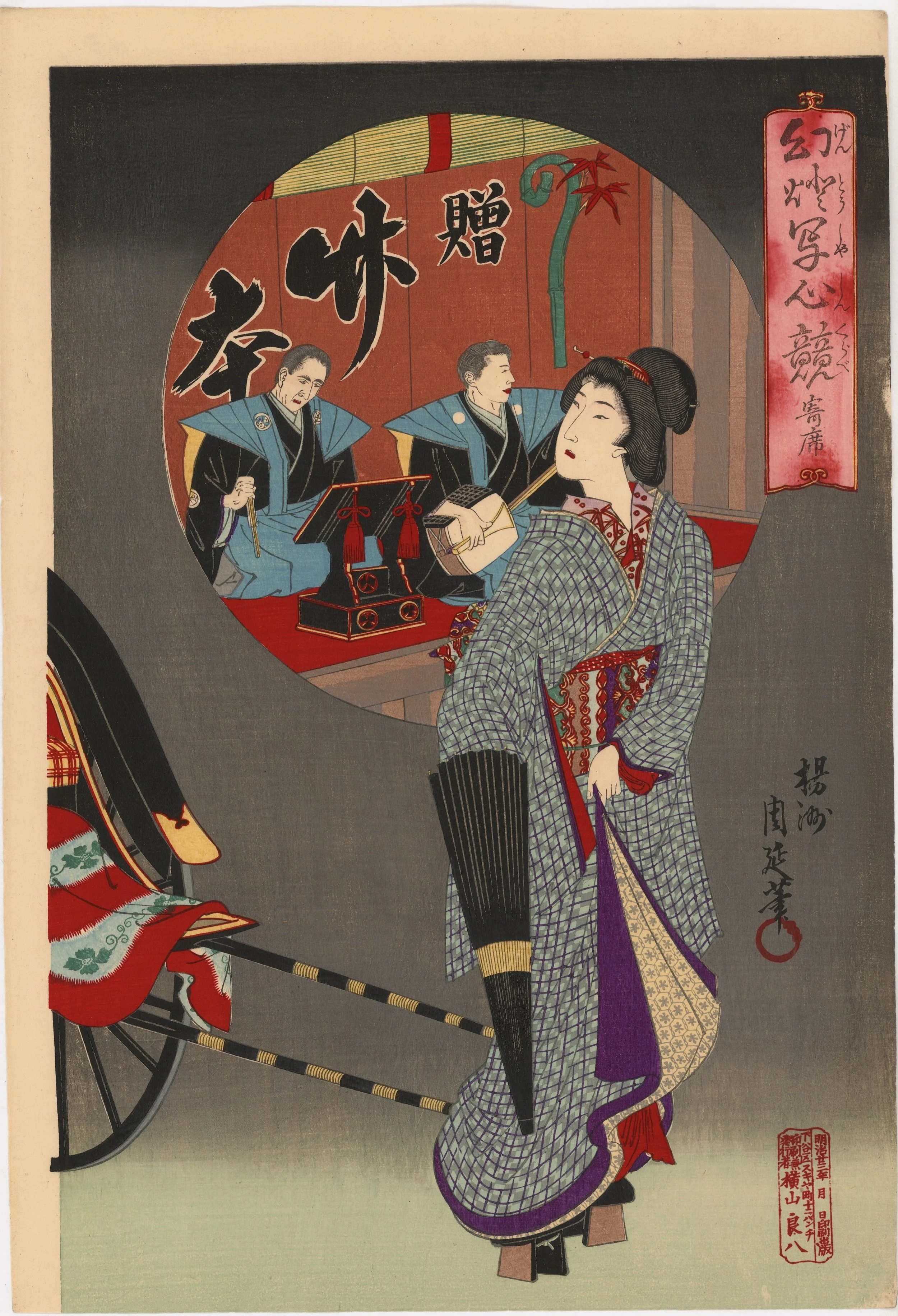 Image 1 of 2
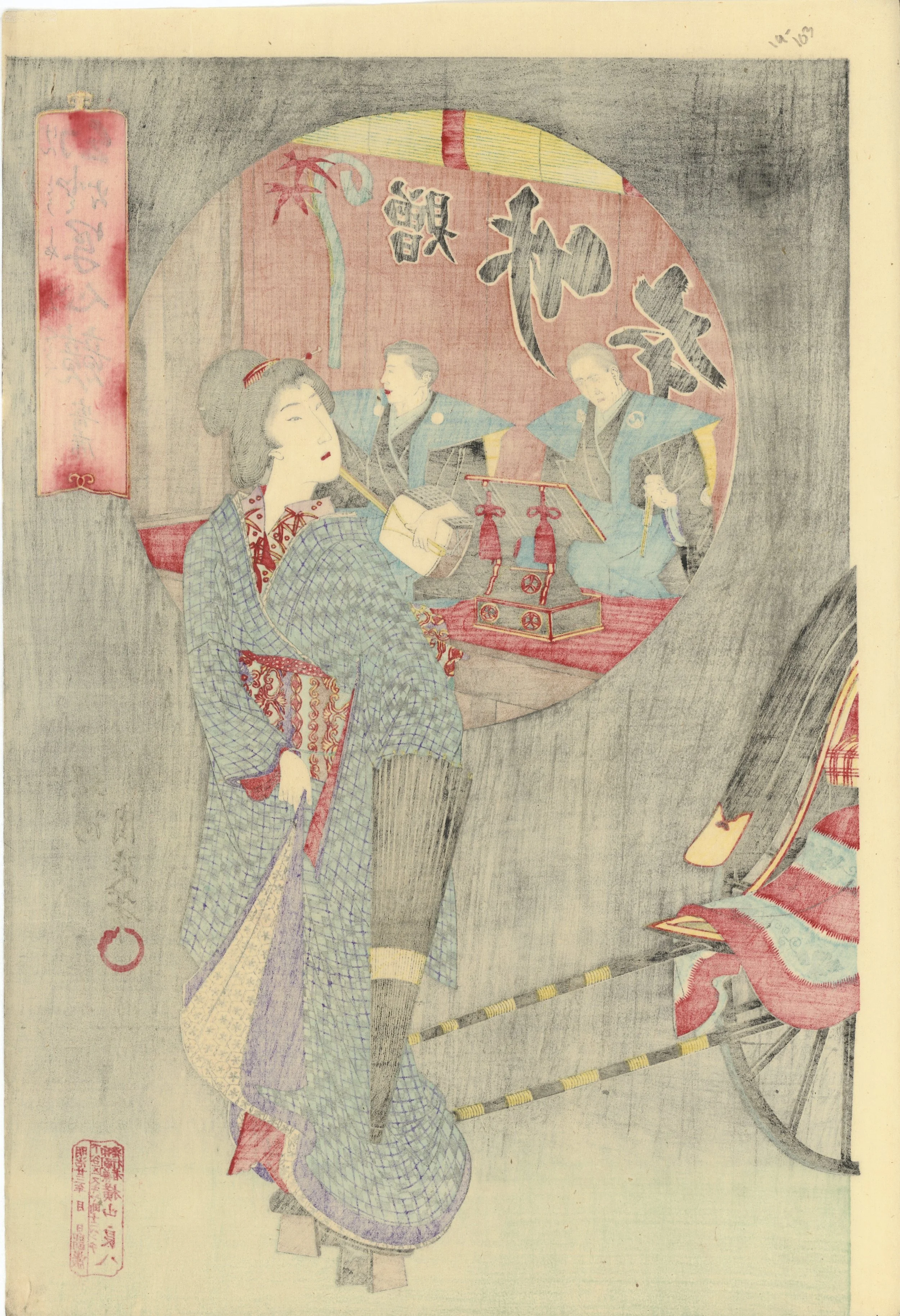 Image 2 of 2