
 Image 1 of 2
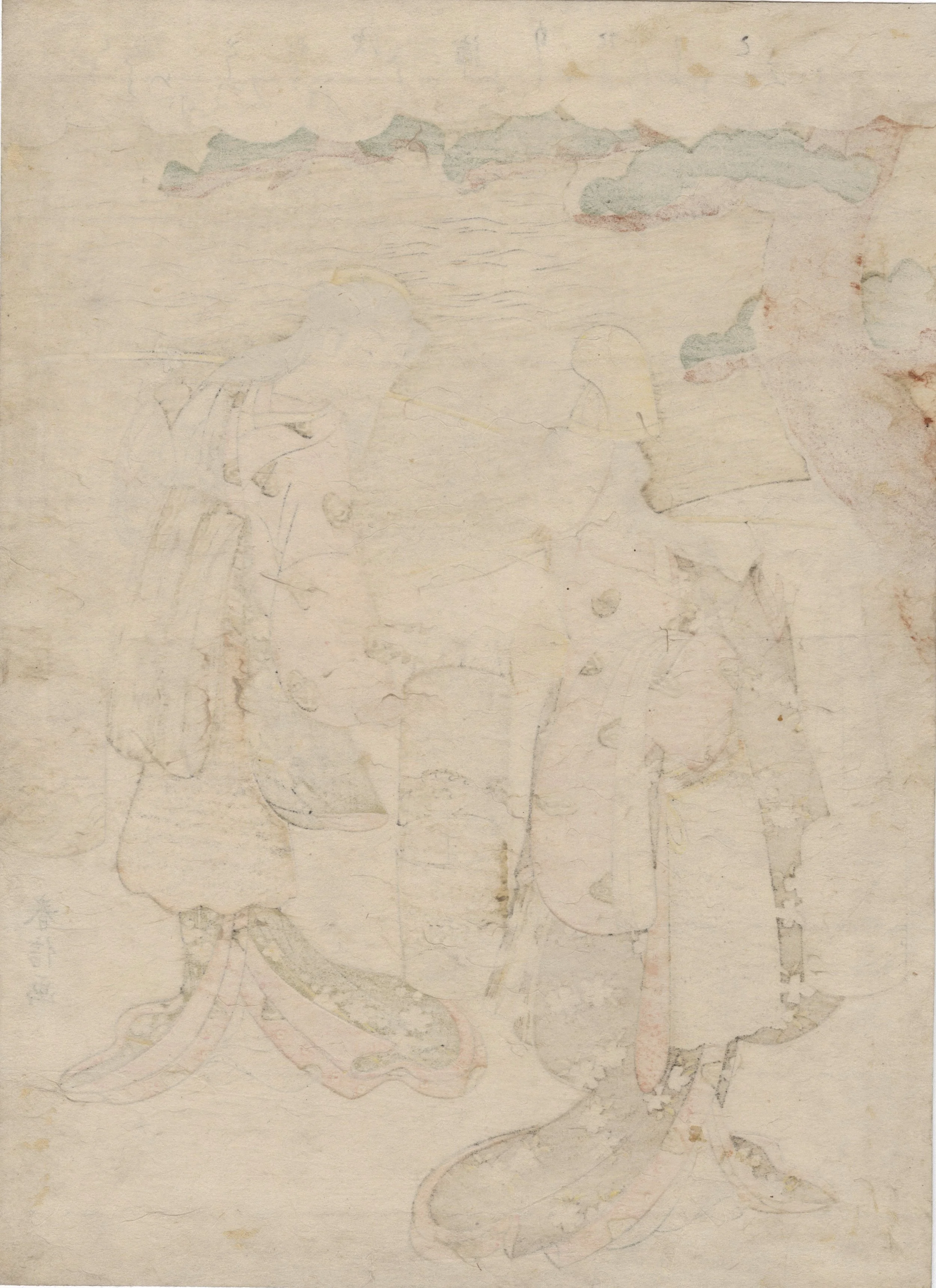 Image 2 of 2
Suzuki Harunobu (1724-1770)
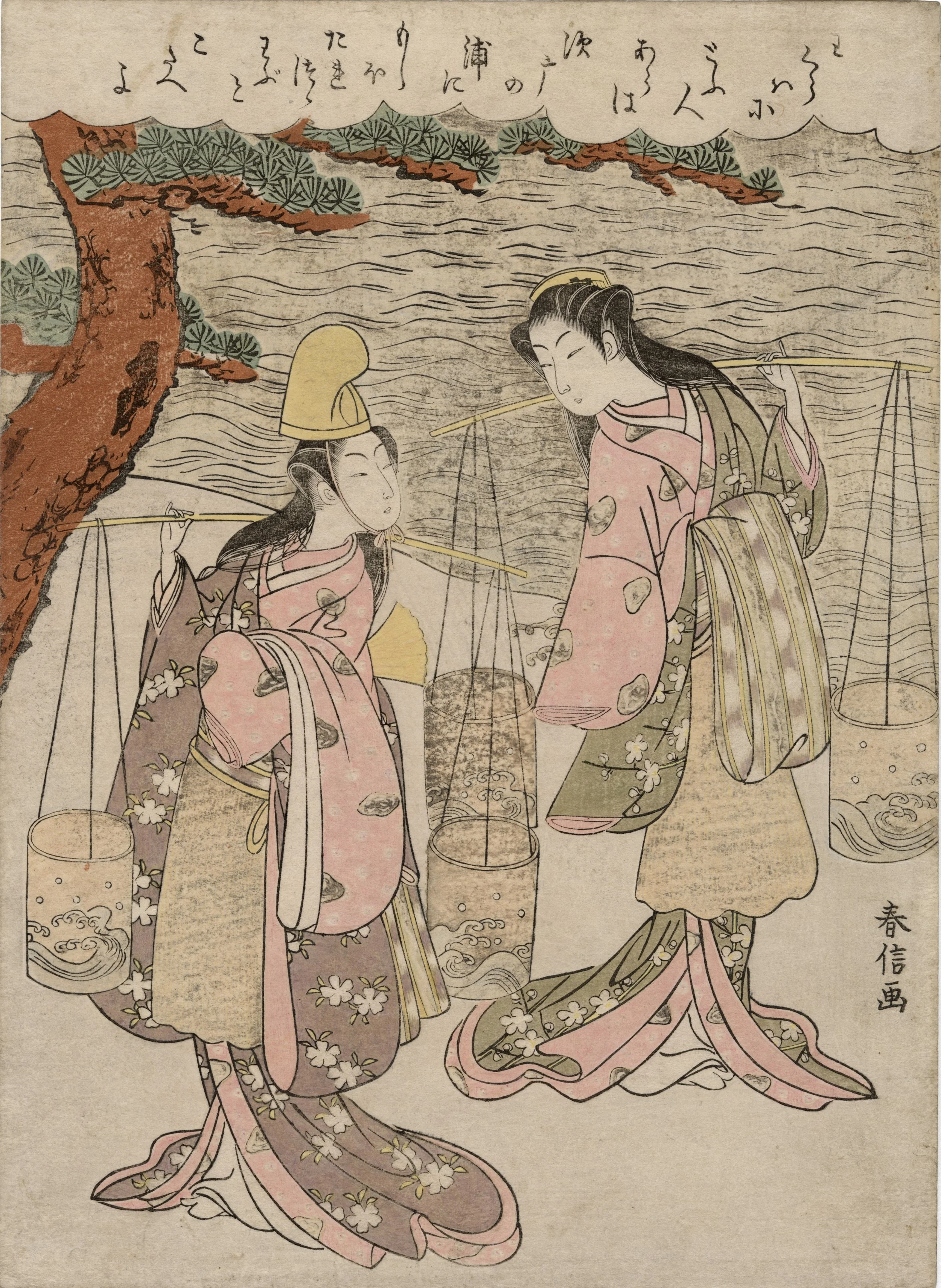
His women with their elegantly drawn oval faces, their thoughts perhaps elsewhere, had an ethereal and child-like quality. His children themselves seemingly possessed mature wisdom. His interior and exterior settings completed the picture of a vanished and dream-like world, calm prevailing always. Inky blacks were boldly juxtaposed with soft palettes of pink and orange.
This was the universe of Suzuki Harunobu. His prints are as instantly recognizable as those of later greats like Utamaro and Hokusai. Born in 1724, he was perhaps the first great Ukiyoe artist. And he contributed far more than his own works: he basically helped create the genre.
There is a classical quality in Harunobu’s work, a painterly sense of movement and light, and a romantic evocation of the court world. His beauties – and it is prints of beauties that dominate his repertoire -- have fine eyebrows and cherry lips, and slender frames cossetted within elegantly folding kimonos. They seem to glide through the air, like a breeze in spring; they are like beauties that breathe.
Some too are engaged in intimate acts – like many Ukiyoe masters, Harunobu produced many erotic works, often without his signature.
He was born to an upper-class family in Edo Castle in 1725 and, his talent evident, went to Kyoto to learn painting from Nishikawa Yushin, a famous artist of Kamikawa. He returned to Edo around 1760 and began to make a living by painting. He had close contacts with the famous scholar Hiraga Gennai and many poets who moved in the upper strata of society.
At the time, wealthy scholars would create “Egoyomi” – calendar-like works that noted each month of the year -- and give them as gifts; the more elegant the skilled the poetry and images, the better the scholar’s reputation. There was a brief craze for these. Because of his connections, Harunobu was soon sought-after to produce them, and his reputation grew.
Woodblock printing had been invented in ancient China but by Harunobu’s time, the technology had advanced very little over the centuries. In fact, prints were only 2- or 3-colors. Working with craftsmen, he devised methods to use more color blocks, and to keep them properly registered. Thus, his were the first designs reproduced in full color as Nishiki-e, or “brocade pictures.” Untold thousands would follow in the ensuing centuries.
This was far more involvement in the actual production of his prints than many of his peers. And his creativity in printing continued throughout his lifetime. One development was the use of embossing -- or blind printing -- to create patterns and textures without pigment.
To do this, thick hosho paper was needed. Publishers didn’t usually use such valuable paper because they wanted to keep prices down. This little detail is telling – like his early Egoyomi, Harunobu’s work was clearly seen as a luxury product for a wealthy market.
Interestingly, and perhaps somewhat because of the mass-printing techniques he helped develop, Ukiyoe prints eventually became art for the masses, costing roughly the same as a bowl or two of noodles. In time, the wealthy eschewed them. But Haronobu’s prints were always prized by the upper classes, who were ready to pay a tidy sum to own one.
Harunobu died in 1770. His reputation and prices have always been strong. But his designs were only part of his contribution. He helped create the Floating World.