Hasui | Snow at Kiba

$0.00

川瀨巴水 Kawase Hasui ( 1883–1957)

木场之雪
Snow at Kiba

1934

木版画 | 纵绘大大判 | 39.3cm x 26.5cm
Woodblock-print | Large Oban tate-e | 39.3cm x 26.5cm

初摺;品相非常好
First edition; very good condition.

$8,588

How does he do it?

Kawase Hasui was renowned for his views of Japan’s famous sights, from Zojo-ji temple (from multiple angles) to the forests of Nikko to temples and bridges far and wide. But he could also infuse remarkable romance and mystery into the most mundane of locations, especially during a snowfall. And this print is a prime example of that.

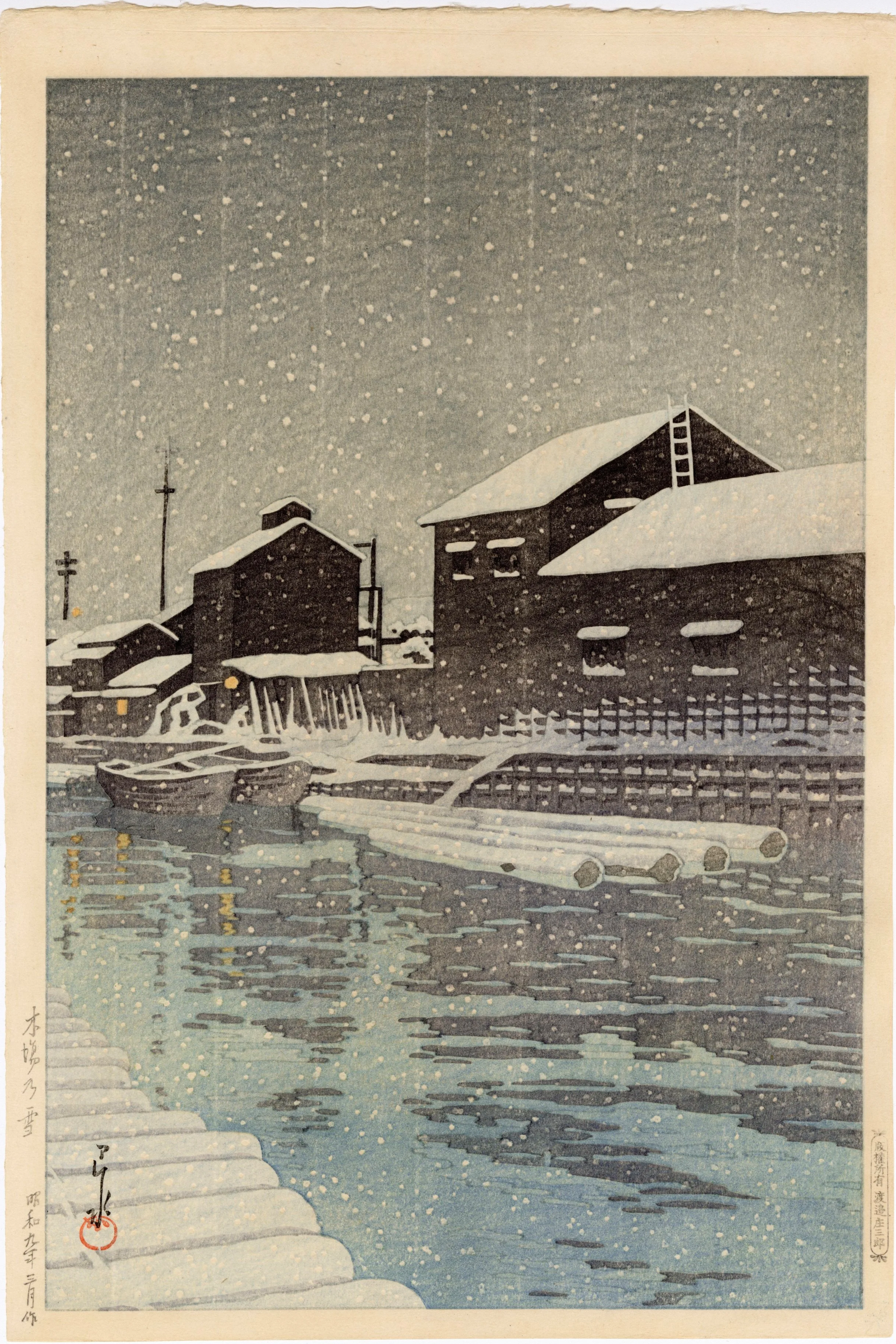
In this richly evocative design, we see the lumberyards on the Kiba River in Fukagawa, Tokyo. The river and adjoining series of canals were ideal for storing lumber and then floating it to buyers. On this dark night, with no one in sight, we see four long pieces of lumber floating in the current, a distant lantern and lit window the only signs that anyone is awake.

These storied lumber yards for a favorite of Ukioye landscape artists, especially in the snow, with both Hiroshige and, later, Kiyochika depicting them.

Although Hasui traveled Japan making preliminary sketches for his prints, a collector I know has a theory that he also worked from photographs. The collector bases this idea on the fact that his perspective in his designs is so precise and accurate. This print supports that thesis – look at how the lines of the rooftops, and then the floating lumber, and then the lumber floating across the river in the foreground, all create a perfect example of single-point perspective.

True or not, it’s a great design in great shape, a first edition.

川濑巴水以风景闻名,笔下从增上寺到日光的森林,再到各地的寺院桥梁,皆是日本风景的经典定格。但他最动人的,是能为寻常巷陌注入浪漫与静谧,尤其是落雪时分 —— 这幅《木场之雪》,正是他雪景版画的代表作。

画中的场景,是东京深川木场的木材堆场。河流与运河相连,曾是江户到昭和年间木材运输的重要通道,也是浮世绘画家钟爱的题材,歌川广重、小林清亲都曾以这里的雪景入画。

巴水以精准的单点透视,将屋顶、河面、浮木的线条层层推进,把傍晚雪落的氛围渲染得淋漓尽致。画面里没有行人,只有飘雪无声落在屋顶、河面与成排的木材上,远处几点昏黄灯火,是暮色里唯一的暖意。河水映着雪色与灯光,晕开一片柔和的蓝,整个场景安静得能听见雪落的声音。

有藏家曾提出,巴水部分作品的透视近乎照片般精准,推测他会参考摄影进行创作。这幅画正是最好的印证,前景的浮木、中景的屋舍、背景的天际线,每一条线条都遵循着严谨的透视法则,却又不失手绘的温度。

本枚初摺品相完美,是巴水雪景题材中,将市井烟火与诗意氛围融合得最动人的作品之一。

Interested in purchasing?
Please contact us.

川瀨巴水 Kawase Hasui ( 1883–1957)

木场之雪
Snow at Kiba

1934

木版画 | 纵绘大大判 | 39.3cm x 26.5cm
Woodblock-print | Large Oban tate-e | 39.3cm x 26.5cm

初摺;品相非常好
First edition; very good condition.

$8,588

How does he do it?

Kawase Hasui was renowned for his views of Japan’s famous sights, from Zojo-ji temple (from multiple angles) to the forests of Nikko to temples and bridges far and wide. But he could also infuse remarkable romance and mystery into the most mundane of locations, especially during a snowfall. And this print is a prime example of that.

In this richly evocative design, we see the lumberyards on the Kiba River in Fukagawa, Tokyo. The river and adjoining series of canals were ideal for storing lumber and then floating it to buyers. On this dark night, with no one in sight, we see four long pieces of lumber floating in the current, a distant lantern and lit window the only signs that anyone is awake.

These storied lumber yards for a favorite of Ukioye landscape artists, especially in the snow, with both Hiroshige and, later, Kiyochika depicting them.

Although Hasui traveled Japan making preliminary sketches for his prints, a collector I know has a theory that he also worked from photographs. The collector bases this idea on the fact that his perspective in his designs is so precise and accurate. This print supports that thesis – look at how the lines of the rooftops, and then the floating lumber, and then the lumber floating across the river in the foreground, all create a perfect example of single-point perspective.

True or not, it’s a great design in great shape, a first edition.

川濑巴水以风景闻名,笔下从增上寺到日光的森林,再到各地的寺院桥梁,皆是日本风景的经典定格。但他最动人的,是能为寻常巷陌注入浪漫与静谧,尤其是落雪时分 —— 这幅《木场之雪》,正是他雪景版画的代表作。

画中的场景,是东京深川木场的木材堆场。河流与运河相连,曾是江户到昭和年间木材运输的重要通道,也是浮世绘画家钟爱的题材,歌川广重、小林清亲都曾以这里的雪景入画。

巴水以精准的单点透视,将屋顶、河面、浮木的线条层层推进,把傍晚雪落的氛围渲染得淋漓尽致。画面里没有行人,只有飘雪无声落在屋顶、河面与成排的木材上,远处几点昏黄灯火,是暮色里唯一的暖意。河水映着雪色与灯光,晕开一片柔和的蓝,整个场景安静得能听见雪落的声音。

有藏家曾提出,巴水部分作品的透视近乎照片般精准,推测他会参考摄影进行创作。这幅画正是最好的印证,前景的浮木、中景的屋舍、背景的天际线,每一条线条都遵循着严谨的透视法则,却又不失手绘的温度。

本枚初摺品相完美,是巴水雪景题材中,将市井烟火与诗意氛围融合得最动人的作品之一。

Interested in purchasing?
Please contact us.

Kawase Hasui (1883–1957)

Hasui Kawase is perhaps the single most recognized woodblock artist of the Shin Hanga – new print – movement in the early- to mid-20th Century. Because he specialized in landscapes, many would say he was a successor to Hiroshige, noting his enveloping portrayals of nature, and his thoughtful placement of humans within them. But that would be too easy, because Hiroshige and Hasui in many ways could not be more different.

Whereas Hiroshige played with flat plains of negative space, Hasui embraced Western painting styles – if not techniques – to display water reflections, shadows and shades of light in all its combinations. You can easily discern the time of day and season from the light. Signs of the 20th Century Japan are everywhere – rickshaws, cars, telephone poles, steamships, even western-style umbrellas and rain slickers. Yes, he embraced snow and rain scenes like Hiroshige, and many famous views, but they live in a three-dimensional, modern world.

His prints are hugely sought-after today, with condition being extremely important to collectors. Many of the original woodblocks were destroyed in the Great Earthquake of 1923; finding examples of those pre-quake prints is challenging, indeed.

He was born Bunjiro Kawase in Tokyo in 1883, the son of a merchant. Hasui studied Japanese-style painting with Kiyokata and Western painting at the Hakubakai. He exhibited his first painting at 19. The publisher Shozaburo Watanabe – seeing the appeal of woodblock prints to the Western tourists then flooding Japan – took Hasui under his wing. The young man travelled widely to capture landscapes, making sketches as he went. Looking at the detail and perspective in some of his prints, one wonders: did he work from photographs as well?

Hasui’s Zojoji Temple in Snow – with a woman pushing against the furious snow with a traditional umbrella -- has been named an Intangible Cultural Treasure, the greatest artistic honor in postwar Japan. He died in 1957.

The publishers Doi, Kawaguchi, Sakai and others also produced some Hasui works. Learning to read the seals on the prints, and therefore dating them, takes time but is well worth it. If you can find this book at a reasonable price, go for it. It’s all there.