Hasui | Zojoji Temple in Shiba, Twenty Views of Tokyo

$0.00

川瀨巴水 Kawase Hasui ( 1883–1957)

东京二十景 芝增上寺
Zojoji Temple in Shiba, from the series of Twenty Views of Tokyo

1925

木版画 | 纵绘大大判 | 38.6cm x 26cm
Woodblock-print | Large Oban tate-e | 38.6cm x 26cm

早期版次;颜色鲜艳;品相非常好
Early edition; strong color; great condition

PRICE ON REQUEST

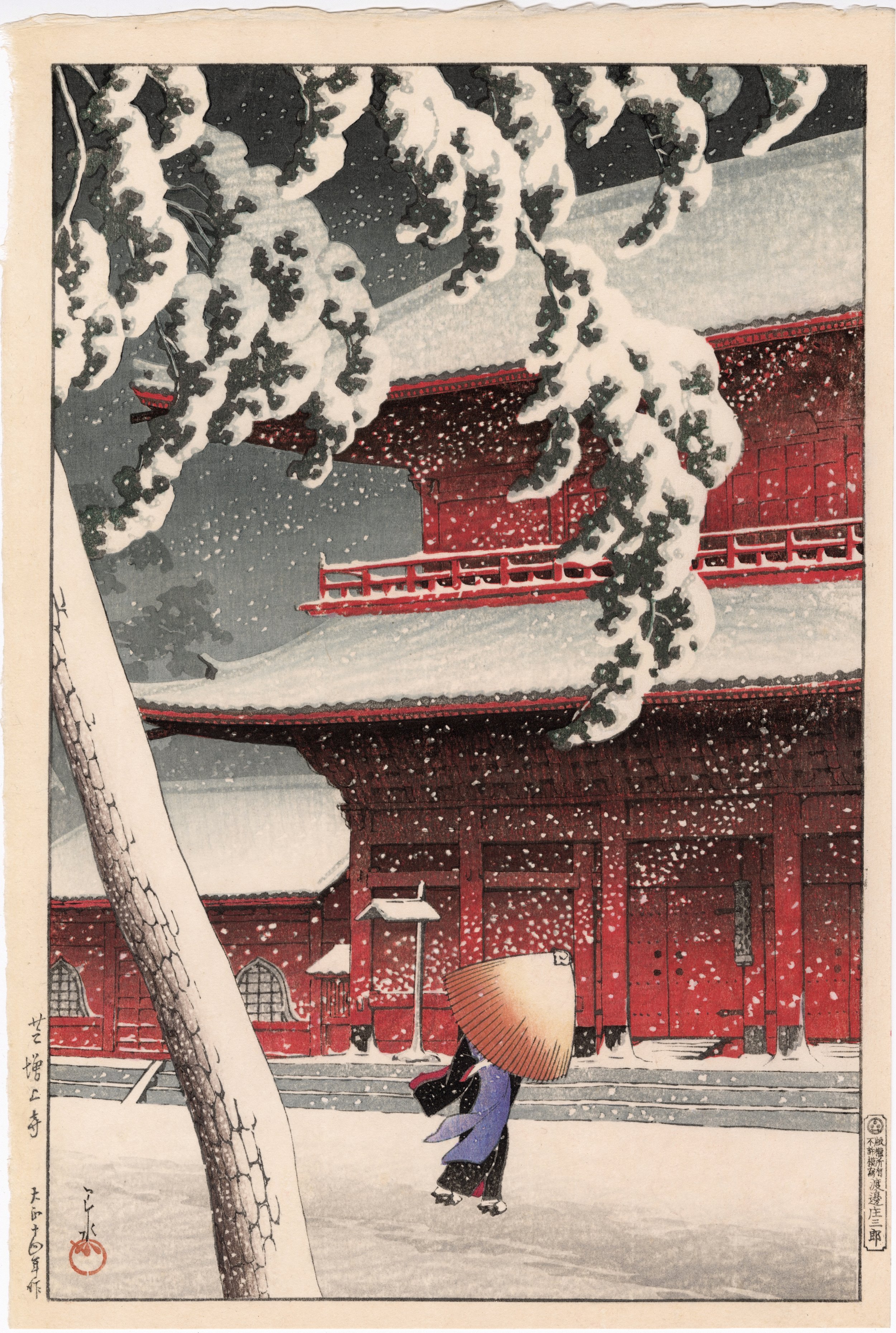
Swirling strands of snow sweep down diagonally from the dark night, slashing across the main gate of Zojo-ji Temple, buffeting a loan woman who pushes on doggedly, her traditional umbrella pointing towards the future.

This is the most famous design by Hasui; indeed, it is one of the most famous Japanese woodblock prints in history. Strikingly modern in composition while paying homage to traditional Japan, it is so renowned that it has been named a Japanese Intangible Cultural Treasure. Many major museums have it in their collections, including The Metropolitan Museum of Art in New York.

This is an early impression of Hasui's celebrated Shiba Zojoji, printed in the years following its initial publication. The colours remain remarkably fresh, with excellent tonal gradation and a strong impression throughout.

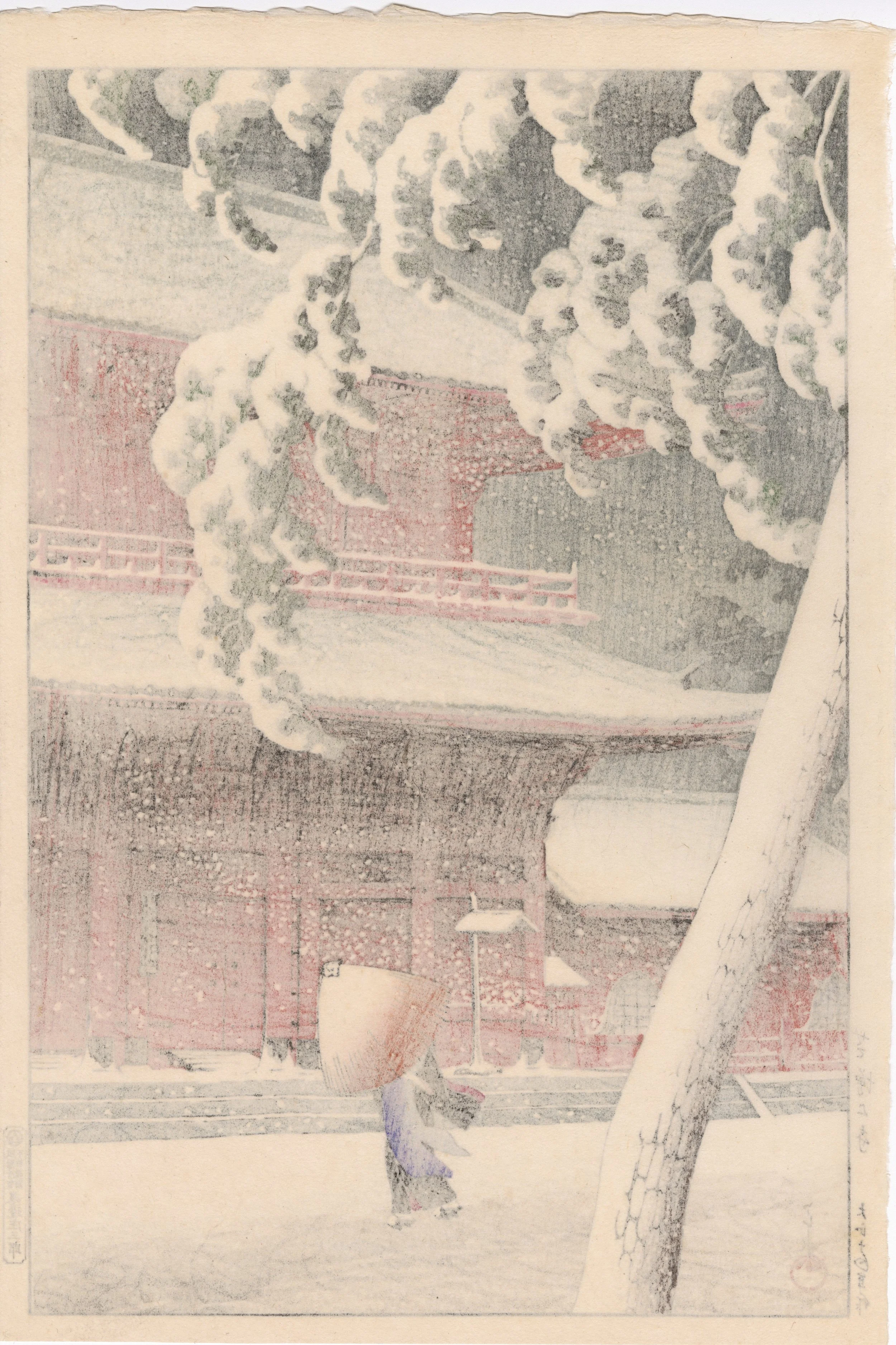
Other clues suggest it is very early: the woman’s kimono is purple, not blue; faint blue bokashi tints the show on the roof of the temple; and a clearly visible band of lighter pigment creates a semi-circle near the top of her umbrella. The black lines of the key block are unbroken.

None of those details dilute the power of the design: a raging snowstorm swiriling against the gememetric mass of the temple gate, and a lone woman pushing on.

如果要选一幅最能代表川濑巴水(Kawase Hasui)的作品,《芝增上寺》几乎不会缺席。

画中的寺院便是位于今东京都港区的芝增上寺,始建于1393年,是净土宗七大本山之一。最醒目的建筑为三解脱门,建于1622年,是东京现存最古老的木造寺门之一,现已被日本政府指定为重要文化财。

厚重的积雪压弯了前景苍松的枝干,风不断卷起雪花,三解脱门的屋顶、栏杆与飞檐早已覆满白雪,映衬着朱红色的建筑格外醒目。门前,一位女子撑着蛇目伞,独自穿过风雪。整幅画除了她,再没有其他行人。没有喧闹,没有戏剧性的情节,只有风雪中的古寺,与那个静静从门前走过的人。

《芝增上寺》发行于1925年,距离关东大地震已过去一年多。当时的东京仍处于漫长的重建过程中,许多人熟悉的街道与建筑早已改变,而增上寺依然静静伫立。或许正因如此,这幅作品推出后迅速受到欢迎,销量超过两千张,在当时极为罕见,原版木更因长期反复印刷而最终磨损报废。

本作为早期印刷版本,色彩层次丰富,保存状态极佳。

Interested in purchasing?
Please contact us.

川瀨巴水 Kawase Hasui ( 1883–1957)

东京二十景 芝增上寺
Zojoji Temple in Shiba, from the series of Twenty Views of Tokyo

1925

木版画 | 纵绘大大判 | 38.6cm x 26cm
Woodblock-print | Large Oban tate-e | 38.6cm x 26cm

早期版次;颜色鲜艳;品相非常好
Early edition; strong color; great condition

PRICE ON REQUEST

Swirling strands of snow sweep down diagonally from the dark night, slashing across the main gate of Zojo-ji Temple, buffeting a loan woman who pushes on doggedly, her traditional umbrella pointing towards the future.

This is the most famous design by Hasui; indeed, it is one of the most famous Japanese woodblock prints in history. Strikingly modern in composition while paying homage to traditional Japan, it is so renowned that it has been named a Japanese Intangible Cultural Treasure. Many major museums have it in their collections, including The Metropolitan Museum of Art in New York.

This is an early impression of Hasui's celebrated Shiba Zojoji, printed in the years following its initial publication. The colours remain remarkably fresh, with excellent tonal gradation and a strong impression throughout.

Other clues suggest it is very early: the woman’s kimono is purple, not blue; faint blue bokashi tints the show on the roof of the temple; and a clearly visible band of lighter pigment creates a semi-circle near the top of her umbrella. The black lines of the key block are unbroken.

None of those details dilute the power of the design: a raging snowstorm swiriling against the gememetric mass of the temple gate, and a lone woman pushing on.

如果要选一幅最能代表川濑巴水(Kawase Hasui)的作品,《芝增上寺》几乎不会缺席。

画中的寺院便是位于今东京都港区的芝增上寺,始建于1393年,是净土宗七大本山之一。最醒目的建筑为三解脱门,建于1622年,是东京现存最古老的木造寺门之一,现已被日本政府指定为重要文化财。

厚重的积雪压弯了前景苍松的枝干,风不断卷起雪花,三解脱门的屋顶、栏杆与飞檐早已覆满白雪,映衬着朱红色的建筑格外醒目。门前,一位女子撑着蛇目伞,独自穿过风雪。整幅画除了她,再没有其他行人。没有喧闹,没有戏剧性的情节,只有风雪中的古寺,与那个静静从门前走过的人。

《芝增上寺》发行于1925年,距离关东大地震已过去一年多。当时的东京仍处于漫长的重建过程中,许多人熟悉的街道与建筑早已改变,而增上寺依然静静伫立。或许正因如此,这幅作品推出后迅速受到欢迎,销量超过两千张,在当时极为罕见,原版木更因长期反复印刷而最终磨损报废。

本作为早期印刷版本,色彩层次丰富,保存状态极佳。

Interested in purchasing?
Please contact us.

Kawase Hasui (1883–1957)

Hasui Kawase is perhaps the single most recognized woodblock artist of the Shin Hanga – new print – movement in the early- to mid-20th Century. Because he specialized in landscapes, many would say he was a successor to Hiroshige, noting his enveloping portrayals of nature, and his thoughtful placement of humans within them. But that would be too easy, because Hiroshige and Hasui in many ways could not be more different.

Whereas Hiroshige played with flat plains of negative space, Hasui embraced Western painting styles – if not techniques – to display water reflections, shadows and shades of light in all its combinations. You can easily discern the time of day and season from the light. Signs of the 20th Century Japan are everywhere – rickshaws, cars, telephone poles, steamships, even western-style umbrellas and rain slickers. Yes, he embraced snow and rain scenes like Hiroshige, and many famous views, but they live in a three-dimensional, modern world.

His prints are hugely sought-after today, with condition being extremely important to collectors. Many of the original woodblocks were destroyed in the Great Earthquake of 1923; finding examples of those pre-quake prints is challenging, indeed.

He was born Bunjiro Kawase in Tokyo in 1883, the son of a merchant. Hasui studied Japanese-style painting with Kiyokata and Western painting at the Hakubakai. He exhibited his first painting at 19. The publisher Shozaburo Watanabe – seeing the appeal of woodblock prints to the Western tourists then flooding Japan – took Hasui under his wing. The young man travelled widely to capture landscapes, making sketches as he went. Looking at the detail and perspective in some of his prints, one wonders: did he work from photographs as well?

Hasui’s Zojoji Temple in Snow – with a man pushing against the furious snow with a traditional umbrella -- has been named an Intangible Cultural Treasure, the greatest artistic honor in postwar Japan. He died in 1957.

The publishers Doi, Kawaguchi, Sakai and others also produced some Hasui works. Learning to read the seals on the prints, and therefore dating them, takes time but is well worth it. If you can find this book at a reasonable price, go for it. It’s all there.