Hiroshige | Ayase River and Kanegafuchi, 100 Famous Views of Edo

$0.00

歌川広重 Utagawa Hiroshige (1797-1858)

名所江戸百景 綾瀬川鐘が淵
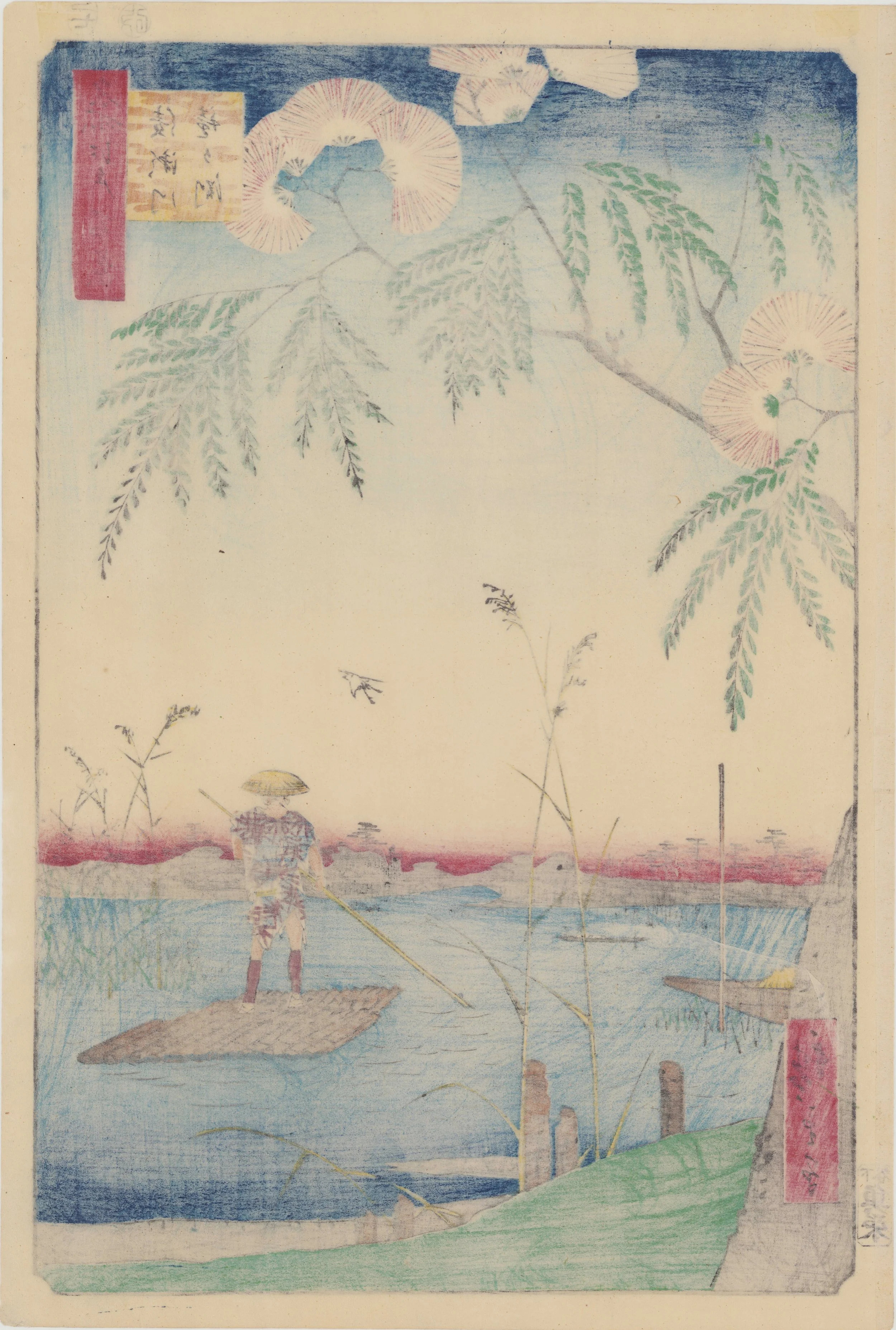
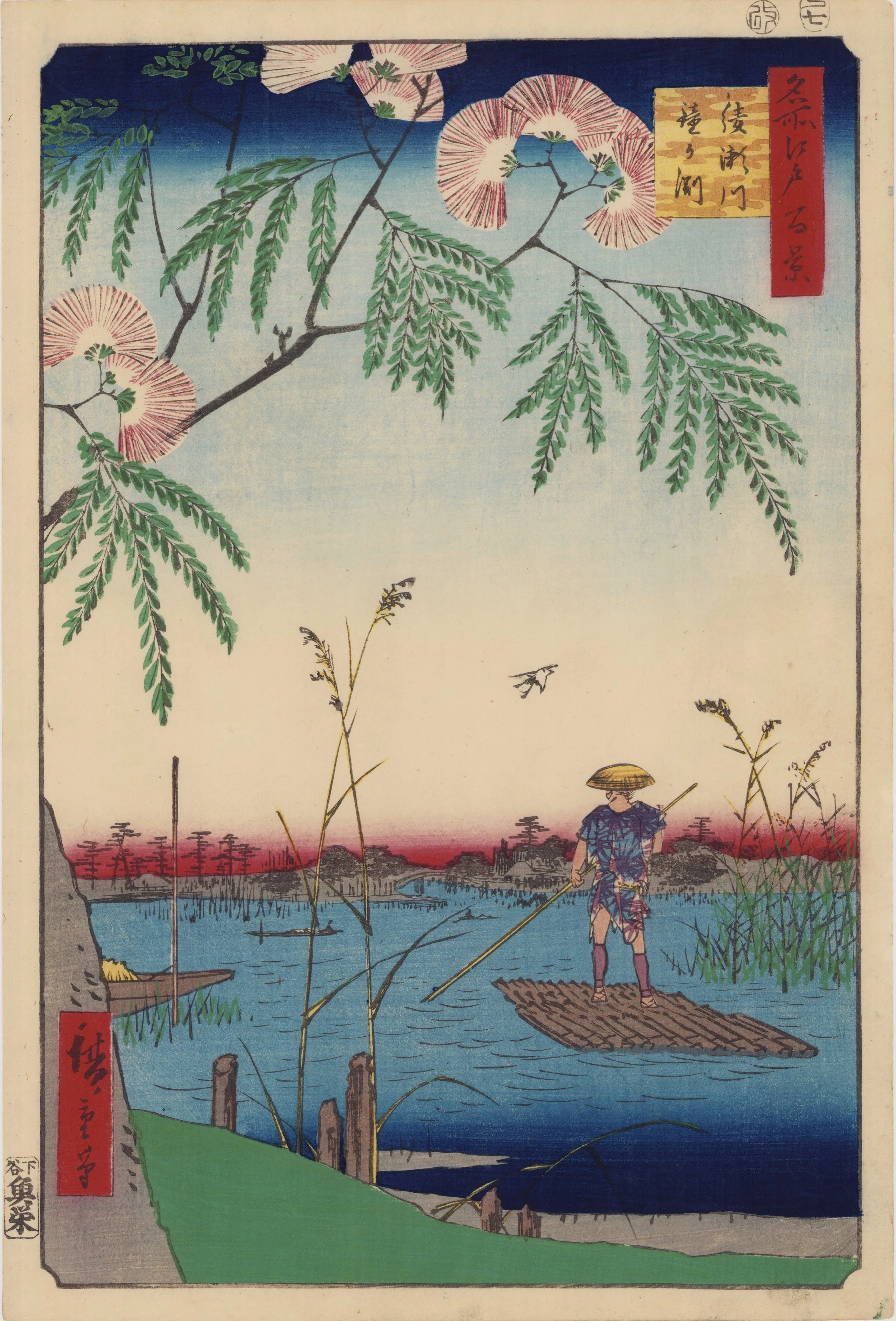
Ayase River and Kanegafuchi, from the series of 100 Famous Views of Edo

1857

木版画 | 纵绘大判 | 36.5cm x 24cm
Woodblock-print | Oban tate-e | 36.5cm x 24cm

中期版次;颜色鲜艳;整体品相非常好
Mid state impression; strong color and good condition.

$4,500

The Sumida River was often portrayed, by Hiroshige and other Ukiyoe and Shin Hanga artists, as a sprawling, panoramic waterway with great distances between banks. But in this surface-level vantage point from “100 Famous Views of Edo,” we see the moody, marshy river and its reedy shores in close-up detail, just like the paddler on the raft to the right.

We are standing at the spot where the river turns south after flowing east. Many designs in this legendary series include strong foreground elements, and this example is no exception: the top of the print is devoted to a closeup of the flowering mimosa tree, its blooms forming engaging half-circles.

In the distance we see the modest span of the Asaye Bridge, over the canal of the same name. Even though we are practically in the center of what was then the most populous city in the world, we get a visceral sense of how rural many sections were, and now nature mixed with humanity. (Note the alighting Heron — a classic touch.)

This example – with very strong color – was published somewhere near the midpoint of this print’s production lifespan. You can tell from the flowers, which are fully colored in, and the yellow-on-yellow cartouche.

Supplentary information from “Hirshoge’s 100 Views of Edo: The Definitive Collectors’ Edition” by the fine scholar Andreas Marks. (Tuttle, 2024)

Interested in purchasing?
Please contact us.

歌川広重 Utagawa Hiroshige (1797-1858)

名所江戸百景 綾瀬川鐘が淵
Ayase River and Kanegafuchi, from the series of 100 Famous Views of Edo

1857

木版画 | 纵绘大判 | 36.5cm x 24cm
Woodblock-print | Oban tate-e | 36.5cm x 24cm

中期版次;颜色鲜艳;整体品相非常好
Mid state impression; strong color and good condition.

$4,500

The Sumida River was often portrayed, by Hiroshige and other Ukiyoe and Shin Hanga artists, as a sprawling, panoramic waterway with great distances between banks. But in this surface-level vantage point from “100 Famous Views of Edo,” we see the moody, marshy river and its reedy shores in close-up detail, just like the paddler on the raft to the right.

We are standing at the spot where the river turns south after flowing east. Many designs in this legendary series include strong foreground elements, and this example is no exception: the top of the print is devoted to a closeup of the flowering mimosa tree, its blooms forming engaging half-circles.

In the distance we see the modest span of the Asaye Bridge, over the canal of the same name. Even though we are practically in the center of what was then the most populous city in the world, we get a visceral sense of how rural many sections were, and now nature mixed with humanity. (Note the alighting Heron — a classic touch.)

This example – with very strong color – was published somewhere near the midpoint of this print’s production lifespan. You can tell from the flowers, which are fully colored in, and the yellow-on-yellow cartouche.

Supplentary information from “Hirshoge’s 100 Views of Edo: The Definitive Collectors’ Edition” by the fine scholar Andreas Marks. (Tuttle, 2024)

Interested in purchasing?
Please contact us.

Utagawa Hiroshige (1797-1858)

Ando Hiroshige (1897-1858) revolutionized the art of landscape prints during the Edo era, building on the success of his senior, Hokusai, but taking a more poetic and naturalist approach to portraying the beauty of Japan.

The son of a low-level Samurai assigned to the fire brigade in Edo, Hiroshige became a student of the Utagawa school as a young man. His first prints focused on beautiful women (bijin), and views of Edo. But in 1833 he began work on his most famous early work, his first series depicting the Tokaido, the "Great Sea Road" between Edo and Tokyo.

Today there is some controversy about this series. Initially, it was believed that Hiroshige had travelled the route along with a local lord (Daimyo) who was making a gift of horses to the Emperor. But more recent scholarship suggests Hiroshige never travelled the road himself, at least not the entire way, and made his designs using published guidebooks.

Nonetheless, the prints were wonderful and revolutionary. They embraced the seasons with a gentle lyricism missing from Hokusai's striking but stylized depictions. In Hiroshige's work, nature is sacred -- but it is always mixed with humanity, with travelers or little inns or bridges. There is a magical harmony between man and the elements.

His depiction of the seasons and weather is especially evocative. Snow blankets some views with a hushed silence, while rain streaks down furiously in others. In some prints natured is agitated; in others, calm prevails. Produced in a horizontal oban yoko-e format, the series was a smash hit.

The Tokaido series made Hiroshige famous, and he became incredible prolific. In the 1840s he produced many strong designs, but many mediocre ones, too, including several subsequent Tokaido series of varying quality.

In 1853, however, he made a big step. He turned his landscapes sideways, embracing a bold vertical oban tate-e format. This gave his designs new energy and a modern feel. The first of these was Famous Views of the Sixty-Odd Provinces. From them on, most of his most noted series were executed in this format.

He saved his greatest for his last. In 1856 he began work on 100 Famous Views of Edo, which many consider his most exceptional work. Here his home city was portrayed with energy and passion, and in these 119 designs he created an incredible record of a vanished place. In addition to the striking vertical format, he developed exciting new compositions, often juxtaposing a strong foreground element with a distant background.

Among the many famous images in this series are Squall at Ohashi and the Plum Garden in Komeido. Both of these were copied by Vincent Van Gogh, a great admirer of Hiroshige. Thus, the great Japanese artist had a profound effect on Western art.

Alas, his beloved Edo ended his life. Hiroshige was claimed by a cholera epidemic that swept the city in 1958. His pupil Shigenobu, who took the name Hiroshige II, completed The Famous Views of Edo.