Hiroshige | Evening Moon at Ryogoku Bridge, Famous Places in the Eastern Capital(Reserved)

$0.00

Reserved

歌川広重 Utagawa Hiroshige (1797-1858)

东都名所 两国之宵月
Evening Moon at Ryogoku Bridge, from the series of Famous Places in the Eastern Capital

1831-32

木版画 | 横绘大判 | 25.7cm x 38.3cm
Woodblock-print | Oban Yoko-e | 25.7cm x 38.3cm

非常罕见;早期版次,厚纸印制,保留完整宽大的边缘;颜色鲜艳;品相非常好
Rare; early impression, printed on thick paper and full margins; strong color; very good condition.

PRICE ON REQUEST

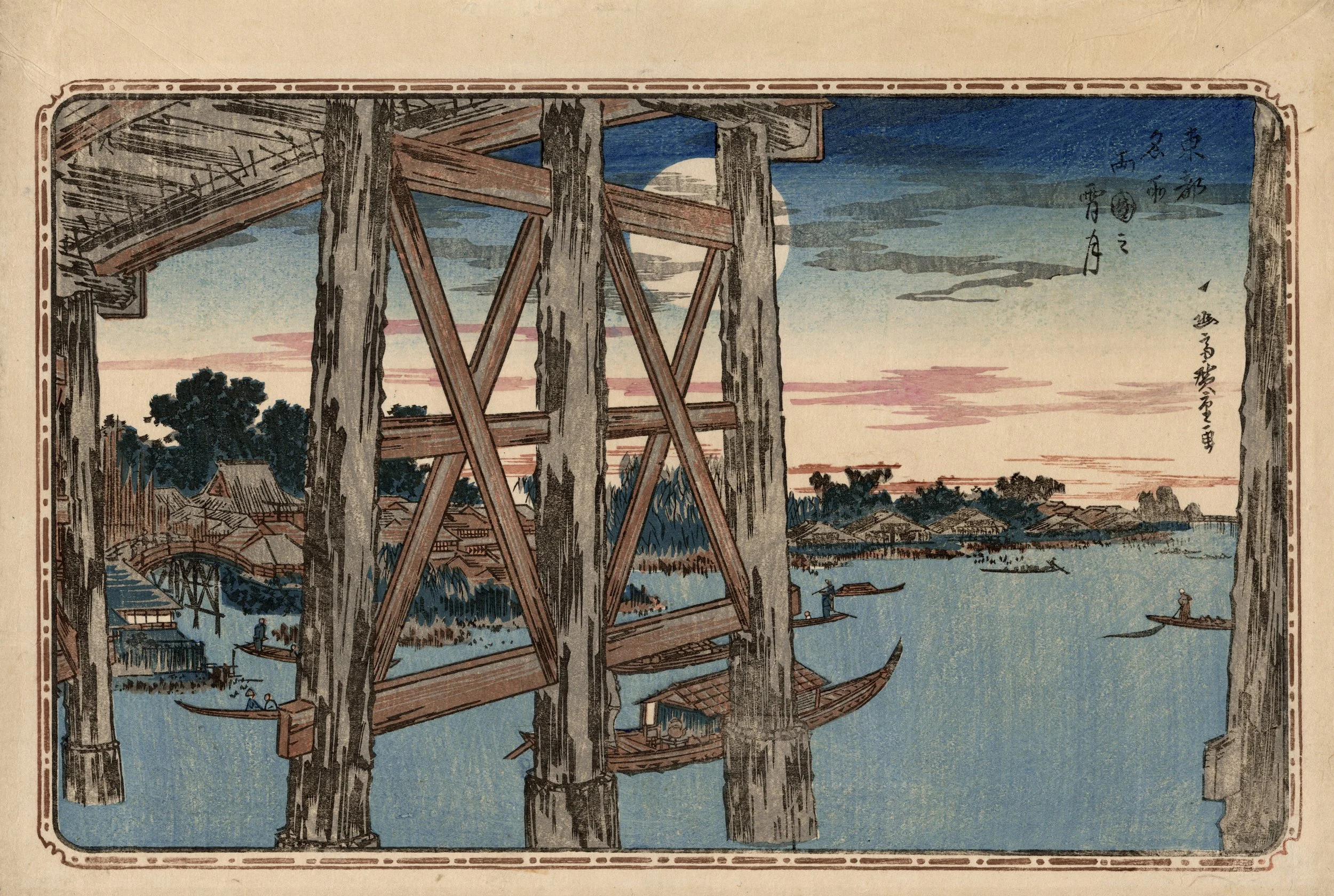
On the cusp of fame, just before his seminal “The 53 Stations of the Tokaido” was released, Hiroshige designed a series of ten famous views of Edo in the oban yoko-e format. This depiction of Ryogoku Bridge across the wide Sumida River is perhaps the most striking of them. Using the intersecting support beams of the span, he creates a geometric image that is almost abstract in its approach. The soft lines of the distant shore are dissected by the harsh straight lines of the stanchions.

The Sumida River slowly unfolds in the twilight as if seen through windows. The bridge is solid and close at hand, yet the river surface appears exceptionally vast, giving the entire work a sense of space and suggesting the tranquility of an Edo summer night. The full and rising moon – again, half-hidden and divided by the beams – is an especially poetic touch, as are the horizontal red and gray clouds that contrast sharply with the verticality of the design.

But look: there is something amusing here – this is a view that Hiroshige could only imagine, as it’s below the walkway but above the surface of the river, unless he was hanging by a rope with his sketchbook.

No less a painter of bridges than the great tonalist James McNeil Whistleris said to have admired Hiroshige’s prints of Ryogoku and the Sumida River, subjects to which the ukiyoe returned again and again.

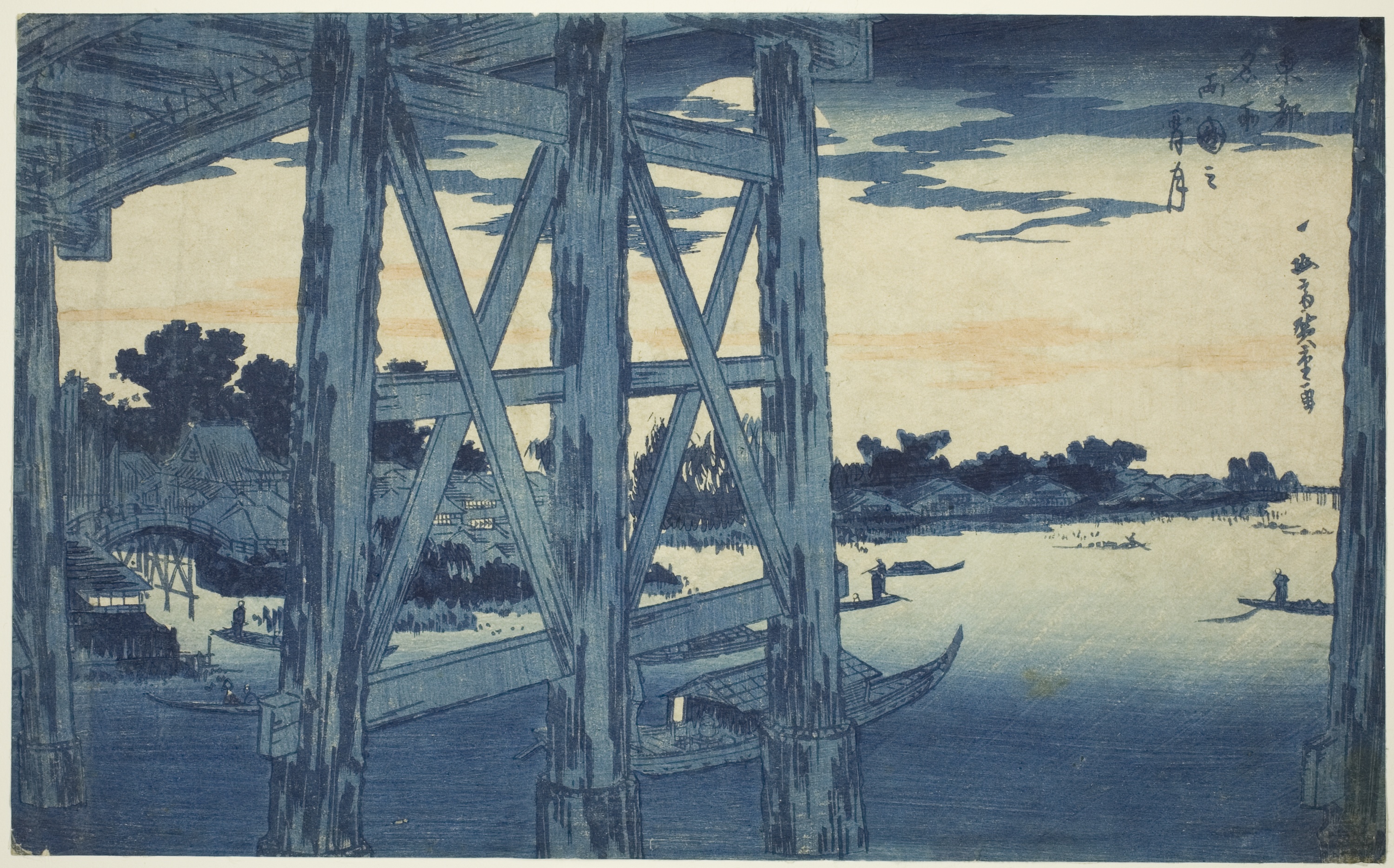
The print is also unique within the series. Unlike the other nine designs, it omits the vertical panel containing the title, censor seal, and publisher's name. Some scholars have suggested that this reflects a later stage in the publication of the series, although the theory remains unproven. An exceptionally rare aizuri-e version of this design is also known. The present impression is a very early full-color edition, printed on rare thick paper with wide, full margins, vivid colors, and excellent preservation.

‍月亮升起时,人们看到的是两国桥;广重却走到了桥底。

粗壮的桥柱与交错的木梁几乎占据了整个画面,将远处的河面、月色与江户城景分割成一个个大小不同的空间。乍看之下,人们的目光往往会停留在桥梁本身,仔细看才发现,透过木梁之间的缝隙,隅田川正在暮色中缓缓展开。

桥梁之间留出的空隙仿佛一扇扇窗,将往来的舟船、河岸的屋舍,以及初升的满月依次收入画中。天空仍残留着几抹淡粉色晚霞,与大片普鲁士蓝交织出柔和而深远的夜色。桥梁厚重而近在眼前,河面却显得格外辽阔,使整幅作品既充满空间感,也营造出江户夏夜独有的静谧氛围。

《东都名所》是广重早期创作的重要名所绘系列,共十枚,也是《东海道五十三次》问世之前最具代表性的横绘大判风景系列。《两国之宵月》则被公认为全系列最杰出的作品之一,也是唯一没有沿用其他作品右侧「画题、极印与版元」竖栏设计的一幅。有学者据此推测,本作可能是在系列发行后期才完成,因此采用了不同的版式,不过这一观点目前仍属于学术上的推测。

本作另有极为罕见的蓝摺版本(aizuri-e)。与几乎完全以普鲁士蓝印制的蓝摺版相比,本件锦绘运用了更加丰富的色彩,在保留夜景宁静氛围的同时,也让桥梁、屋舍与天空呈现出更鲜明的层次。

《两国之宵月》本身便是广重早期风景版画中极少见于市场的作品,而本作更为早期版次,采用少见的厚纸印制,完整保留宽大的纸边,色彩鲜艳,保存状态极佳。兼具作品稀有性、早期印刷与优秀品相的《两国之宵月》,如今已十分难得。

Interested in purchasing?
Please contact us.

Reserved

歌川広重 Utagawa Hiroshige (1797-1858)

东都名所 两国之宵月
Evening Moon at Ryogoku Bridge, from the series of Famous Places in the Eastern Capital

1831-32

木版画 | 横绘大判 | 25.7cm x 38.3cm
Woodblock-print | Oban Yoko-e | 25.7cm x 38.3cm

非常罕见;早期版次,厚纸印制,保留完整宽大的边缘;颜色鲜艳;品相非常好
Rare; early impression, printed on thick paper and full margins; strong color; very good condition.

PRICE ON REQUEST

On the cusp of fame, just before his seminal “The 53 Stations of the Tokaido” was released, Hiroshige designed a series of ten famous views of Edo in the oban yoko-e format. This depiction of Ryogoku Bridge across the wide Sumida River is perhaps the most striking of them. Using the intersecting support beams of the span, he creates a geometric image that is almost abstract in its approach. The soft lines of the distant shore are dissected by the harsh straight lines of the stanchions.

The Sumida River slowly unfolds in the twilight as if seen through windows. The bridge is solid and close at hand, yet the river surface appears exceptionally vast, giving the entire work a sense of space and suggesting the tranquility of an Edo summer night. The full and rising moon – again, half-hidden and divided by the beams – is an especially poetic touch, as are the horizontal red and gray clouds that contrast sharply with the verticality of the design.

But look: there is something amusing here – this is a view that Hiroshige could only imagine, as it’s below the walkway but above the surface of the river, unless he was hanging by a rope with his sketchbook.

No less a painter of bridges than the great tonalist James McNeil Whistleris said to have admired Hiroshige’s prints of Ryogoku and the Sumida River, subjects to which the ukiyoe returned again and again.

The print is also unique within the series. Unlike the other nine designs, it omits the vertical panel containing the title, censor seal, and publisher's name. Some scholars have suggested that this reflects a later stage in the publication of the series, although the theory remains unproven. An exceptionally rare aizuri-e version of this design is also known. The present impression is a very early full-color edition, printed on rare thick paper with wide, full margins, vivid colors, and excellent preservation.

‍月亮升起时,人们看到的是两国桥;广重却走到了桥底。

粗壮的桥柱与交错的木梁几乎占据了整个画面,将远处的河面、月色与江户城景分割成一个个大小不同的空间。乍看之下,人们的目光往往会停留在桥梁本身,仔细看才发现,透过木梁之间的缝隙,隅田川正在暮色中缓缓展开。

桥梁之间留出的空隙仿佛一扇扇窗,将往来的舟船、河岸的屋舍,以及初升的满月依次收入画中。天空仍残留着几抹淡粉色晚霞,与大片普鲁士蓝交织出柔和而深远的夜色。桥梁厚重而近在眼前,河面却显得格外辽阔,使整幅作品既充满空间感,也营造出江户夏夜独有的静谧氛围。

《东都名所》是广重早期创作的重要名所绘系列,共十枚,也是《东海道五十三次》问世之前最具代表性的横绘大判风景系列。《两国之宵月》则被公认为全系列最杰出的作品之一,也是唯一没有沿用其他作品右侧「画题、极印与版元」竖栏设计的一幅。有学者据此推测,本作可能是在系列发行后期才完成,因此采用了不同的版式,不过这一观点目前仍属于学术上的推测。

本作另有极为罕见的蓝摺版本(aizuri-e)。与几乎完全以普鲁士蓝印制的蓝摺版相比,本件锦绘运用了更加丰富的色彩,在保留夜景宁静氛围的同时,也让桥梁、屋舍与天空呈现出更鲜明的层次。

《两国之宵月》本身便是广重早期风景版画中极少见于市场的作品,而本作更为早期版次,采用少见的厚纸印制,完整保留宽大的纸边,色彩鲜艳,保存状态极佳。兼具作品稀有性、早期印刷与优秀品相的《两国之宵月》,如今已十分难得。

Interested in purchasing?
Please contact us.

Utagawa Hiroshige (1797-1858)

Ando Hiroshige (1897-1858) revolutionized the art of landscape prints during the Edo era, building on the success of his senior, Hokusai, but taking a more poetic and naturalist approach to portraying the beauty of Japan.

The son of a low-level Samurai assigned to the fire brigade in Edo, Hiroshige became a student of the Utagawa school as a young man. His first prints focused on beautiful women (bijin), and views of Edo. But in 1833 he began work on his most famous early work, his first series depicting the Tokaido, the "Great Sea Road" between Edo and Tokyo.

Today there is some controversy about this series. Initially, it was believed that Hiroshige had travelled the route along with a local lord (Daimyo) who was making a gift of horses to the Emperor. But more recent scholarship suggests Hiroshige never travelled the road himself, at least not the entire way, and made his designs using published guidebooks.

Nonetheless, the prints were wonderful and revolutionary. They embraced the seasons with a gentle lyricism missing from Hokusai's striking but stylized depictions. In Hiroshige's work, nature is sacred -- but it is always mixed with humanity, with travelers or little inns or bridges. There is a magical harmony between man and the elements.

His depiction of the seasons and weather is especially evocative. Snow blankets some views with a hushed silence, while rain streaks down furiously in others. In some prints natured is agitated; in others, calm prevails. Produced in a horizontal oban yoko-e format, the series was a smash hit.

The Tokaido series made Hiroshige famous, and he became incredible prolific. In the 1840s he produced many strong designs, but many mediocre ones, too, including several subsequent Tokaido series of varying quality.

In 1853, however, he made a big step. He turned his landscapes sideways, embracing a bold vertical oban tate-e format. This gave his designs new energy and a modern feel. The first of these was Famous Views of the Sixty-Odd Provinces. From them on, most of his most noted series were executed in this format.

He saved his greatest for his last. In 1856 he began work on 100 Famous Views of Edo, which many consider his most exceptional work. Here his home city was portrayed with energy and passion, and in these 119 designs he created an incredible record of a vanished place. In addition to the striking vertical format, he developed exciting new compositions, often juxtaposing a strong foreground element with a distant background.

Among the many famous images in this series are Squall at Ohashi and the Plum Garden in Komeido. Both of these were copied by Vincent Van Gogh, a great admirer of Hiroshige. Thus, the great Japanese artist had a profound effect on Western art.

Alas, his beloved Edo ended his life. Hiroshige was claimed by a cholera epidemic that swept the city in 1958. His pupil Shigenobu, who took the name Hiroshige II, completed The Famous Views of Edo.