
 Image 1 of 2
 Image 2 of 2
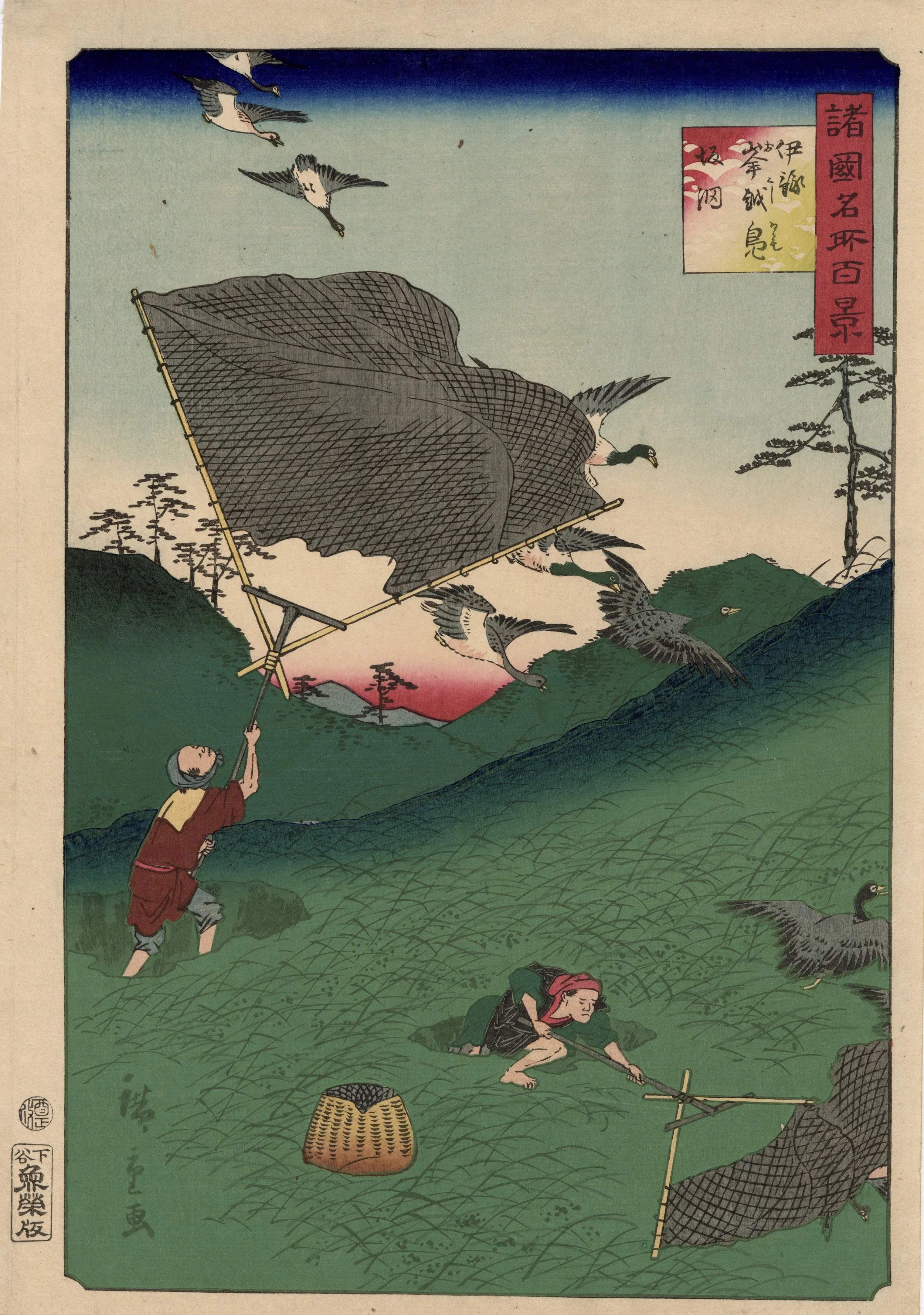
Utagawa Hiroshige II (active 1826-1869)
Born Chinpei Suzuki in 1826, Hiroshige II was given the name of Shigenobu after becoming one of Hiroshige’s very few students. In his career he hewed so closely to the master’s style, focusing on landscapes and the romantic interactions between human beings and the natural world, that it’s hard to determine whether he had a style of his own. He had a firm grasp of composition and color, yes, but the quality of his lines didn’t always match that of his teacher. (On occasion his people look sadly like stick figures.)
He took the name Hiroshige II after marrying Hiroshige’s 16-year-old daughter, Otatsu. He even completed his father-in-law’s final series – at least one, and possibly two, prints in “100 Famous Views of Edo” are attributed to Hiroshige II, done presumably after Hiroshige’s death in 1858.
But Hiroshige II produced some memorable works of his own, especially in the magnificent, “100 Famous Views of the Provinces” which he designed between 1859 and 1862. This includes “Kintai Bridge at Iwakuni in Suo Province,” which shows this legendary bridge of stone spans slashing across the paper on a left-to-right downward diagonal, a mirror of Hiroshige’s famed “Squall at Ohashi.”
During the time this series was produced, woodblock printing technology reached its zenith, and the printing quality of some of his prints is extraordinary. The “Deluxe” editions of these include wonderfully elaborate cartouches.
In the 1860s Hiroshige II was extremely prolific, including contributing to the “Processional Tokaido” with practically every other major Ukiyo-e artist of the day. Other series of varying quality focused on Edo and its environs. He was, like his teacher, especially adept at rain and snow scenes – some of his rain views, such as in “Eight Views of the Sumida River” in 1861, give a sense of a sudden downpour that is perhaps even more palpable than those of Hiroshige’s.
As this was just at the time of the “opening” of Japan, many of these prints are notable for the glimpses of western culture they provide, including ominous “Black Ships” riding at anchor, and Western men with giant noses, bushy eyebrows and ridiculous mustaches and beards, which the Japanese of the time must have found fascinating – amusing? – indeed.
Alas, things didn’t work out too well for our friend Hiroshige II. He and Otatsu divorced and he fell into alcoholism. He was last known to earn a meagre sum by decorating lanterns, kites and tea chests.
As for Otatsu, well, she married another painter and student of her late father’s named Goto Torakichi, who became Hiroshige III.
One woman, two Hiroshiges. Honestly, I’d like to know more about her – she sounds like a real number.