Hiroshige | Ishiyakushi, from the 53 Stations of the Tokaido (Reserved)

$0.00

歌川広重 Utagawa Hiroshige (1797-1858)

东海道五十三次之内 石药师
Ishiyakushi, from The Fifty-three Stations of the Tokaido

1833-34

木版画 | 横绘大判 | 25.5cm x 38cm
Woodblock-print | Oban yoko -e | 25.5cm x 38cm

早期版次;颜色鲜艳;品相非常好;边缘完整
Fine impression, color and condition; full margin.

RESERVED

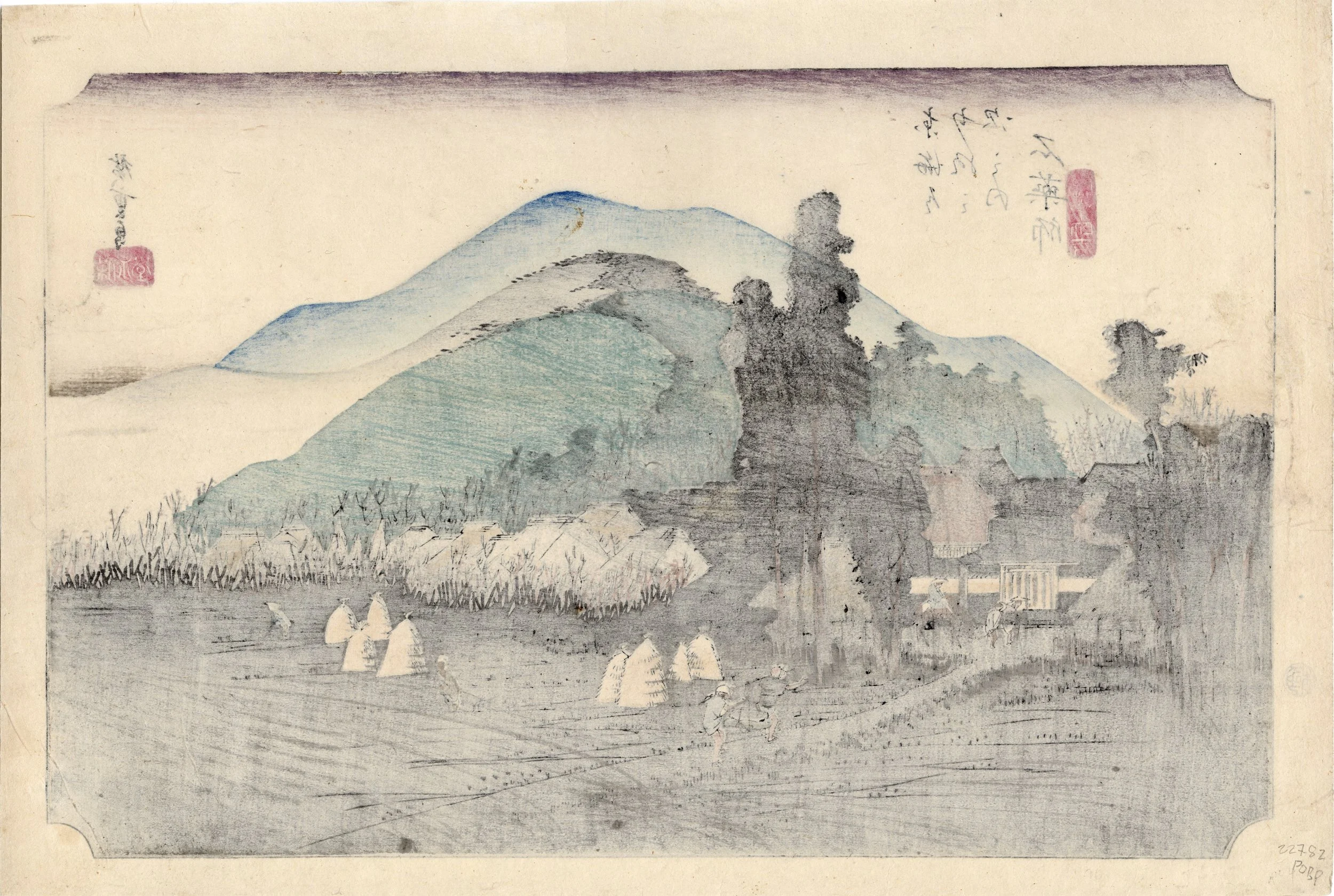
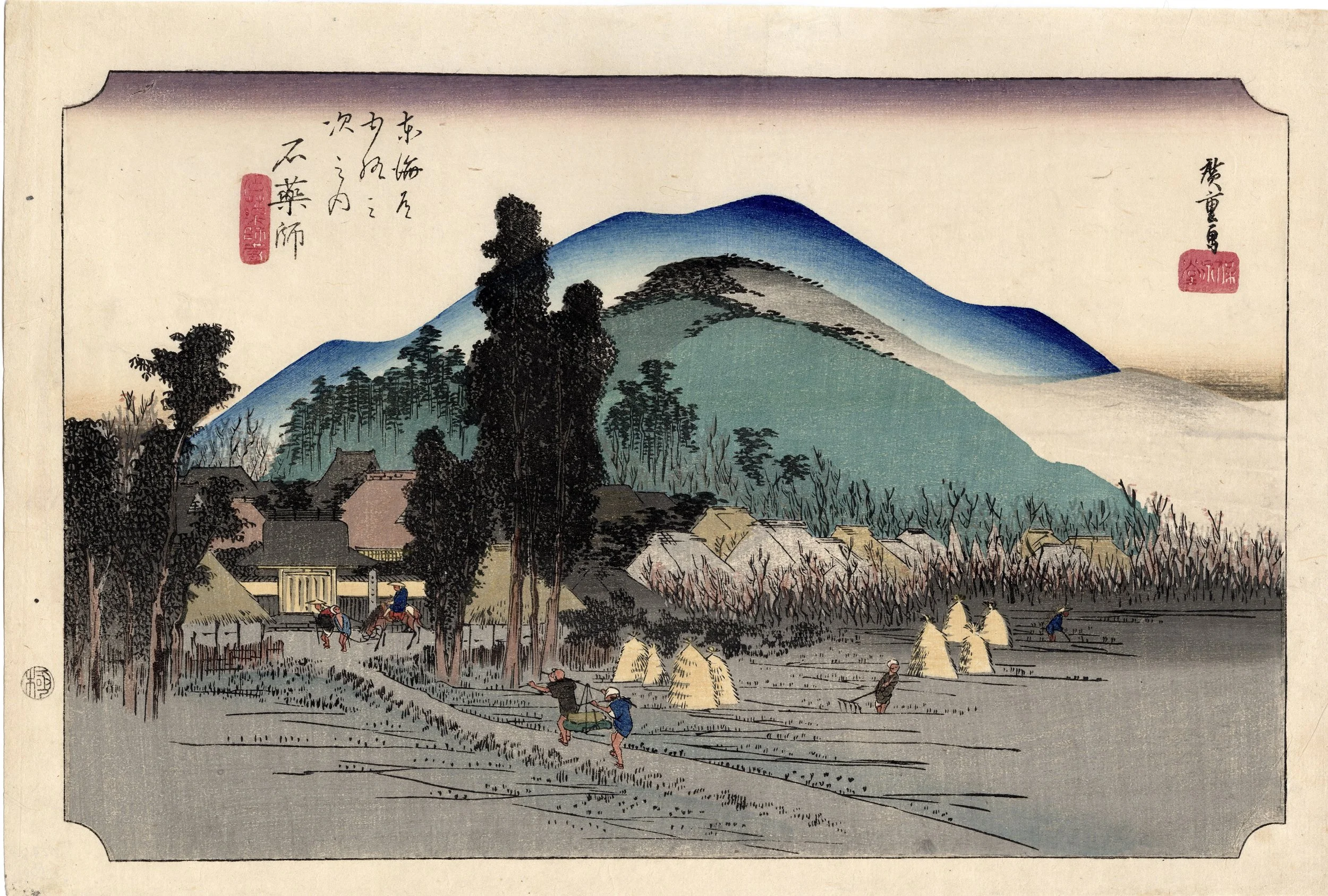
The so-called Great Tokaido – also known as the Hoeido Tokaido, for the publisher – was Hiroshige’s career-making early masterpiece series, revolutionizing the landscape genre in Japanese wood block prints. In it, he depicted the storied Sea Highway from Edo to Kyoto, and 53 stops or “stations” along the route, in realistic terms, often elegantly placing humans amid the beauty and wonder of nature.

Many of these prints, in fact, show nature at it’s fiercest – whether it be rain, wind or snow. But not this one. Here we are at the 45th station, Ishiyakushi, but all is calm.

In the middleground, we see the gate of Ishiyakushi temple. In the background, the vast Suzuka Mountains stretch across the sky, their tops rendered in deep blue, their bases shrouded in mist. Nearer mountains are hidden in shadows. Weary travelers move along the highway in the foreground as farmers till the soil and evening descends.

The scholar Muneshige Narazaki wrote of this wonderful print:

The farmers working in the paddy fields, the travelers on the road, and this scene as a whole are portrayed realistically and yet with a deep sense of poetry… The print somehow seems to evoke the relationship this area has with dark antiquity; it is as if the scene contains hidden echoes of the ancient gods.

I couldn’t say it better myself, so why bother?

《东海道五十三次之内》是歌川广重于1833年至1834年推出的横版名所绘系列,全套共55张。此系列不仅是广重的代表作,更成为名所绘的里程碑,掀起了后世以东海道为主题的创作热潮,在艺术与历史上均具卓越价值。

作为系列第四十四处宿场,“石药师”,位于今三重县铃鹿市,名由古刹石药师寺而来。广重此次未将视线局限于名胜建筑,而是将视角移向旷野,描绘了一幅极具生活气息的自然景色。

画面背景中,苍茫的铃鹿山脉横亘天际,广重在此展现了高超的“晕染”技法。山巅覆着一层深沉的绀青,山腰则在薄雾的笼罩下透出淡淡的草绿,山影与云气交融,传达出暮色将至时的清冷感。山脚下,石药师寺那掩映在茂密树丛中的大门已经紧闭,预示着一天的结束。

视线转至近景,此刻正值秋日的收割时节,水田里矗立着一堆堆整齐的稻草垛。几名农人正赶在天黑前低头劳作,有的挑着沉甸甸的扁担穿行在田间,一派繁忙却有序的农家景象。而左侧的田埂上,三位旅人正沿着斜伸的小径缓缓走来,正准备进入石药师宿投宿。这种巧妙的对角线构图,不仅引导着观者的视线从忙碌的农田投向远方的山影,更赋予了静止画面一种时空的延伸感。

广重以淡雅而辽远的笔致,捕捉了季节与昼夜转换时的敏锐感触。即便没有奇景巨构,石药师那寂寥而生动的薄暮原野,依然能让观者跨越两百年,感受到秋日黄昏中的微寒。

Interested in purchasing?
Please contact us.

歌川広重 Utagawa Hiroshige (1797-1858)

东海道五十三次之内 石药师
Ishiyakushi, from The Fifty-three Stations of the Tokaido

1833-34

木版画 | 横绘大判 | 25.5cm x 38cm
Woodblock-print | Oban yoko -e | 25.5cm x 38cm

早期版次;颜色鲜艳;品相非常好;边缘完整
Fine impression, color and condition; full margin.

RESERVED

The so-called Great Tokaido – also known as the Hoeido Tokaido, for the publisher – was Hiroshige’s career-making early masterpiece series, revolutionizing the landscape genre in Japanese wood block prints. In it, he depicted the storied Sea Highway from Edo to Kyoto, and 53 stops or “stations” along the route, in realistic terms, often elegantly placing humans amid the beauty and wonder of nature.

Many of these prints, in fact, show nature at it’s fiercest – whether it be rain, wind or snow. But not this one. Here we are at the 45th station, Ishiyakushi, but all is calm.

In the middleground, we see the gate of Ishiyakushi temple. In the background, the vast Suzuka Mountains stretch across the sky, their tops rendered in deep blue, their bases shrouded in mist. Nearer mountains are hidden in shadows. Weary travelers move along the highway in the foreground as farmers till the soil and evening descends.

The scholar Muneshige Narazaki wrote of this wonderful print:

The farmers working in the paddy fields, the travelers on the road, and this scene as a whole are portrayed realistically and yet with a deep sense of poetry… The print somehow seems to evoke the relationship this area has with dark antiquity; it is as if the scene contains hidden echoes of the ancient gods.

I couldn’t say it better myself, so why bother?

《东海道五十三次之内》是歌川广重于1833年至1834年推出的横版名所绘系列,全套共55张。此系列不仅是广重的代表作,更成为名所绘的里程碑,掀起了后世以东海道为主题的创作热潮,在艺术与历史上均具卓越价值。

作为系列第四十四处宿场,“石药师”,位于今三重县铃鹿市,名由古刹石药师寺而来。广重此次未将视线局限于名胜建筑,而是将视角移向旷野,描绘了一幅极具生活气息的自然景色。

画面背景中,苍茫的铃鹿山脉横亘天际,广重在此展现了高超的“晕染”技法。山巅覆着一层深沉的绀青,山腰则在薄雾的笼罩下透出淡淡的草绿,山影与云气交融,传达出暮色将至时的清冷感。山脚下,石药师寺那掩映在茂密树丛中的大门已经紧闭,预示着一天的结束。

视线转至近景,此刻正值秋日的收割时节,水田里矗立着一堆堆整齐的稻草垛。几名农人正赶在天黑前低头劳作,有的挑着沉甸甸的扁担穿行在田间,一派繁忙却有序的农家景象。而左侧的田埂上,三位旅人正沿着斜伸的小径缓缓走来,正准备进入石药师宿投宿。这种巧妙的对角线构图,不仅引导着观者的视线从忙碌的农田投向远方的山影,更赋予了静止画面一种时空的延伸感。

广重以淡雅而辽远的笔致,捕捉了季节与昼夜转换时的敏锐感触。即便没有奇景巨构,石药师那寂寥而生动的薄暮原野,依然能让观者跨越两百年,感受到秋日黄昏中的微寒。

Interested in purchasing?
Please contact us.

Utagawa Hiroshige (1797-1858)

Ando Hiroshige (1897-1858) revolutionized the art of landscape prints during the Edo era, building on the success of his senior, Hokusai, but taking a more poetic and naturalist approach to portraying the beauty of Japan.

The son of a low-level Samurai assigned to the fire brigade in Edo, Hiroshige became a student of the Utagawa school as a young man. His first prints focused on beautiful women (bijin), and views of Edo. But in 1833 he began work on his most famous early work, his first series depicting the Tokaido, the "Great Sea Road" between Edo and Tokyo.

Today there is some controversy about this series. Initially, it was believed that Hiroshige had travelled the route along with a local lord (Daimyo) who was making a gift of horses to the Emperor. But more recent scholarship suggests Hiroshige never travelled the road himself, at least not the entire way, and made his designs using published guidebooks.

Nonetheless, the prints were wonderful and revolutionary. They embraced the seasons with a gentle lyricism missing from Hokusai's striking but stylized depictions. In Hiroshige's work, nature is sacred -- but it is always mixed with humanity, with travelers or little inns or bridges. There is a magical harmony between man and the elements.

His depiction of the seasons and weather is especially evocative. Snow blankets some views with a hushed silence, while rain streaks down furiously in others. In some prints natured is agitated; in others, calm prevails. Produced in a horizontal oban yoko-e format, the series was a smash hit.

The Tokaido series made Hiroshige famous, and he became incredible prolific. In the 1840s he produced many strong designs, but many mediocre ones, too, including several subsequent Tokaido series of varying quality.

In 1853, however, he made a big step. He turned his landscapes sideways, embracing a bold vertical oban tate-e format. This gave his designs new energy and a modern feel. The first of these was Famous Views of the Sixty-Odd Provinces. From them on, most of his most noted series were executed in this format.

He saved his greatest for his last. In 1856 he began work on 100 Famous Views of Edo, which many consider his most exceptional work. Here his home city was portrayed with energy and passion, and in these 119 designs he created an incredible record of a vanished place. In addition to the striking vertical format, he developed exciting new compositions, often juxtaposing a strong foreground element with a distant background.

Among the many famous images in this series are Squall at Ohashi and the Plum Garden in Komeido. Both of these were copied by Vincent Van Gogh, a great admirer of Hiroshige. Thus, the great Japanese artist had a profound effect on Western art.

Alas, his beloved Edo ended his life. Hiroshige was claimed by a cholera epidemic that swept the city in 1958. His pupil Shigenobu, who took the name Hiroshige II, completed The Famous Views of Edo.