Hiroshige | Mimasaka Province, Yamabushi Valley, Famous Places in the 60 Odd Provinces

$0.00

歌川広重 Utagawa Hiroshige (1797-1858)

六十余州名所图会 美作 山伏谷
Mimasaka Province, Yamabushi Valley, from the series of Famous Places in the Sixty-Odd Provinces

1853

木版画 | 纵绘大判 | 37.8cm x 25.8cm
Woodblock-print | Oban tate-e | 37.8cm x 25.8cm

早期版次;颜色鲜艳;品相非常好;边缘完整
Fine impression, color and condition; full margins.

$8,988

Sometimes it slashes down diagonally. Sometimes it plummets directly from the clouds. On other occasions, it’s a fine mist, barely discernable.

Rain. And few artists in history – in any genre, in any medium, from any culture – have captured rain in all its myriad forms, from dramatic to just, well, damp, quite like Utagawa Hiroshige. Indeed, two of his most famous prints – Shono, from the “53 Stations of the Tokaido,” and Sudden Shower at Ohashi from “100 Famous Views of Edo”— are rain-drenched in the extreme.

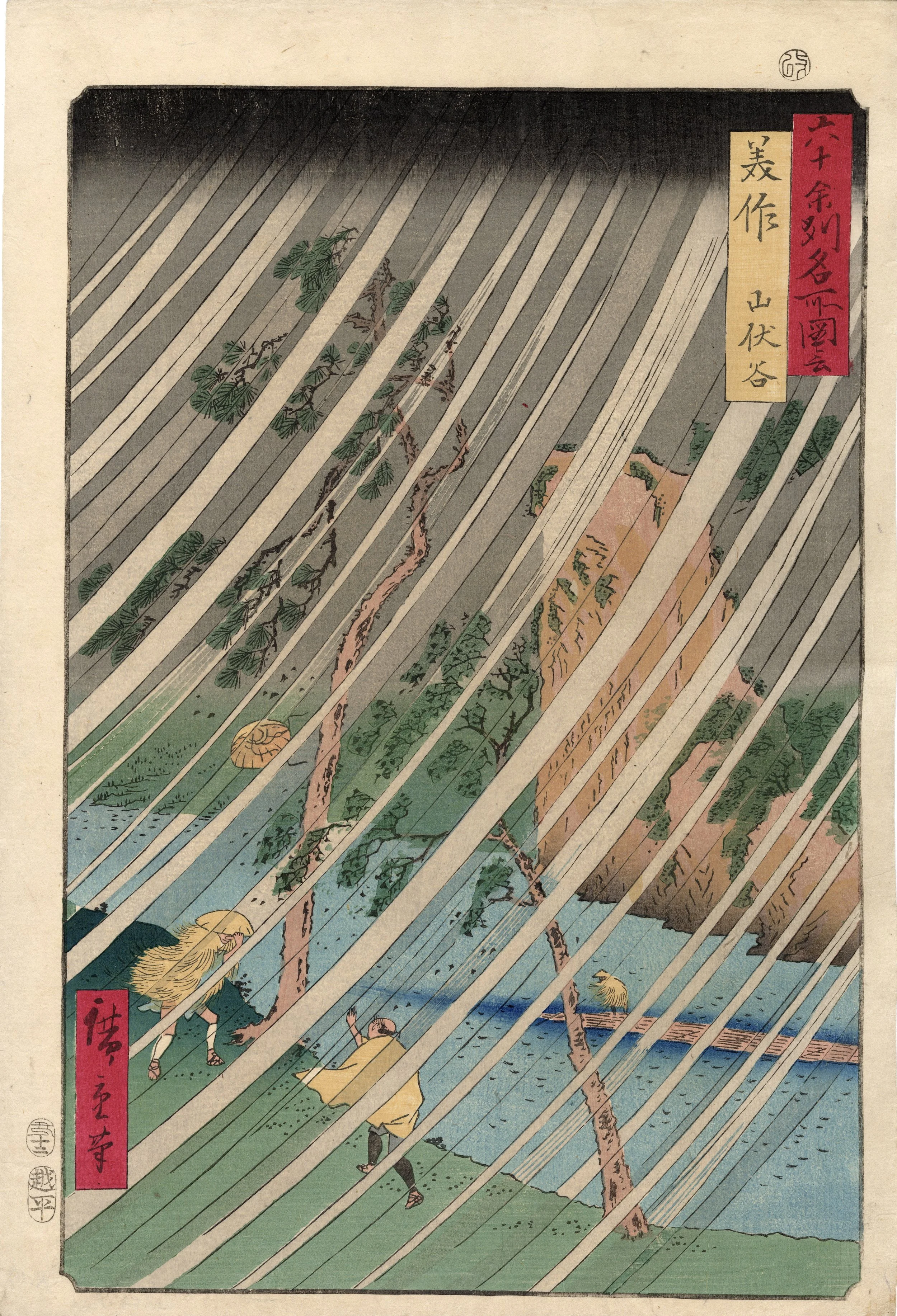
In those cases, crisscrossing straight lines layered atop the design give rain a physical and geometric presence rarely seen before. But this print, Minasaka Province, Yamabushi Valley from “60-Odd Views of the Provinces,” is something else entirely. Here the rain doesn’t create texture atop the composition, it completely blocks our view at points. Solid, curving bands of water create an image that is nearly abstract, and undeniably modern.

This series marked the moment when Hiroshige turned many of his landscape designs into vertical, oban tate-e formats, creating bold dynamics that dramatically emphasized Japan’s topography – and provided new ways to portray rain. At the same time, the series embraced all manner of subtle bokashi and fine printing techniques to bring the images to life.

Mimasaka Province was deep in the mountains of Western Japan and known for the “mountain ascetics” — mourntain hermits who revel in the force of nature and are known as yamabushi — who lived there.

We see the rain cut through the straight-standing Jizo Rock across the river. Otherwise, the rain has washed away most details of the far shore. In the foreground, a traveler has lost his hat to the wind, while a second struggles to control his coat of straw.

This example is crisp and clean, with rich colors.

在《六十余州名所图会》这一波澜壮阔的系列中,歌川广重用七十幅竖绘作品重构了全日本的胜景。不同于他在其他作品中对前人图谱的温和致敬,在这幅《美作 山伏谷》里,广重展现了近乎偏执的原创野心。

美作山伏谷,地如其名,本是山中修验僧苦行之所,荒僻而险峻。但广重关心的并非地理志上的坐标,而是将这片深邃的峡谷简化为两个纯粹的视觉元素:风,与雨。

画面最摄人心魄之处,在于那贯穿天地的、极具流畅感的斜向长线。它们如同被狂风拽动的帘幕,以统一的曲度划破画面,不仅表现出骤雨的力量,更具象化了那股将斗笠卷入深谷的无形狂风。这种极具生命力的线条处理,将‘风’与‘雨’交织成一种动态的视觉屏障,令观者如临其境。

画面左下角,三名旅人在狂风暴雨中艰难前行。一名旅人的斗笠被狂风吹落,正挣扎着去捡拾;另两名旅人则蜷缩着身子,在泥泞的小径上艰难前行。悬崖上被风吹歪的松树与山谷间湍急的溪流相呼应,将自然界的狂暴与人类的渺小形成了鲜明对比。

这或许是广重在系列里最成功的设计之一。他没有依赖任何现成的名胜图式,而是凭借对自然瞬息的敏锐捕捉,将一场荒野的暴雨升华为了一场跨越时代的视觉交响乐。这种对风雨线条的抽象处理,不仅超越了时代,更成为后世研究广重“雨景艺术”不可绕过的巅峰。

Interested in purchasing?
Please contact us.

歌川広重 Utagawa Hiroshige (1797-1858)

六十余州名所图会 美作 山伏谷
Mimasaka Province, Yamabushi Valley, from the series of Famous Places in the Sixty-Odd Provinces

1853

木版画 | 纵绘大判 | 37.8cm x 25.8cm
Woodblock-print | Oban tate-e | 37.8cm x 25.8cm

早期版次;颜色鲜艳;品相非常好;边缘完整
Fine impression, color and condition; full margins.

$8,988

Sometimes it slashes down diagonally. Sometimes it plummets directly from the clouds. On other occasions, it’s a fine mist, barely discernable.

Rain. And few artists in history – in any genre, in any medium, from any culture – have captured rain in all its myriad forms, from dramatic to just, well, damp, quite like Utagawa Hiroshige. Indeed, two of his most famous prints – Shono, from the “53 Stations of the Tokaido,” and Sudden Shower at Ohashi from “100 Famous Views of Edo”— are rain-drenched in the extreme.

In those cases, crisscrossing straight lines layered atop the design give rain a physical and geometric presence rarely seen before. But this print, Minasaka Province, Yamabushi Valley from “60-Odd Views of the Provinces,” is something else entirely. Here the rain doesn’t create texture atop the composition, it completely blocks our view at points. Solid, curving bands of water create an image that is nearly abstract, and undeniably modern.

This series marked the moment when Hiroshige turned many of his landscape designs into vertical, oban tate-e formats, creating bold dynamics that dramatically emphasized Japan’s topography – and provided new ways to portray rain. At the same time, the series embraced all manner of subtle bokashi and fine printing techniques to bring the images to life.

Mimasaka Province was deep in the mountains of Western Japan and known for the “mountain ascetics” — mourntain hermits who revel in the force of nature and are known as yamabushi — who lived there.

We see the rain cut through the straight-standing Jizo Rock across the river. Otherwise, the rain has washed away most details of the far shore. In the foreground, a traveler has lost his hat to the wind, while a second struggles to control his coat of straw.

This example is crisp and clean, with rich colors.

在《六十余州名所图会》这一波澜壮阔的系列中,歌川广重用七十幅竖绘作品重构了全日本的胜景。不同于他在其他作品中对前人图谱的温和致敬,在这幅《美作 山伏谷》里,广重展现了近乎偏执的原创野心。

美作山伏谷,地如其名,本是山中修验僧苦行之所,荒僻而险峻。但广重关心的并非地理志上的坐标,而是将这片深邃的峡谷简化为两个纯粹的视觉元素:风,与雨。

画面最摄人心魄之处,在于那贯穿天地的、极具流畅感的斜向长线。它们如同被狂风拽动的帘幕,以统一的曲度划破画面,不仅表现出骤雨的力量,更具象化了那股将斗笠卷入深谷的无形狂风。这种极具生命力的线条处理,将‘风’与‘雨’交织成一种动态的视觉屏障,令观者如临其境。

画面左下角,三名旅人在狂风暴雨中艰难前行。一名旅人的斗笠被狂风吹落,正挣扎着去捡拾;另两名旅人则蜷缩着身子,在泥泞的小径上艰难前行。悬崖上被风吹歪的松树与山谷间湍急的溪流相呼应,将自然界的狂暴与人类的渺小形成了鲜明对比。

这或许是广重在系列里最成功的设计之一。他没有依赖任何现成的名胜图式,而是凭借对自然瞬息的敏锐捕捉,将一场荒野的暴雨升华为了一场跨越时代的视觉交响乐。这种对风雨线条的抽象处理,不仅超越了时代,更成为后世研究广重“雨景艺术”不可绕过的巅峰。

Interested in purchasing?
Please contact us.

Utagawa Hiroshige (1797-1858)

Ando Hiroshige (1897-1858) revolutionized the art of landscape prints during the Edo era, building on the success of his senior, Hokusai, but taking a more poetic and naturalist approach to portraying the beauty of Japan.

The son of a low-level Samurai assigned to the fire brigade in Edo, Hiroshige became a student of the Utagawa school as a young man. His first prints focused on beautiful women (bijin), and views of Edo. But in 1833 he began work on his most famous early work, his first series depicting the Tokaido, the "Great Sea Road" between Edo and Tokyo.

Today there is some controversy about this series. Initially, it was believed that Hiroshige had travelled the route along with a local lord (Daimyo) who was making a gift of horses to the Emperor. But more recent scholarship suggests Hiroshige never travelled the road himself, at least not the entire way, and made his designs using published guidebooks.

Nonetheless, the prints were wonderful and revolutionary. They embraced the seasons with a gentle lyricism missing from Hokusai's striking but stylized depictions. In Hiroshige's work, nature is sacred -- but it is always mixed with humanity, with travelers or little inns or bridges. There is a magical harmony between man and the elements.

His depiction of the seasons and weather is especially evocative. Snow blankets some views with a hushed silence, while rain streaks down furiously in others. In some prints natured is agitated; in others, calm prevails. Produced in a horizontal oban yoko-e format, the series was a smash hit.

The Tokaido series made Hiroshige famous, and he became incredible prolific. In the 1840s he produced many strong designs, but many mediocre ones, too, including several subsequent Tokaido series of varying quality.

In 1853, however, he made a big step. He turned his landscapes sideways, embracing a bold vertical oban tate-e format. This gave his designs new energy and a modern feel. The first of these was Famous Views of the Sixty-Odd Provinces. From them on, most of his most noted series were executed in this format.

He saved his greatest for his last. In 1856 he began work on 100 Famous Views of Edo, which many consider his most exceptional work. Here his home city was portrayed with energy and passion, and in these 119 designs he created an incredible record of a vanished place. In addition to the striking vertical format, he developed exciting new compositions, often juxtaposing a strong foreground element with a distant background.

Among the many famous images in this series are Squall at Ohashi and the Plum Garden in Komeido. Both of these were copied by Vincent Van Gogh, a great admirer of Hiroshige. Thus, the great Japanese artist had a profound effect on Western art.

Alas, his beloved Edo ended his life. Hiroshige was claimed by a cholera epidemic that swept the city in 1958. His pupil Shigenobu, who took the name Hiroshige II, completed The Famous Views of Edo.