Hiroshige | Mino Province, Yoro Falls Famous Places in the 60 Odd Provinces

$0.00

歌川広重 Utagawa Hiroshige (1797-1858)

六十余州名所图会 美浓 养老瀑布
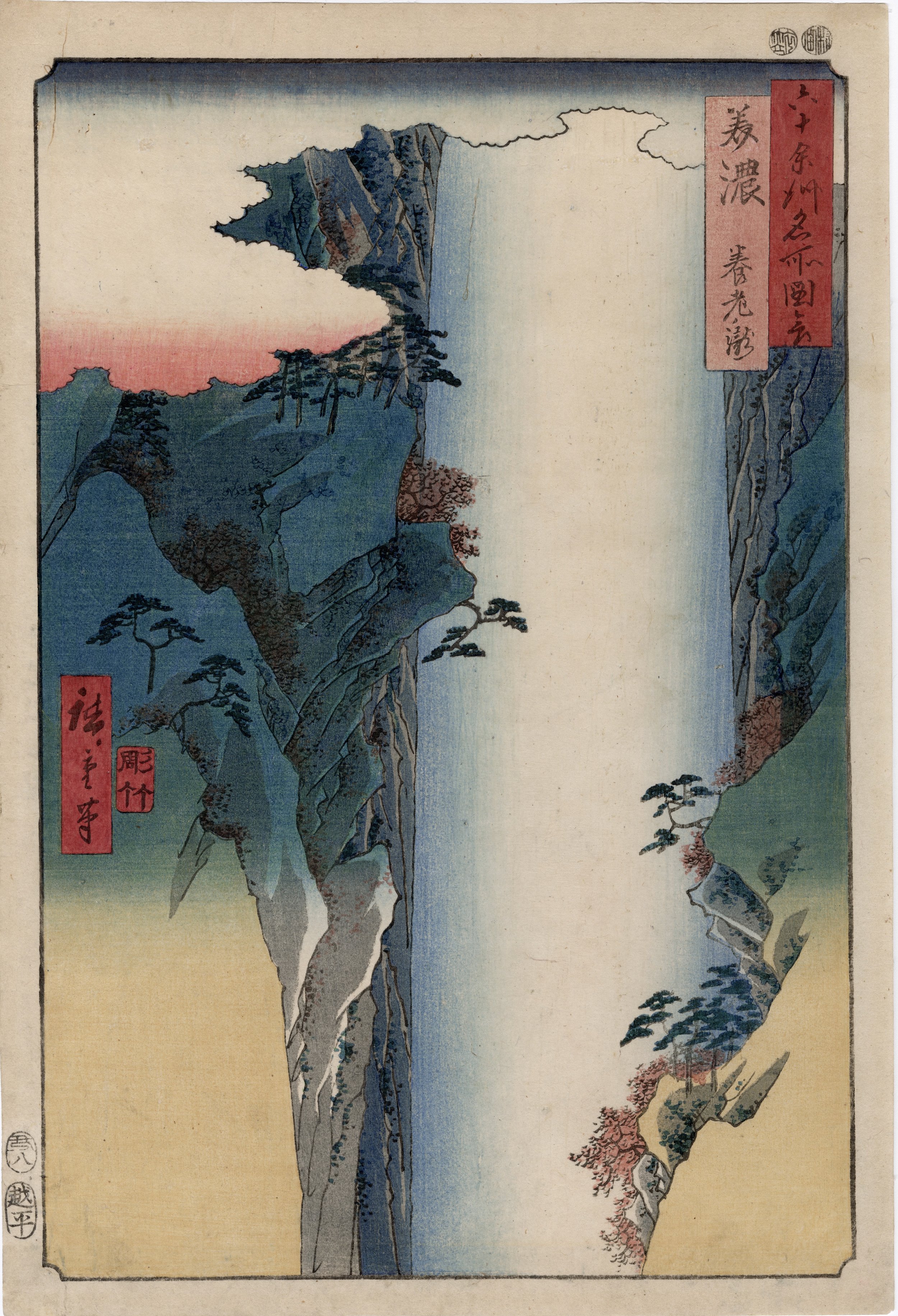
Mino Province, Yoro Falls, from the series of Famous Places in the Sixty-Odd Provinces

1853

木版画 | 纵绘大判 | 37.8cm x 25.8cm
Woodblock-print | Oban tate-e | 37.8cm x 25.8cm

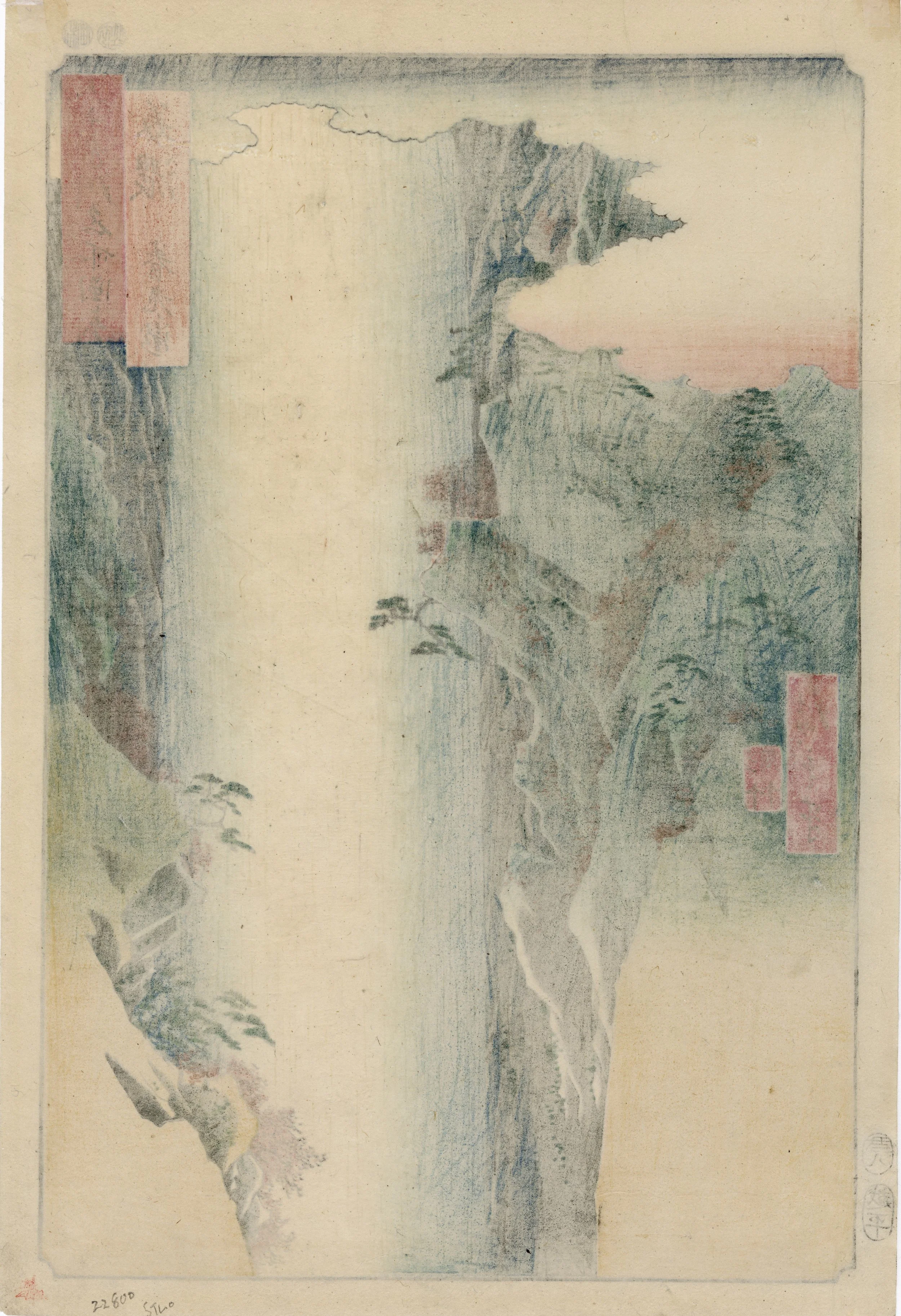
非常早期的版次;整体品相完好;非常轻微地黄化;瀑布留白处有轻微褐斑
Fine impression; very slight toning; light foxing in the blank areas of the waterfall, otherwise in good condition

$7,388

Hokusai depicted the Yoro Falls in Mino province as a tumbling, frothy torrent. Eisen took a similar approach with this powerful view of Kegon waterfallall spray and roaring power.

Here, in what is considered one of the most successful designs from his groundbreaking “60 Famous View of the Provinces,” Hiroshige goes in the opposite direction – he breaks Yoro Falls into its simplest element: Water. Going. Straight. Down.

Indeed, the design is almost abstract in its simplicity. The falling water forms a bold vertical component, dividing the image into two halves. While Hokusai and Eisen added little travelers to demonstrate the falls’ size, Hiroshige uses tiny trees cutting into the vertical lines for the purpose of scale, and stylized clouds above to suggest that the water flows from the very heavens above. At the same time, we don’t see where it ends; for all the viewer knows, the water keeps falling forever.  

In fact, the falls drop 32 meters. The water, according to legend, is rejuvenating and was even, according to Empress Gensho, (A.D. 683-748) not unlike sake.

This early edition inclues print printing in the water, which has fine blue-to-white bokashi from the inside out. Later editions feature all-blue falls, which lesson the impact.

葛饰北斋笔下的美浓国“养老瀑布犹如翻滚奔腾、水花四溅的巨流;溪斋英泉在描绘著名的“华严瀑布”时也采取了类似的手法,极力渲染漫天水雾与雷霆万钧的气势。

然而,在这幅被公认为《六十余州名所图会》系列中最成功的构图中,歌川广重却反其道而行之——他将养老瀑布拆解为最纯粹的元素:水,垂直,落下

事实上,这种设计因其极致的简练而近乎于一种“抽象”。倾泻而下的飞瀑构成了一个强有力的垂直轴心,将画面一分为二。北斋与英泉倾向于通过描绘渺小的旅人来反衬瀑布的雄伟,而广重则别出心裁,他利用切入垂直线条的微小树木来确立空间比例,并辅以山顶云雾缭绕的意象,暗示这股清流仿佛自九天倾泻而下。与此同时,画面并未展示瀑布的尽头;在观者眼中,这流水似乎将永无止境地坠落下去。

叹惋的是,现实中的养老瀑布远没有画中这般壮丽。但在现实世界,又有谁能做到呢?在浮世绘瀑布题材的殿堂里,广重的这件作品或许正是那极致的终章。

Interested in purchasing?
Please contact
us.

歌川広重 Utagawa Hiroshige (1797-1858)

六十余州名所图会 美浓 养老瀑布
Mino Province, Yoro Falls, from the series of Famous Places in the Sixty-Odd Provinces

1853

木版画 | 纵绘大判 | 37.8cm x 25.8cm
Woodblock-print | Oban tate-e | 37.8cm x 25.8cm

非常早期的版次;整体品相完好;非常轻微地黄化;瀑布留白处有轻微褐斑
Fine impression; very slight toning; light foxing in the blank areas of the waterfall, otherwise in good condition

$7,388

Hokusai depicted the Yoro Falls in Mino province as a tumbling, frothy torrent. Eisen took a similar approach with this powerful view of Kegon waterfallall spray and roaring power.

Here, in what is considered one of the most successful designs from his groundbreaking “60 Famous View of the Provinces,” Hiroshige goes in the opposite direction – he breaks Yoro Falls into its simplest element: Water. Going. Straight. Down.

Indeed, the design is almost abstract in its simplicity. The falling water forms a bold vertical component, dividing the image into two halves. While Hokusai and Eisen added little travelers to demonstrate the falls’ size, Hiroshige uses tiny trees cutting into the vertical lines for the purpose of scale, and stylized clouds above to suggest that the water flows from the very heavens above. At the same time, we don’t see where it ends; for all the viewer knows, the water keeps falling forever.  

In fact, the falls drop 32 meters. The water, according to legend, is rejuvenating and was even, according to Empress Gensho, (A.D. 683-748) not unlike sake.

This early edition inclues print printing in the water, which has fine blue-to-white bokashi from the inside out. Later editions feature all-blue falls, which lesson the impact.

葛饰北斋笔下的美浓国“养老瀑布犹如翻滚奔腾、水花四溅的巨流;溪斋英泉在描绘著名的“华严瀑布”时也采取了类似的手法,极力渲染漫天水雾与雷霆万钧的气势。

然而,在这幅被公认为《六十余州名所图会》系列中最成功的构图中,歌川广重却反其道而行之——他将养老瀑布拆解为最纯粹的元素:水,垂直,落下

事实上,这种设计因其极致的简练而近乎于一种“抽象”。倾泻而下的飞瀑构成了一个强有力的垂直轴心,将画面一分为二。北斋与英泉倾向于通过描绘渺小的旅人来反衬瀑布的雄伟,而广重则别出心裁,他利用切入垂直线条的微小树木来确立空间比例,并辅以山顶云雾缭绕的意象,暗示这股清流仿佛自九天倾泻而下。与此同时,画面并未展示瀑布的尽头;在观者眼中,这流水似乎将永无止境地坠落下去。

叹惋的是,现实中的养老瀑布远没有画中这般壮丽。但在现实世界,又有谁能做到呢?在浮世绘瀑布题材的殿堂里,广重的这件作品或许正是那极致的终章。

Interested in purchasing?
Please contact
us.

Utagawa Hiroshige (1797-1858)

Ando Hiroshige (1897-1858) revolutionized the art of landscape prints during the Edo era, building on the success of his senior, Hokusai, but taking a more poetic and naturalist approach to portraying the beauty of Japan.

The son of a low-level Samurai assigned to the fire brigade in Edo, Hiroshige became a student of the Utagawa school as a young man. His first prints focused on beautiful women (bijin), and views of Edo. But in 1833 he began work on his most famous early work, his first series depicting the Tokaido, the "Great Sea Road" between Edo and Tokyo.

Today there is some controversy about this series. Initially, it was believed that Hiroshige had travelled the route along with a local lord (Daimyo) who was making a gift of horses to the Emperor. But more recent scholarship suggests Hiroshige never travelled the road himself, at least not the entire way, and made his designs using published guidebooks.

Nonetheless, the prints were wonderful and revolutionary. They embraced the seasons with a gentle lyricism missing from Hokusai's striking but stylized depictions. In Hiroshige's work, nature is sacred -- but it is always mixed with humanity, with travelers or little inns or bridges. There is a magical harmony between man and the elements.

His depiction of the seasons and weather is especially evocative. Snow blankets some views with a hushed silence, while rain streaks down furiously in others. In some prints natured is agitated; in others, calm prevails. Produced in a horizontal oban yoko-e format, the series was a smash hit.

The Tokaido series made Hiroshige famous, and he became incredible prolific. In the 1840s he produced many strong designs, but many mediocre ones, too, including several subsequent Tokaido series of varying quality.

In 1853, however, he made a big step. He turned his landscapes sideways, embracing a bold vertical oban tate-e format. This gave his designs new energy and a modern feel. The first of these was Famous Views of the Sixty-Odd Provinces. From them on, most of his most noted series were executed in this format.

He saved his greatest for his last. In 1856 he began work on 100 Famous Views of Edo, which many consider his most exceptional work. Here his home city was portrayed with energy and passion, and in these 119 designs he created an incredible record of a vanished place. In addition to the striking vertical format, he developed exciting new compositions, often juxtaposing a strong foreground element with a distant background.

Among the many famous images in this series are Squall at Ohashi and the Plum Garden in Komeido. Both of these were copied by Vincent Van Gogh, a great admirer of Hiroshige. Thus, the great Japanese artist had a profound effect on Western art.

Alas, his beloved Edo ended his life. Hiroshige was claimed by a cholera epidemic that swept the city in 1958. His pupil Shigenobu, who took the name Hiroshige II, completed The Famous Views of Edo.