Hiroshige | Misty Moon over Tsukuda Island Seashore, Famous Places of the Eastern Capital

$0.00

歌川広重 Utagawa Hiroshige (1797-1858)

东都名所 佃岛海边之胧月
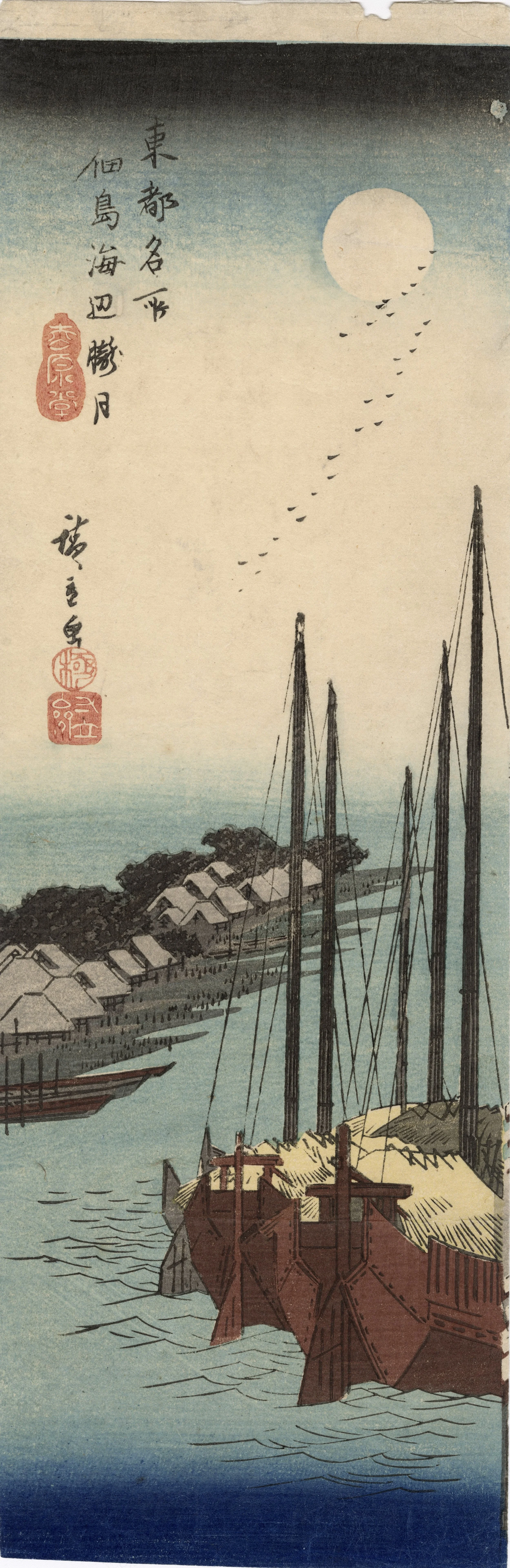
Misty Moon over Tsukuda Island Seashore, from the series of Famous Places of the Eastern Capital

1835-38

木版画 | 中短册 | 38cm x 22.5cm
Woodblock | Chutanzaku|38cm x 22.5cm

早期版次;颜色鲜艳;品相非常好;上方边缘有一处小缺角
Fine impression and color; minor loss at the top edge, otherwise in good condition

$7,588

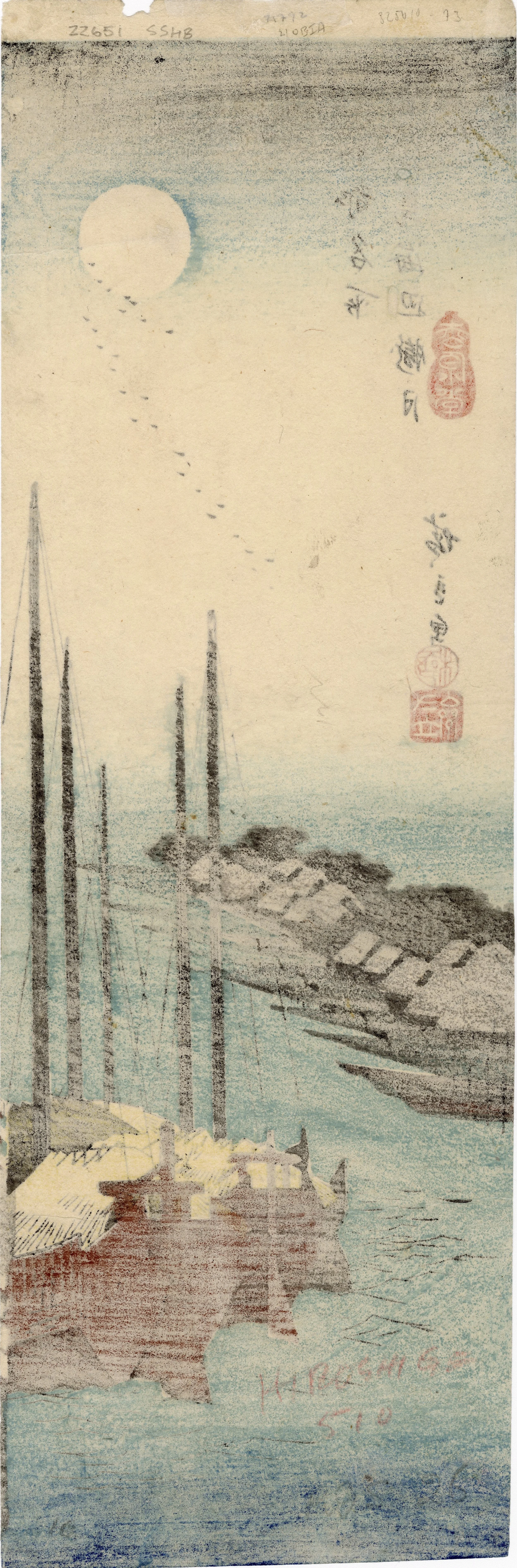
Tsukudajima Island sat at the mouth of the Sumida River in Edo Bay. Marshy, reclaimed-land, it was the home port of numerous coastal freighters and fishing boats, and appeared often in Ukiyoe. Both Hokusai and Hiroshige regularly depicted it, the low-lying grasses always juxtaposed with the vertical masts of the many wooden ships, which are usually at rest, as here, their sails down.

It first became a fishing port around 1645 when the Shogunate brought a group of whitebait fishermen to Edo, the new capital, from near Osaka. They brought the name with them.

This lovely, moon-lit print is in the unusual and very narrow Chū-tanzaku format. It gives the impression of a painting one might hang in one’s home. The ultra-vertical shape allows Hiroshige to accentuate the height of the masts, while getting a bit creative with the diagonal, diminishing-perspective rooftop lines of the modest homes. The moon and the (again) diagonal flight of geese helps creative an inviting composition.

在江户时代的佃岛,渔民们拥有一种令旁人艳羡的“皇亲”特权:他们是唯一获准为德川将军家供奉“白鱼”(Shirauo)群体。这种夜间捕捞的半透明珍馐,不仅是将军席上的美味,更让这座始建于17世纪中叶的人造岛屿成为了江户湾特殊的文化地标。

本幅《佃岛秋月》捕捉的正是这片承载着幕府往事的水域。画面的近景处,几艘巨大的“辨才船”(Bezaisen)静静停泊,其厚重的轮廓与左侧远方纤细的渔村灯火形成了鲜明对比。画面中最为动人的是对夜色的捕捉:一轮满月高悬,归雁成行,掠过清冷的月影。海面的波纹随着视线向远方推移,逐渐隐入水天一色的薄雾中。

这种狭长构图不仅没有限制景观的表达,反而通过垂直的延伸感,强调了海天的辽阔与秋夜的肃穆。广重以洗练的线条和沉静的色调,将原本繁忙的货运港口转化为一处充满诗意的避风港。

本作属于《东都名所》系列,是广重在长短册格式中规模最大的名所绘作品,创作于1837年至1838年间。这一系列展现了广重早期对透视技法的熟练运用,他通过灵动的“S型”构图引导观众视线,在狭长的画幅中营造出深远的层次感。凭借对有限空间的巧妙驾驭,这一系列也被公认为广重长短册风景画中的巅峰之作。

Interested in purchasing?
Please contact us.

歌川広重 Utagawa Hiroshige (1797-1858)

东都名所 佃岛海边之胧月
Misty Moon over Tsukuda Island Seashore, from the series of Famous Places of the Eastern Capital

1835-38

木版画 | 中短册 | 38cm x 22.5cm
Woodblock | Chutanzaku|38cm x 22.5cm

早期版次;颜色鲜艳;品相非常好;上方边缘有一处小缺角
Fine impression and color; minor loss at the top edge, otherwise in good condition

$7,588

Tsukudajima Island sat at the mouth of the Sumida River in Edo Bay. Marshy, reclaimed-land, it was the home port of numerous coastal freighters and fishing boats, and appeared often in Ukiyoe. Both Hokusai and Hiroshige regularly depicted it, the low-lying grasses always juxtaposed with the vertical masts of the many wooden ships, which are usually at rest, as here, their sails down.

It first became a fishing port around 1645 when the Shogunate brought a group of whitebait fishermen to Edo, the new capital, from near Osaka. They brought the name with them.

This lovely, moon-lit print is in the unusual and very narrow Chū-tanzaku format. It gives the impression of a painting one might hang in one’s home. The ultra-vertical shape allows Hiroshige to accentuate the height of the masts, while getting a bit creative with the diagonal, diminishing-perspective rooftop lines of the modest homes. The moon and the (again) diagonal flight of geese helps creative an inviting composition.

在江户时代的佃岛,渔民们拥有一种令旁人艳羡的“皇亲”特权:他们是唯一获准为德川将军家供奉“白鱼”(Shirauo)群体。这种夜间捕捞的半透明珍馐,不仅是将军席上的美味,更让这座始建于17世纪中叶的人造岛屿成为了江户湾特殊的文化地标。

本幅《佃岛秋月》捕捉的正是这片承载着幕府往事的水域。画面的近景处,几艘巨大的“辨才船”(Bezaisen)静静停泊,其厚重的轮廓与左侧远方纤细的渔村灯火形成了鲜明对比。画面中最为动人的是对夜色的捕捉:一轮满月高悬,归雁成行,掠过清冷的月影。海面的波纹随着视线向远方推移,逐渐隐入水天一色的薄雾中。

这种狭长构图不仅没有限制景观的表达,反而通过垂直的延伸感,强调了海天的辽阔与秋夜的肃穆。广重以洗练的线条和沉静的色调,将原本繁忙的货运港口转化为一处充满诗意的避风港。

本作属于《东都名所》系列,是广重在长短册格式中规模最大的名所绘作品,创作于1837年至1838年间。这一系列展现了广重早期对透视技法的熟练运用,他通过灵动的“S型”构图引导观众视线,在狭长的画幅中营造出深远的层次感。凭借对有限空间的巧妙驾驭,这一系列也被公认为广重长短册风景画中的巅峰之作。

Interested in purchasing?
Please contact us.

Utagawa Hiroshige (1797-1858)

Ando Hiroshige (1897-1858) revolutionized the art of landscape prints during the Edo era, building on the success of his senior, Hokusai, but taking a more poetic and naturalist approach to portraying the beauty of Japan.

The son of a low-level Samurai assigned to the fire brigade in Edo, Hiroshige became a student of the Utagawa school as a young man. His first prints focused on beautiful women (bijin), and views of Edo. But in 1833 he began work on his most famous early work, his first series depicting the Tokaido, the "Great Sea Road" between Edo and Tokyo.

Today there is some controversy about this series. Initially, it was believed that Hiroshige had travelled the route along with a local lord (Daimyo) who was making a gift of horses to the Emperor. But more recent scholarship suggests Hiroshige never travelled the road himself, at least not the entire way, and made his designs using published guidebooks.

Nonetheless, the prints were wonderful and revolutionary. They embraced the seasons with a gentle lyricism missing from Hokusai's striking but stylized depictions. In Hiroshige's work, nature is sacred -- but it is always mixed with humanity, with travelers or little inns or bridges. There is a magical harmony between man and the elements.

His depiction of the seasons and weather is especially evocative. Snow blankets some views with a hushed silence, while rain streaks down furiously in others. In some prints natured is agitated; in others, calm prevails. Produced in a horizontal oban yoko-e format, the series was a smash hit.

The Tokaido series made Hiroshige famous, and he became incredible prolific. In the 1840s he produced many strong designs, but many mediocre ones, too, including several subsequent Tokaido series of varying quality.

In 1853, however, he made a big step. He turned his landscapes sideways, embracing a bold vertical oban tate-e format. This gave his designs new energy and a modern feel. The first of these was Famous Views of the Sixty-Odd Provinces. From them on, most of his most noted series were executed in this format.

He saved his greatest for his last. In 1856 he began work on 100 Famous Views of Edo, which many consider his most exceptional work. Here his home city was portrayed with energy and passion, and in these 119 designs he created an incredible record of a vanished place. In addition to the striking vertical format, he developed exciting new compositions, often juxtaposing a strong foreground element with a distant background.

Among the many famous images in this series are Squall at Ohashi and the Plum Garden in Komeido. Both of these were copied by Vincent Van Gogh, a great admirer of Hiroshige. Thus, the great Japanese artist had a profound effect on Western art.

Alas, his beloved Edo ended his life. Hiroshige was claimed by a cholera epidemic that swept the city in 1958. His pupil Shigenobu, who took the name Hiroshige II, completed The Famous Views of Edo.