
Hiroshige | New Year's Eve Foxfires at the Changing Tree, Oji, 100 Famous Views of Edo

$0.00

歌川広重 Utagawa Hiroshige (1797-1858)

名所江户百景 王子装束榎 除夕狐火
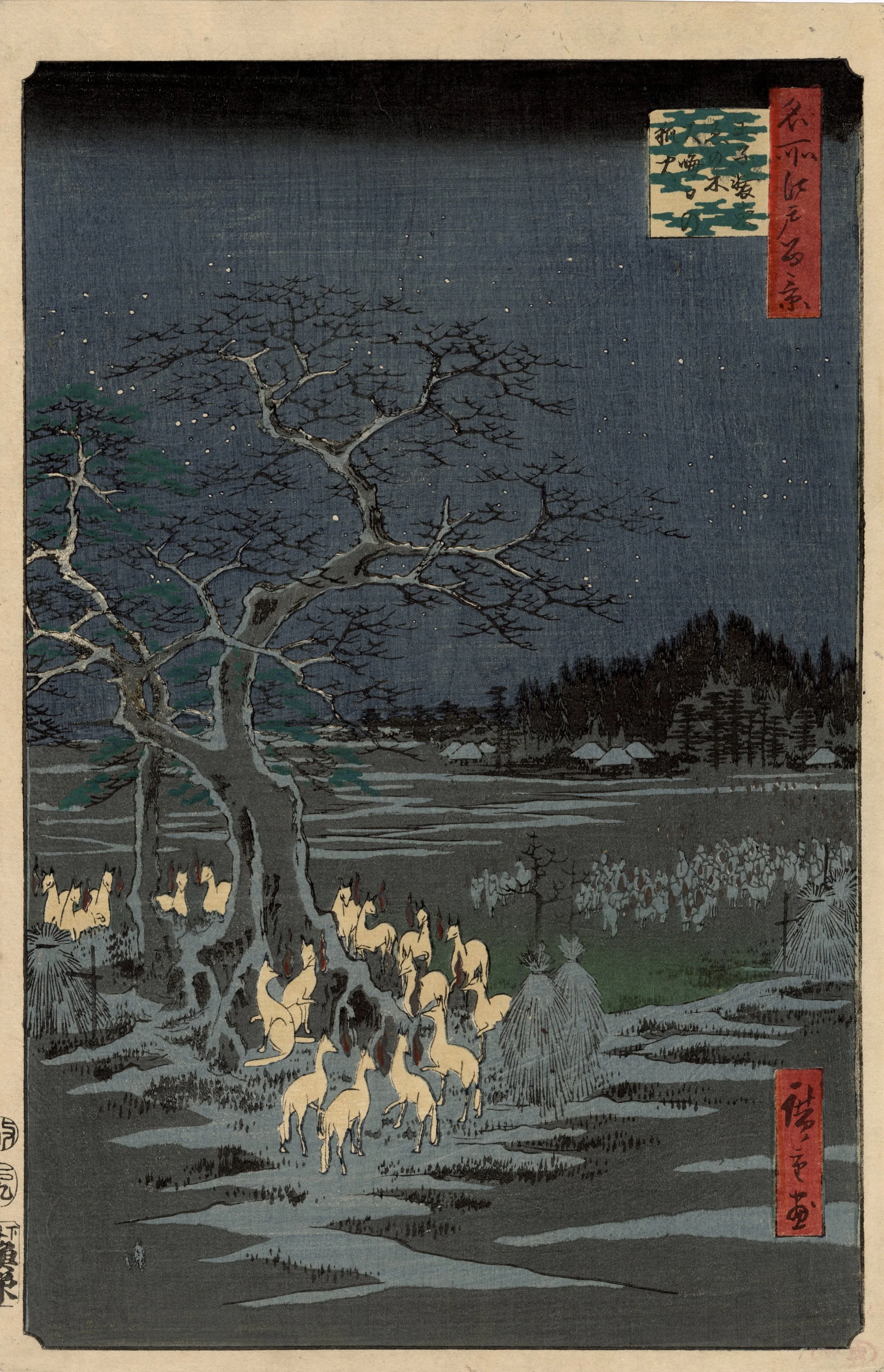
New Year's Eve Foxfires at the Changing Tree, Oji, from the series of “100 Famous Views of Edo.”

1857

木版画 | 纵绘大判 | 35.7cm x 23.2cm
Woodblock-print | Oban tate-e | 35.7cm x 23.2cm

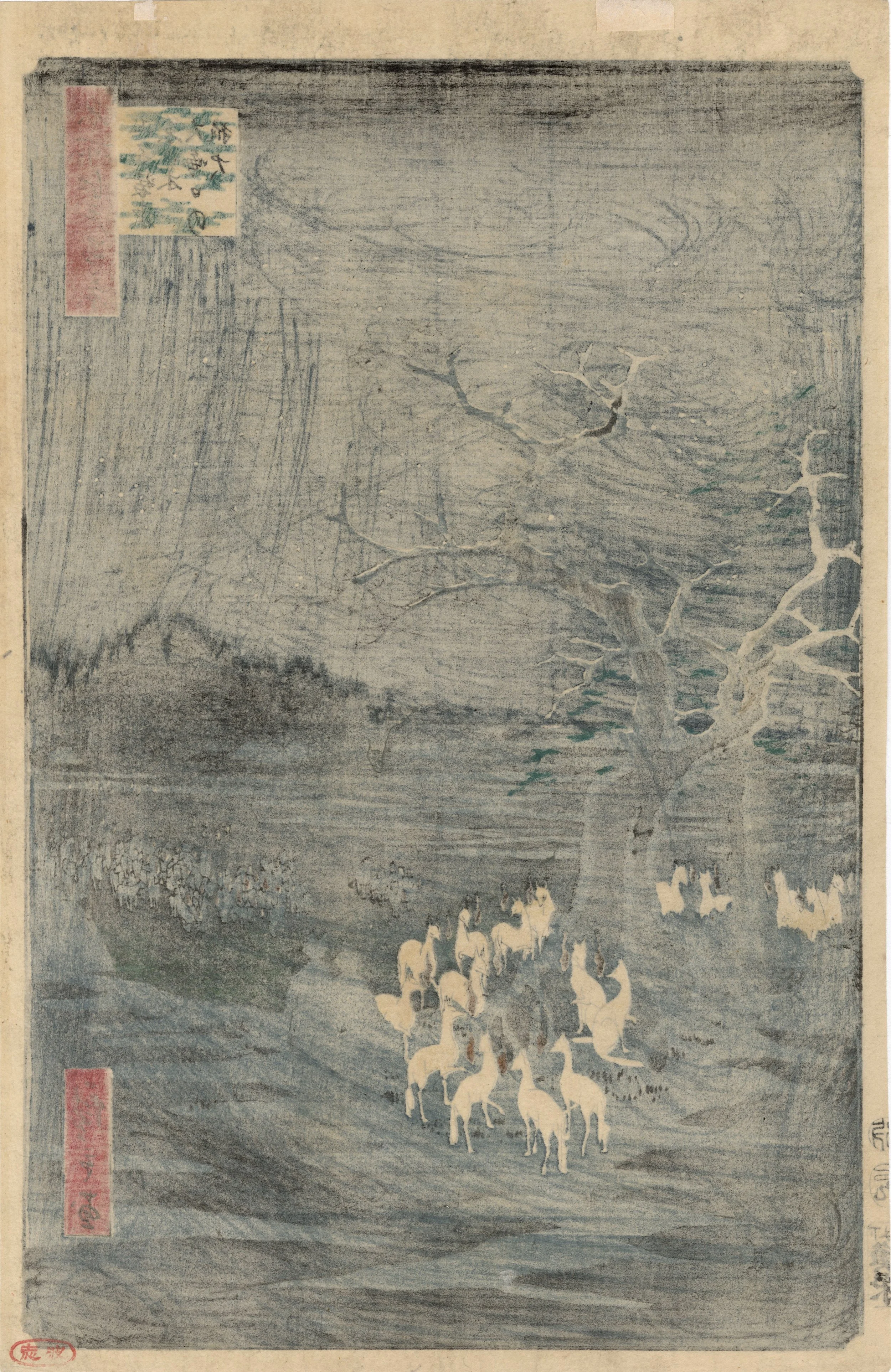
早期版次带清晰的木纹;颜色鲜艳;整体品相非常好;边缘经轻微裁剪;
Early impression with woodgrain and strong color; slight trimming to margins, otherwise in good condition.

$22,000

On New Year’s Eve, from all the eight provinces of Kanto, the foxes gather at an ancient tree near Oji Shrine in Edo. They change their attire, and then enter the shrine to receive their commands for the New Year. From their mouths appear mysterious flames — “foxfires.” Farmers can tell by the flames what they can expect in the coming year’s crop.

Such is the mythical scene that Hiroshige portrays in this remarkable and, at least for him, unique print. Calling it a “haunting masterpiece” and one of the three best designs from “100 Famous Views of Edo,” the scholar Henry D. Smith II notes that while by this time in his storied career Hiroshige “held fast to his ingrained reliance on the certainties of the observed world. Here alone he ventured into the world of spirits.”

Indeed it is the only design from this series to involve fantasy. It creates a truly spooky yet irresistible tableau. And rarely will you find night so powerfully portrayed in ukiyo-e; we glimpse the spooky nocturnal world of the elusive foxes gathering silently for this solemn occasion. This example features a rich black sky and visible woodgrain sprinkled with twinkling stars.

The distant houses are dark. The ground is frozen with the deep cold of winter. All of Edo sleeps so the clever foxes can have the night to themselves.

Extraordinary.

Interested in purchasing?
Please contact us.

Utagawa Hiroshige (1797-1858)

Ando Hiroshige (1897-1858) revolutionized the art of landscape prints during the Edo era, building on the success of his senior, Hokusai, but taking a more poetic and naturalist approach to portraying the beauty of Japan.

The son of a low-level Samurai assigned to the fire brigade in Edo, Hiroshige became a student of the Utagawa school as a young man. His first prints focused on beautiful women (bijin), and views of Edo. But in 1833 he began work on his most famous early work, his first series depicting the Tokaido, the "Great Sea Road" between Edo and Tokyo.

Today there is some controversy about this series. Initially, it was believed that Hiroshige had travelled the route along with a local lord (Daimyo) who was making a gift of horses to the Emperor. But more recent scholarship suggests Hiroshige never travelled the road himself, at least not the entire way, and made his designs using published guidebooks.

Nonetheless, the prints were wonderful and revolutionary. They embraced the seasons with a gentle lyricism missing from Hokusai's striking but stylized depictions. In Hiroshige's work, nature is sacred -- but it is always mixed with humanity, with travelers or little inns or bridges. There is a magical harmony between man and the elements.

His depiction of the seasons and weather is especially evocative. Snow blankets some views with a hushed silence, while rain streaks down furiously in others. In some prints natured is agitated; in others, calm prevails. Produced in a horizontal oban yoko-e format, the series was a smash hit.

The Tokaido series made Hiroshige famous, and he became incredible prolific. In the 1840s he produced many strong designs, but many mediocre ones, too, including several subsequent Tokaido series of varying quality.

In 1853, however, he made a big step. He turned his landscapes sideways, embracing a bold vertical oban tate-e format. This gave his designs new energy and a modern feel. The first of these was Famous Views of the Sixty-Odd Provinces. From them on, most of his most noted series were executed in this format.

He saved his greatest for his last. In 1856 he began work on 100 Famous Views of Edo, which many consider his most exceptional work. Here his home city was portrayed with energy and passion, and in these 119 designs he created an incredible record of a vanished place. In addition to the striking vertical format, he developed exciting new compositions, often juxtaposing a strong foreground element with a distant background.

Among the many famous images in this series are Squall at Ohashi and the Plum Garden in Komeido. Both of these were copied by Vincent Van Gogh, a great admirer of Hiroshige. Thus, the great Japanese artist had a profound effect on Western art.

Alas, his beloved Edo ended his life. Hiroshige was claimed by a cholera epidemic that swept the city in 1958. His pupil Shigenobu, who took the name Hiroshige II, completed The Famous Views of Edo.