Hiroshige | Shimotsuke Province, Urami Waterfall, Famous Places in the 60 Odd Provinces

$0.00

歌川広重 Utagawa Hiroshige (1797-1858)

六十余州名所图会 下野 日光山里见之泷
Shimotsuke Province, Urami Waterfall, from the series of Famous Places in the Sixty-Odd Provinces

1853

木版画 | 纵绘大判 | 36.6cm x 26cm
Woodblock-print | Oban tate-e | 36.6cm x 26cm

非常早期的版次;颜色鲜艳;整体品相完好;非常轻微地黄化;下方边缘经轻微修剪
Fine impression and color; very slight toning; slightly trimmed at the bottom edge, otherwise in good condition

$7,588

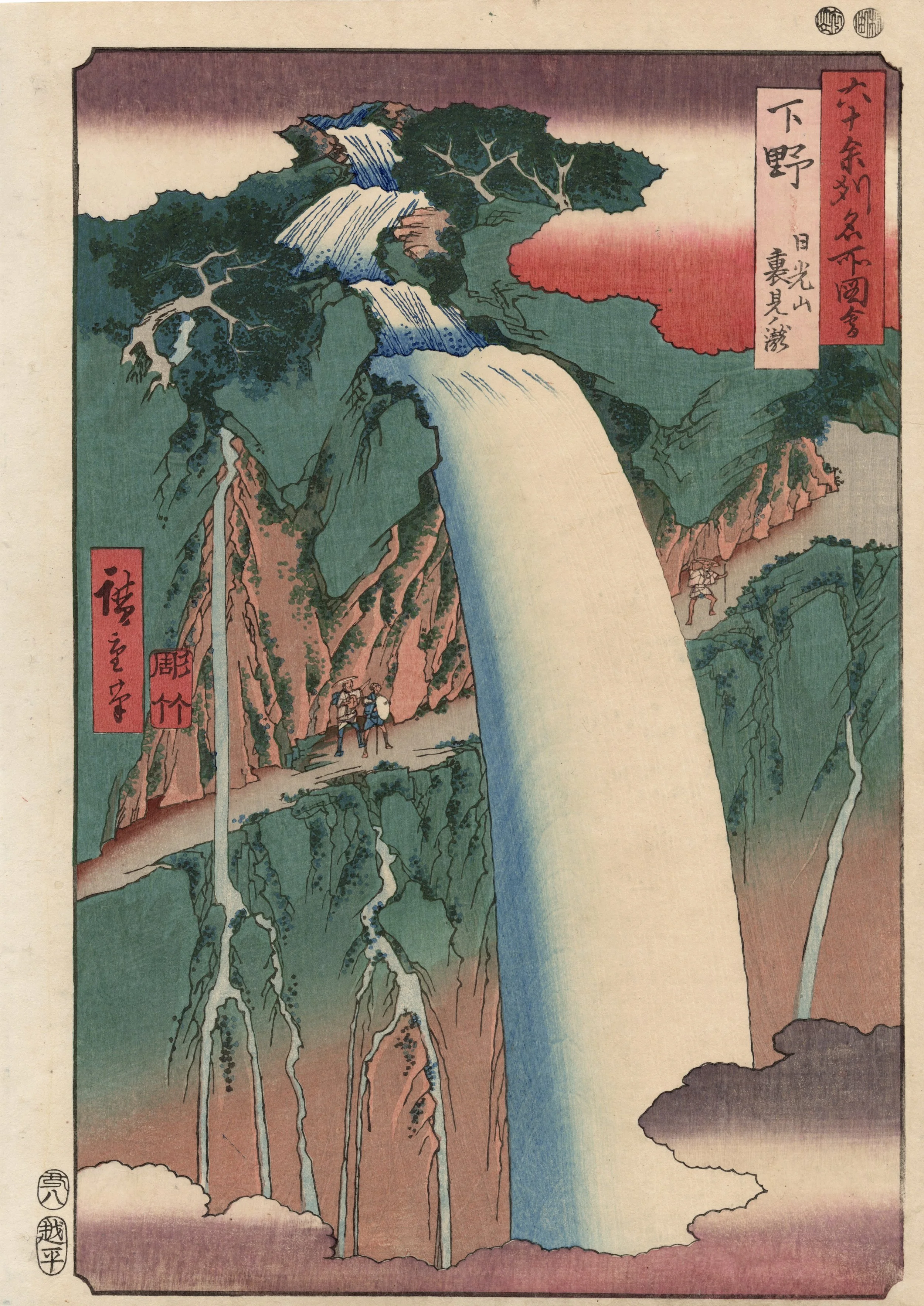
Urami Waterfall in Mount Nikko is known as the “backward-viewing falls” for the simple reason, as wonderfully portrayed here by Hiroshige, that you could walk behind the cascading water. It is 45-meters high and was a favorite of Ukiyoe designers, including this view by Eisen. Indeed, waterfalls were a favorite subject in Ukiyoe, and a natural phenomenon that was common in Japan due to the country’s mountainous, vertical topography.

This print comes from Hiroshige’s “Famous Views of the 60-Odd Provinces” from 1853-55, which includes two waterfall views, the other being Mino Province: Yōrō Waterfall.

These are considered among the best two designs of this series, with the plunging water creating bold and modern compositions. Hiroshige’s water is smooth and deceptively simple, while Eisen’s, for example, is jagged with splashes and currents. The vertical tate-e format that Hiroshige and his publisher chose for this series allowed him to accentuate the falls’ height.

Hiroshige further exaggerated the height by shrinking the tiny travelers journeying behind the water. One can only imagine the rush of venturing behind that thundering, plunging current.

溪斋英泉在描绘《里见之泷》时,醉心于表现游客从瀑布背后岩穴向外观望的奇特视角。然而,歌川广重在这幅作品中,却选择从侧面切入,将瀑布还原为一种更具物理力量的形态。

与养老瀑布那种绝对的垂直感不同,此处的里见之瀑呈现出一种带有惯性的抛物线弧度。广重将飞流直下的水幕简化为一段厚实、略向右倾斜的白色色块。这道弧线不仅确立了画面的动势,更像是一柄利刃,从视觉上强行切开了日光山层叠的岩壁。

画面的趣味在于空间的重叠与掩映。巨大的主瀑布如同一道屏障,遮挡了后方的部分山道,而山道上低头行走的渺小旅人,在厚重的水幕后方若隐若现,这种对比反而比直观的描绘更能反衬出瀑布的规模。在主瀑布后的阴影处,广重还点缀了几缕细流,它们与倾斜的主流形成了视觉上的交错,勾勒出日光山谷那种乱石嶙峋的层次感。

广重无意去复刻那种追求奇巧的视觉快感,而是利用大面积的留白与山石的色彩挤压,营造出一种冷峻的秩序感。如果说《养老之泷》是关于纯粹垂直的实验,那么这幅《里见之泷》则是利用弧线与遮挡关系,在方寸之间定格了日光山最神韵的一面。

Interested in purchasing?
Please contact
us.

歌川広重 Utagawa Hiroshige (1797-1858)

六十余州名所图会 下野 日光山里见之泷
Shimotsuke Province, Urami Waterfall, from the series of Famous Places in the Sixty-Odd Provinces

1853

木版画 | 纵绘大判 | 36.6cm x 26cm
Woodblock-print | Oban tate-e | 36.6cm x 26cm

非常早期的版次;颜色鲜艳;整体品相完好;非常轻微地黄化;下方边缘经轻微修剪
Fine impression and color; very slight toning; slightly trimmed at the bottom edge, otherwise in good condition

$7,588

Urami Waterfall in Mount Nikko is known as the “backward-viewing falls” for the simple reason, as wonderfully portrayed here by Hiroshige, that you could walk behind the cascading water. It is 45-meters high and was a favorite of Ukiyoe designers, including this view by Eisen. Indeed, waterfalls were a favorite subject in Ukiyoe, and a natural phenomenon that was common in Japan due to the country’s mountainous, vertical topography.

This print comes from Hiroshige’s “Famous Views of the 60-Odd Provinces” from 1853-55, which includes two waterfall views, the other being Mino Province: Yōrō Waterfall.

These are considered among the best two designs of this series, with the plunging water creating bold and modern compositions. Hiroshige’s water is smooth and deceptively simple, while Eisen’s, for example, is jagged with splashes and currents. The vertical tate-e format that Hiroshige and his publisher chose for this series allowed him to accentuate the falls’ height.

Hiroshige further exaggerated the height by shrinking the tiny travelers journeying behind the water. One can only imagine the rush of venturing behind that thundering, plunging current.

溪斋英泉在描绘《里见之泷》时,醉心于表现游客从瀑布背后岩穴向外观望的奇特视角。然而,歌川广重在这幅作品中,却选择从侧面切入,将瀑布还原为一种更具物理力量的形态。

与养老瀑布那种绝对的垂直感不同,此处的里见之瀑呈现出一种带有惯性的抛物线弧度。广重将飞流直下的水幕简化为一段厚实、略向右倾斜的白色色块。这道弧线不仅确立了画面的动势,更像是一柄利刃,从视觉上强行切开了日光山层叠的岩壁。

画面的趣味在于空间的重叠与掩映。巨大的主瀑布如同一道屏障,遮挡了后方的部分山道,而山道上低头行走的渺小旅人,在厚重的水幕后方若隐若现,这种对比反而比直观的描绘更能反衬出瀑布的规模。在主瀑布后的阴影处,广重还点缀了几缕细流,它们与倾斜的主流形成了视觉上的交错,勾勒出日光山谷那种乱石嶙峋的层次感。

广重无意去复刻那种追求奇巧的视觉快感,而是利用大面积的留白与山石的色彩挤压,营造出一种冷峻的秩序感。如果说《养老之泷》是关于纯粹垂直的实验,那么这幅《里见之泷》则是利用弧线与遮挡关系,在方寸之间定格了日光山最神韵的一面。

Interested in purchasing?
Please contact
us.

Utagawa Hiroshige (1797-1858)

Ando Hiroshige (1897-1858) revolutionized the art of landscape prints during the Edo era, building on the success of his senior, Hokusai, but taking a more poetic and naturalist approach to portraying the beauty of Japan.

The son of a low-level Samurai assigned to the fire brigade in Edo, Hiroshige became a student of the Utagawa school as a young man. His first prints focused on beautiful women (bijin), and views of Edo. But in 1833 he began work on his most famous early work, his first series depicting the Tokaido, the "Great Sea Road" between Edo and Tokyo.

Today there is some controversy about this series. Initially, it was believed that Hiroshige had travelled the route along with a local lord (Daimyo) who was making a gift of horses to the Emperor. But more recent scholarship suggests Hiroshige never travelled the road himself, at least not the entire way, and made his designs using published guidebooks.

Nonetheless, the prints were wonderful and revolutionary. They embraced the seasons with a gentle lyricism missing from Hokusai's striking but stylized depictions. In Hiroshige's work, nature is sacred -- but it is always mixed with humanity, with travelers or little inns or bridges. There is a magical harmony between man and the elements.

His depiction of the seasons and weather is especially evocative. Snow blankets some views with a hushed silence, while rain streaks down furiously in others. In some prints natured is agitated; in others, calm prevails. Produced in a horizontal oban yoko-e format, the series was a smash hit.

The Tokaido series made Hiroshige famous, and he became incredible prolific. In the 1840s he produced many strong designs, but many mediocre ones, too, including several subsequent Tokaido series of varying quality.

In 1853, however, he made a big step. He turned his landscapes sideways, embracing a bold vertical oban tate-e format. This gave his designs new energy and a modern feel. The first of these was Famous Views of the Sixty-Odd Provinces. From them on, most of his most noted series were executed in this format.

He saved his greatest for his last. In 1856 he began work on 100 Famous Views of Edo, which many consider his most exceptional work. Here his home city was portrayed with energy and passion, and in these 119 designs he created an incredible record of a vanished place. In addition to the striking vertical format, he developed exciting new compositions, often juxtaposing a strong foreground element with a distant background.

Among the many famous images in this series are Squall at Ohashi and the Plum Garden in Komeido. Both of these were copied by Vincent Van Gogh, a great admirer of Hiroshige. Thus, the great Japanese artist had a profound effect on Western art.

Alas, his beloved Edo ended his life. Hiroshige was claimed by a cholera epidemic that swept the city in 1958. His pupil Shigenobu, who took the name Hiroshige II, completed The Famous Views of Edo.