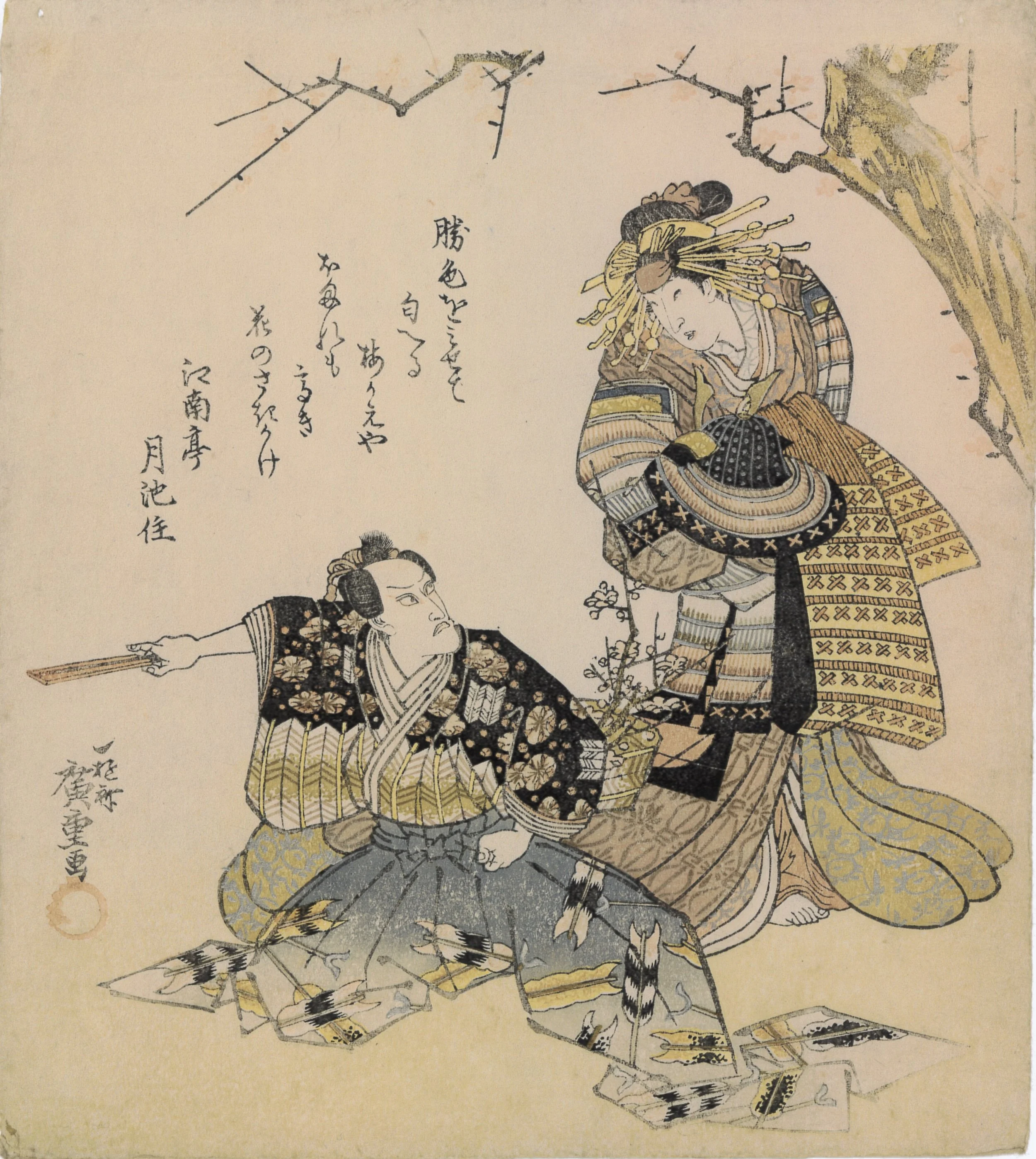
Hiroshige | The actors Ichikawa Danjuro VII as Kajiwara Genta Kagesue and Ichikawa Monnosuke III as Umegae

$0.00
Sold

歌川広重 Utagawa Hiroshige (1797-1858)

摺物绘:七代目市川团十郎 饰 梶原源太景季, 三代目市川门之助 饰 梅枝
Surimono: The actors Ichikawa Danjuro VII as Kajiwara Genta Kagesue and Ichikawa Monnosuke III as Umegae

1821

木版画 | 21cm × 18.5 cm
Woodblock | 21cm x 18.5cm

早期版次;颜色鲜艳;品相非常好
Fine impression, color and condition

Shono. Kambara. Sudden Shower over Shin-Ohashi, The Plum Garden at Kameido.

These are some of the greatest Japanese prints ever produced – perhaps some of the greatest works of art ever produced on the planet – and they all came from the skillful hand of Utagawa Hiroshige, the great Ukiyo-e master of landscapes. Vincent van Vogh was so in awe of the last two that he copied them. One could thus say that Hiroshige’s bold compositions and modern pictural sense had an impact on representational art forevermore.

But Hiroshige did not spring fully formed into the Ukiyoe world. Like all artists, he started small, in obscurity, and clawed his way up the ladder.

Here we see a remarkable example of one of Hiroshige’s earliest works, one that to the untrained eye bears little resemblance to those later masterpieces. He was 24 when it was published. It is a surimono, a privately produced print, depicting the famous kabuki actors Ichikawa Danjuro VII and Ichikawa Monnosuke III. Above their heads dances a 31-syllable kyoka, or comic poem. (It roughly translates as “mad verse.”)

Kyoka were created by merchants, samurai and artisans who would gather in parties to read each others’ works, which were then printed privately and given as gifts for New Years. They are small and exquisitely fine.

The scholar Jim Dwinger writes in “Hiroshige: Nature and the City” that “there is growing acceptance among scholars that the roots of Hiroshige’s artistic career resident in the work of kyōka.” Dwinger also points out that Hiroshige’s early figure portraits, especially those of bijin, bore a striking resemblance to the works of Eisen and Kunisada. (In this image, the female character is played by a man, as was the case in all Kabuki.)

Look above the actors’ heads: Do we see the branches of a plum tree that remind us of The Plum Garden at Kameido? Perhaps so. This great talent was on his way.

For the Hiroshige completist, this surimono is a rare find indeed, the work of the great artist as a young man.

摺物绘是浮世绘中最优雅、最奢华的一个特殊品类。江户时代,富有的商人和文化人群体有组建诗社的社交习惯,他们定期聚会并分享创作的“狂歌”。主办者会收集会员的作品,邀请画师按文字内容作画,这种带有诗歌的单幅“定制”画作就是“摺物绘”,通常会在事后分发给会员,会员又再分赠友人,作为自己财力、文化素养、品味、社会阶级的表现。

摺物绘与普通浮世绘不同,通常为色纸判(20.5cm X 18.5cm),尺寸远比常见的浮世绘要小。画中文字部分为狂歌,画面主体多为静物,也有役者绘、美人画等较为传统的浮世绘题材,但更为少见。摺物绘并不公开销售,因此制作数量很小,流传至今的数量更加稀少。它代表着会员的经济与社会地位,往往会聘请第一流的画师,在制作上不惜代价,因此每一张都身价不菲,有着更高的稀缺性和完成度。

这幅画出自著名的风景画大师歌川广重之手,他一生创作过的摺物绘数量本就不多,役者绘主体的摺物绘更是少之又少。事实上广重只有在创作生涯初期画过一些役者绘,此后完全将重心转移到了风景画、美人画和花鸟画上,这幅画可谓有着双重“罕见光环”。画中所画的是以平安末期武将梶原源太景季为蓝本创作的歌舞伎故事,左侧的男性就是由当时的人气演员七代目市川团十郎饰演的男主角,典型的武士装扮和衣服上的箭羽花样也在强调他的身份。右侧则是三代目市川门之助饰演的女主角梅枝,两人之间的梅花和右上角的梅树都是人物身份的重要提示。

作为摺物绘,本作在制作上亦不惜成本,使用了云母、金银箔与空摺等工艺,使画面在光线变化下呈现出细腻而内敛的层次感。这些高成本技法并非用于张扬,而是服务于私密欣赏的雅玩语境,也正是摺物绘区别于一般浮世绘的重要特征之一。

Interested in purchasing?
Please contact us.

歌川広重 Utagawa Hiroshige (1797-1858)

摺物绘:七代目市川团十郎 饰 梶原源太景季, 三代目市川门之助 饰 梅枝
Surimono: The actors Ichikawa Danjuro VII as Kajiwara Genta Kagesue and Ichikawa Monnosuke III as Umegae

1821

木版画 | 21cm × 18.5 cm
Woodblock | 21cm x 18.5cm

早期版次;颜色鲜艳;品相非常好
Fine impression, color and condition

Shono. Kambara. Sudden Shower over Shin-Ohashi, The Plum Garden at Kameido.

These are some of the greatest Japanese prints ever produced – perhaps some of the greatest works of art ever produced on the planet – and they all came from the skillful hand of Utagawa Hiroshige, the great Ukiyo-e master of landscapes. Vincent van Vogh was so in awe of the last two that he copied them. One could thus say that Hiroshige’s bold compositions and modern pictural sense had an impact on representational art forevermore.

But Hiroshige did not spring fully formed into the Ukiyoe world. Like all artists, he started small, in obscurity, and clawed his way up the ladder.

Here we see a remarkable example of one of Hiroshige’s earliest works, one that to the untrained eye bears little resemblance to those later masterpieces. He was 24 when it was published. It is a surimono, a privately produced print, depicting the famous kabuki actors Ichikawa Danjuro VII and Ichikawa Monnosuke III. Above their heads dances a 31-syllable kyoka, or comic poem. (It roughly translates as “mad verse.”)

Kyoka were created by merchants, samurai and artisans who would gather in parties to read each others’ works, which were then printed privately and given as gifts for New Years. They are small and exquisitely fine.

The scholar Jim Dwinger writes in “Hiroshige: Nature and the City” that “there is growing acceptance among scholars that the roots of Hiroshige’s artistic career resident in the work of kyōka.” Dwinger also points out that Hiroshige’s early figure portraits, especially those of bijin, bore a striking resemblance to the works of Eisen and Kunisada. (In this image, the female character is played by a man, as was the case in all Kabuki.)

Look above the actors’ heads: Do we see the branches of a plum tree that remind us of The Plum Garden at Kameido? Perhaps so. This great talent was on his way.

For the Hiroshige completist, this surimono is a rare find indeed, the work of the great artist as a young man.

摺物绘是浮世绘中最优雅、最奢华的一个特殊品类。江户时代,富有的商人和文化人群体有组建诗社的社交习惯,他们定期聚会并分享创作的“狂歌”。主办者会收集会员的作品,邀请画师按文字内容作画,这种带有诗歌的单幅“定制”画作就是“摺物绘”,通常会在事后分发给会员,会员又再分赠友人,作为自己财力、文化素养、品味、社会阶级的表现。

摺物绘与普通浮世绘不同,通常为色纸判(20.5cm X 18.5cm),尺寸远比常见的浮世绘要小。画中文字部分为狂歌,画面主体多为静物,也有役者绘、美人画等较为传统的浮世绘题材,但更为少见。摺物绘并不公开销售,因此制作数量很小,流传至今的数量更加稀少。它代表着会员的经济与社会地位,往往会聘请第一流的画师,在制作上不惜代价,因此每一张都身价不菲,有着更高的稀缺性和完成度。

这幅画出自著名的风景画大师歌川广重之手,他一生创作过的摺物绘数量本就不多,役者绘主体的摺物绘更是少之又少。事实上广重只有在创作生涯初期画过一些役者绘,此后完全将重心转移到了风景画、美人画和花鸟画上,这幅画可谓有着双重“罕见光环”。画中所画的是以平安末期武将梶原源太景季为蓝本创作的歌舞伎故事,左侧的男性就是由当时的人气演员七代目市川团十郎饰演的男主角,典型的武士装扮和衣服上的箭羽花样也在强调他的身份。右侧则是三代目市川门之助饰演的女主角梅枝,两人之间的梅花和右上角的梅树都是人物身份的重要提示。

作为摺物绘,本作在制作上亦不惜成本,使用了云母、金银箔与空摺等工艺,使画面在光线变化下呈现出细腻而内敛的层次感。这些高成本技法并非用于张扬,而是服务于私密欣赏的雅玩语境,也正是摺物绘区别于一般浮世绘的重要特征之一。

Interested in purchasing?
Please contact us.

Utagawa Hiroshige (1797-1858)

Ando Hiroshige (1897-1858) revolutionized the art of landscape prints during the Edo era, building on the success of his senior, Hokusai, but taking a more poetic and naturalist approach to portraying the beauty of Japan.

The son of a low-level Samurai assigned to the fire brigade in Edo, Hiroshige became a student of the Utagawa school as a young man. His first prints focused on beautiful women (bijin), and views of Edo. But in 1833 he began work on his most famous early work, his first series depicting the Tokaido, the "Great Sea Road" between Edo and Tokyo.

Today there is some controversy about this series. Initially, it was believed that Hiroshige had travelled the route along with a local lord (Daimyo) who was making a gift of horses to the Emperor. But more recent scholarship suggests Hiroshige never travelled the road himself, at least not the entire way, and made his designs using published guidebooks.

Nonetheless, the prints were wonderful and revolutionary. They embraced the seasons with a gentle lyricism missing from Hokusai's striking but stylized depictions. In Hiroshige's work, nature is sacred -- but it is always mixed with humanity, with travelers or little inns or bridges. There is a magical harmony between man and the elements.

His depiction of the seasons and weather is especially evocative. Snow blankets some views with a hushed silence, while rain streaks down furiously in others. In some prints natured is agitated; in others, calm prevails. Produced in a horizontal oban yoko-e format, the series was a smash hit.

The Tokaido series made Hiroshige famous, and he became incredible prolific. In the 1840s he produced many strong designs, but many mediocre ones, too, including several subsequent Tokaido series of varying quality.

In 1853, however, he made a big step. He turned his landscapes sideways, embracing a bold vertical oban tate-e format. This gave his designs new energy and a modern feel. The first of these was Famous Views of the Sixty-Odd Provinces. From them on, most of his most noted series were executed in this format.

He saved his greatest for his last. In 1856 he began work on 100 Famous Views of Edo, which many consider his most exceptional work. Here his home city was portrayed with energy and passion, and in these 119 designs he created an incredible record of a vanished place. In addition to the striking vertical format, he developed exciting new compositions, often juxtaposing a strong foreground element with a distant background.

Among the many famous images in this series are Squall at Ohashi and the Plum Garden in Komeido. Both of these were copied by Vincent Van Gogh, a great admirer of Hiroshige. Thus, the great Japanese artist had a profound effect on Western art.

Alas, his beloved Edo ended his life. Hiroshige was claimed by a cholera epidemic that swept the city in 1958. His pupil Shigenobu, who took the name Hiroshige II, completed The Famous Views of Edo.