Hiroshige | The Sumida River Embankment in Edo, 36 Views of Mt Fuji

$0.00

歌川広重 Utagawa Hiroshige (1797-1858)

富士三十六景  东都隅田堤
The Sumida River Embankment in Edo, from the series of Thirty-six Views of Mount Fuji

1858

木版画 | 纵绘大判 | 37.5cm x 25.6cm
Woodblock-print | Oban tate-e | 37.5cm x 25.6cm

早期的版次;颜色鲜艳;品相非常好
Fine impression, color and condition

$4,888

Even today, on a clear afternoon, with no haze, you can catch a peek of Fuji San between the skyscrapers of Tokyo if you are lucky. So it was in Edo times, though landscape artists tended to indulge in a little artistic license and make the mountain appear bigger than it was in reality.

That’s what Hiroshige has done here, in this fine design from his last great series, “36 Views of Mt. Fuji.” It was a fitting finale for him, closing the loop on the great era of Ukiyoe landscapes that began roughly 28 years earlier, with Hokusai’s seminal series of the same name.

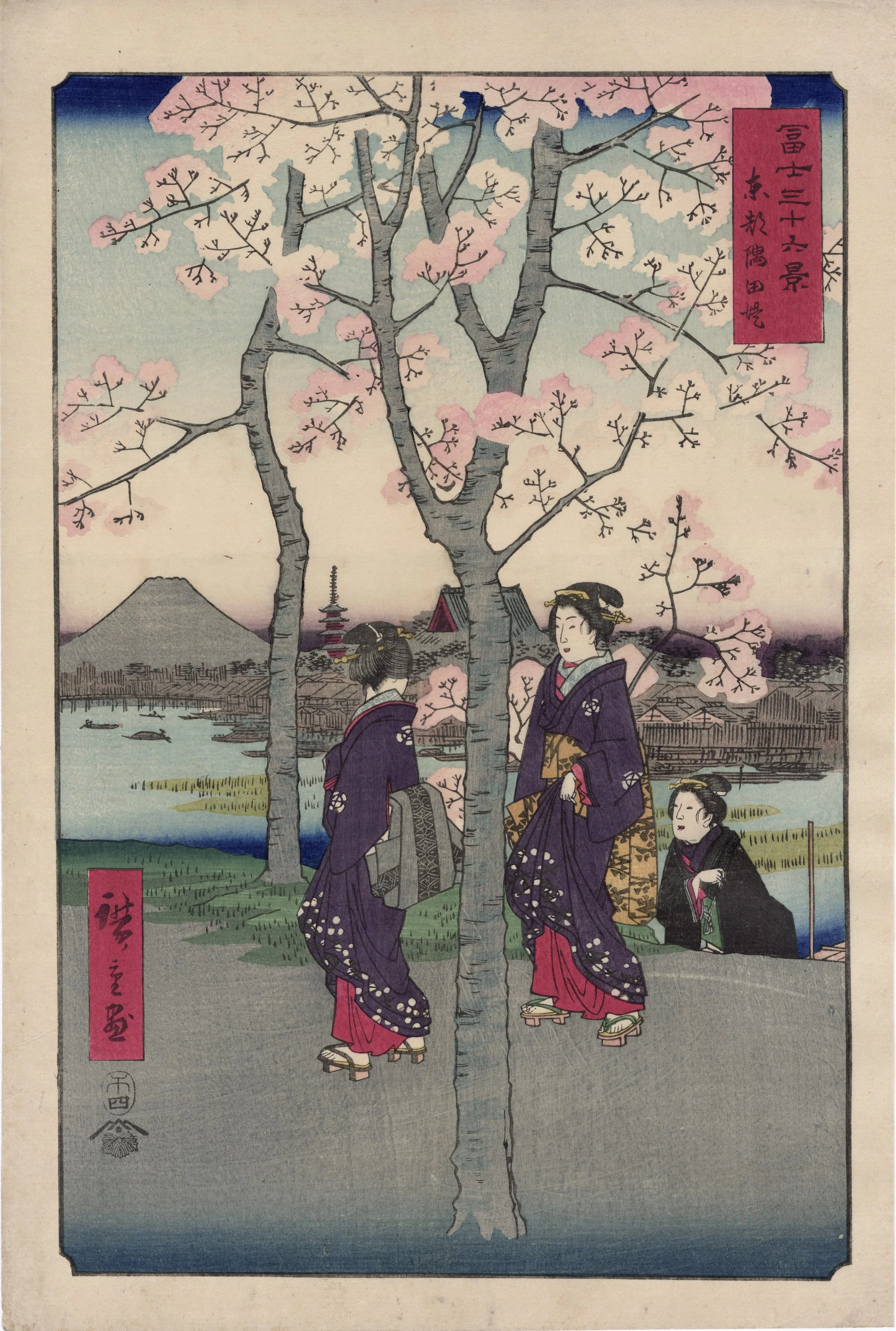
Here we see two Geishas enjoying a spring breeze of the Sumida River, with cherry blossoms above them and a purple sunset in the distance, framing the great mountain and echoing the rich purple of their kimonos. The elegant trunks of the tress bisect the composition and the horizontal line of the far shore, which includes the Kinryūsan Temple complex in Asakusa, featured in many other great woodblock prints, including this famous example from just a few years earlier.

The lavish use of purple in this print is especially interesting to contemplate. This was a pigment that faded to blue quickly, we can we tell that this is a very early impression. The reds are rich and, as a bonus, the margins are expansive.

即便到了如今,空气通透无雾的晴朗午后,运气好的话,仍能在东京林立的高楼之间,瞥见富士山的身影。江户时代的人们亦是如此。不过风景画师们常会加入艺术化的夸张手法,让富士山看起来比实际更加巍峨壮阔。

广重这幅佳作亦是如此,出自他晚年巅峰系列《富士三十六景》。这套作品成为他创作生涯的完美收尾,也为浮世绘风景画的黄金时代画上句号。约莫二十八年前,北斋以同名经典系列开启了这一时代,至此首尾呼应、圆满落幕。

画面中,两名艺妓漫步在隅田堤的樱花树下,两名身着深紫和服的女子走在前景,还有一人在右侧休憩。枝头樱花盛放,远山的淡紫晕染,恰好呼应了和服的深紫色调。前景的堤岸路面做了浅灰处理,引导视线自然落向远景的富士山。秀挺的樱花树干纵向分割画面,远景的隅田川水面、浅草寺塔与屋舍清晰铺展,这座寺院频繁现身于各类经典浮世绘作品中。整幅作品将春日赏樱的日常闲情,与江户人对富士山的崇敬融为一体,是广重晚期市井风景的经典写照。

Interested in purchasing?
Please contact us.

歌川広重 Utagawa Hiroshige (1797-1858)

富士三十六景  东都隅田堤
The Sumida River Embankment in Edo, from the series of Thirty-six Views of Mount Fuji

1858

木版画 | 纵绘大判 | 37.5cm x 25.6cm
Woodblock-print | Oban tate-e | 37.5cm x 25.6cm

早期的版次;颜色鲜艳;品相非常好
Fine impression, color and condition

$4,888

Even today, on a clear afternoon, with no haze, you can catch a peek of Fuji San between the skyscrapers of Tokyo if you are lucky. So it was in Edo times, though landscape artists tended to indulge in a little artistic license and make the mountain appear bigger than it was in reality.

That’s what Hiroshige has done here, in this fine design from his last great series, “36 Views of Mt. Fuji.” It was a fitting finale for him, closing the loop on the great era of Ukiyoe landscapes that began roughly 28 years earlier, with Hokusai’s seminal series of the same name.

Here we see two Geishas enjoying a spring breeze of the Sumida River, with cherry blossoms above them and a purple sunset in the distance, framing the great mountain and echoing the rich purple of their kimonos. The elegant trunks of the tress bisect the composition and the horizontal line of the far shore, which includes the Kinryūsan Temple complex in Asakusa, featured in many other great woodblock prints, including this famous example from just a few years earlier.

The lavish use of purple in this print is especially interesting to contemplate. This was a pigment that faded to blue quickly, we can we tell that this is a very early impression. The reds are rich and, as a bonus, the margins are expansive.

即便到了如今,空气通透无雾的晴朗午后,运气好的话,仍能在东京林立的高楼之间,瞥见富士山的身影。江户时代的人们亦是如此。不过风景画师们常会加入艺术化的夸张手法,让富士山看起来比实际更加巍峨壮阔。

广重这幅佳作亦是如此,出自他晚年巅峰系列《富士三十六景》。这套作品成为他创作生涯的完美收尾,也为浮世绘风景画的黄金时代画上句号。约莫二十八年前,北斋以同名经典系列开启了这一时代,至此首尾呼应、圆满落幕。

画面中,两名艺妓漫步在隅田堤的樱花树下,两名身着深紫和服的女子走在前景,还有一人在右侧休憩。枝头樱花盛放,远山的淡紫晕染,恰好呼应了和服的深紫色调。前景的堤岸路面做了浅灰处理,引导视线自然落向远景的富士山。秀挺的樱花树干纵向分割画面,远景的隅田川水面、浅草寺塔与屋舍清晰铺展,这座寺院频繁现身于各类经典浮世绘作品中。整幅作品将春日赏樱的日常闲情,与江户人对富士山的崇敬融为一体,是广重晚期市井风景的经典写照。

Interested in purchasing?
Please contact us.

Utagawa Hiroshige (1797-1858)

Ando Hiroshige (1897-1858) revolutionized the art of landscape prints during the Edo era, building on the success of his senior, Hokusai, but taking a more poetic and naturalist approach to portraying the beauty of Japan.

The son of a low-level Samurai assigned to the fire brigade in Edo, Hiroshige became a student of the Utagawa school as a young man. His first prints focused on beautiful women (bijin), and views of Edo. But in 1833 he began work on his most famous early work, his first series depicting the Tokaido, the "Great Sea Road" between Edo and Tokyo.

Today there is some controversy about this series. Initially, it was believed that Hiroshige had travelled the route along with a local lord (Daimyo) who was making a gift of horses to the Emperor. But more recent scholarship suggests Hiroshige never travelled the road himself, at least not the entire way, and made his designs using published guidebooks.

Nonetheless, the prints were wonderful and revolutionary. They embraced the seasons with a gentle lyricism missing from Hokusai's striking but stylized depictions. In Hiroshige's work, nature is sacred -- but it is always mixed with humanity, with travelers or little inns or bridges. There is a magical harmony between man and the elements.

His depiction of the seasons and weather is especially evocative. Snow blankets some views with a hushed silence, while rain streaks down furiously in others. In some prints natured is agitated; in others, calm prevails. Produced in a horizontal oban yoko-e format, the series was a smash hit.

The Tokaido series made Hiroshige famous, and he became incredible prolific. In the 1840s he produced many strong designs, but many mediocre ones, too, including several subsequent Tokaido series of varying quality.

In 1853, however, he made a big step. He turned his landscapes sideways, embracing a bold vertical oban tate-e format. This gave his designs new energy and a modern feel. The first of these was Famous Views of the Sixty-Odd Provinces. From them on, most of his most noted series were executed in this format.

He saved his greatest for his last. In 1856 he began work on 100 Famous Views of Edo, which many consider his most exceptional work. Here his home city was portrayed with energy and passion, and in these 119 designs he created an incredible record of a vanished place. In addition to the striking vertical format, he developed exciting new compositions, often juxtaposing a strong foreground element with a distant background.

Among the many famous images in this series are Squall at Ohashi and the Plum Garden in Komeido. Both of these were copied by Vincent Van Gogh, a great admirer of Hiroshige. Thus, the great Japanese artist had a profound effect on Western art.

Alas, his beloved Edo ended his life. Hiroshige was claimed by a cholera epidemic that swept the city in 1958. His pupil Shigenobu, who took the name Hiroshige II, completed The Famous Views of Edo.