Hokuju | Senso-ji Temple at Kinryuzan, The Eastern Capital

$0.00

昇亭北壽 Shotei Hokuju (1763–1824)

东都金龙山浅草寺之图
Senso-ji Temple at Kinryuzan, from the series of The Eastern Capital

1818-30

木版画 | 横绘大判 | 25.4cm x 39cm
Woodblock-print | Oban yoko -e | 25.4cm x 39cm

早期版本版次;颜色鲜艳;局部纸张较薄处背面经加固处理
Fine edition, impression and color; several thin areas have been reinforced from the verso

$10,000

Shotei Hokuju, perhaps more than any other ukiyoe artist of his era, was fascinated with Western compositional forms, especially the use of perspective. Again and again he sought new ways to use it in his print designs, such as in this lovely view of Ryogoku from the same series. But in his view of Senso-ji Temple, one of Edo's most famous landmarks -- and one often depicted by ukiyoe artists both great and minor -- he even rearranged the placement of the buildings to satisfy his vision.

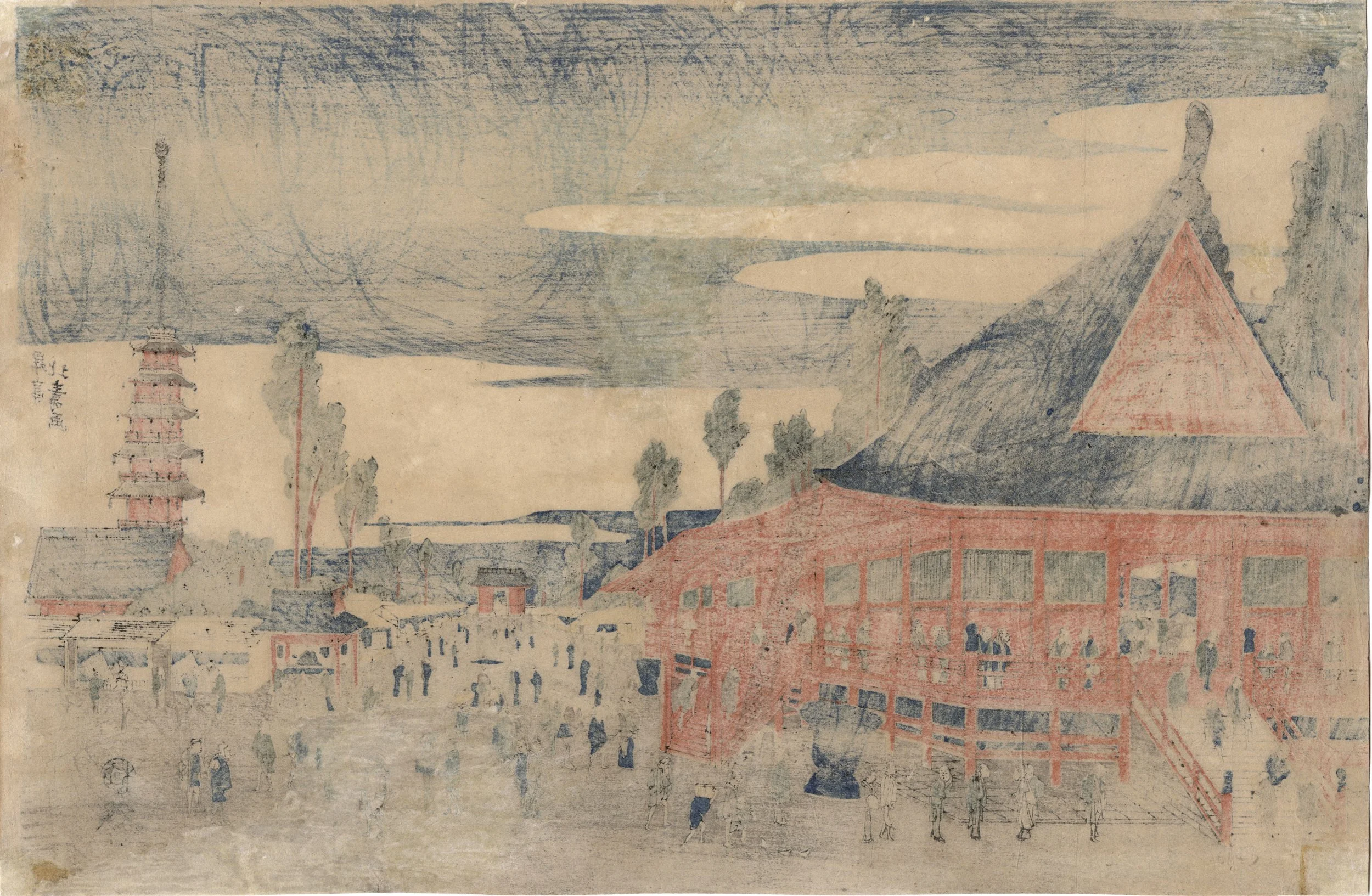
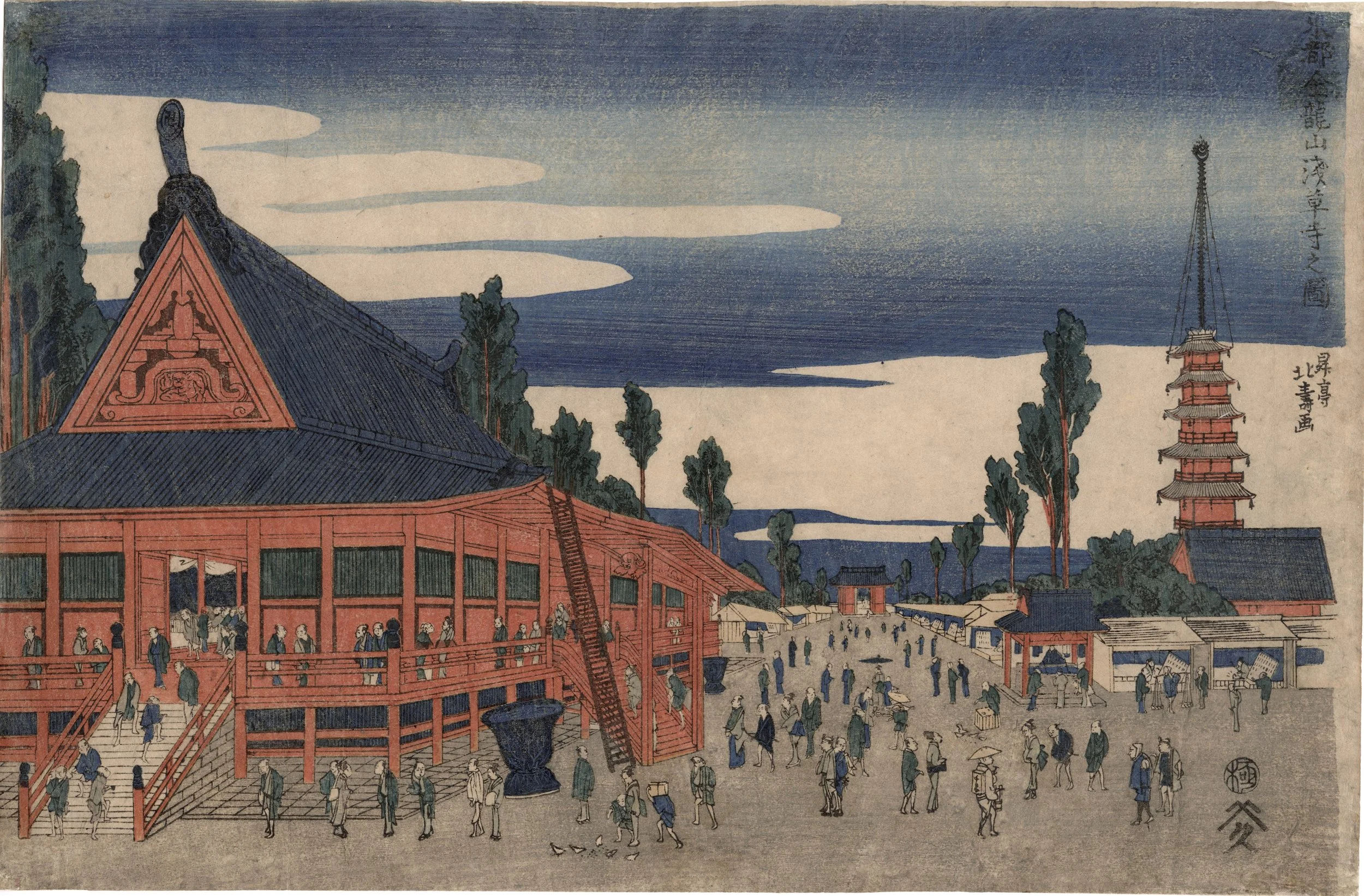
In "Senso-ji Temple on Kinryuzan in the Eastern Capital," the massive hall occupies the left foreground, with its deep blue roof stretching forward; the five-story pagoda stands far away at the other end. Worshippers move between the main hall, courtyards, and the shops along the way; they seem especially Lilliputian beneath the towering architecture and expansive sky.

The juxtaposition of the main hall and the pagoda creates a clear sense of depth, with the figures, trees and trinket- and food stalls gradually shrinking in the distance. In reality, all the buildings here are much closer together, and the people were bigger. And whereas Hokuju experimented often with Western-style cumulus clouds, here the clouds are so classically rendered that they could have sprung from a Chinese painting or a folding screen.

Hokuju certainly wasn’t the first artist to mess around with the landscaping of this storied temple complex in pursuit of composational perfection. In this famed print of the same grounds, Hiroshige took his own liberties. Way, way in the distance in Hokuju’s design we see the “thunder gate” that Hiroshige featured so prominently. Hokuju goes so far in the opposite direction that he basically shrinks it to an afterthought.

All in all, Western visual concepts meet a classic Edo site in this wonderful design.

 浅草寺是江户最著名的名所之一,也是浮世绘师反复描绘的题材。昇亭北寿却以一种颇为特别的方式重新安排了这片人们熟悉的风景。《东都金龙山浅草寺之图》创作于文政年间(1818–30),与《东都两国之风景》等作品同属他描绘江户名所的一组“东都”风景画。

画面中,巨大的本堂占据左侧近景,深蓝色的屋顶向前伸展;右侧的五重塔则远远立于另一端。两座建筑一近一远,视线沿着中间的参道一直延伸至远处。参拜者穿行于本堂、院落与沿途的商铺之间,人物虽多,却在宏大的建筑与天空之下显得格外渺小。

最引人注目的,是北寿对透视与色彩的运用。近处庞大的本堂与远处纤细的五重塔形成明显的纵深,人物也随着距离逐渐缩小。与此同时,北寿将近一半的画面留给天空,深蓝色由上而下逐渐变浅,大片白云横贯其间。浅草寺鲜明的朱红与天空浓重的深蓝几乎构成了整幅画最主要的两种色彩,这种鲜明的红蓝对比也成为了本作最突出的视觉特点之一。

类似的空间处理也出现在《东都两国之风景》中。在那幅作品中,北寿以极低的视点突出两国桥向远方延伸的长度;而在这里,他将巨大的本堂置于眼前,又把五重塔推向远处。西洋透视法到了北寿笔下,并不是简单地模仿西方绘画,而成为了他重新描绘江户风景的一种方式。

Interested in purchasing?
Please contact us.

昇亭北壽 Shotei Hokuju (1763–1824)

东都金龙山浅草寺之图
Senso-ji Temple at Kinryuzan, from the series of The Eastern Capital

1818-30

木版画 | 横绘大判 | 25.4cm x 39cm
Woodblock-print | Oban yoko -e | 25.4cm x 39cm

早期版本版次;颜色鲜艳;局部纸张较薄处背面经加固处理
Fine edition, impression and color; several thin areas have been reinforced from the verso

$10,000

Shotei Hokuju, perhaps more than any other ukiyoe artist of his era, was fascinated with Western compositional forms, especially the use of perspective. Again and again he sought new ways to use it in his print designs, such as in this lovely view of Ryogoku from the same series. But in his view of Senso-ji Temple, one of Edo's most famous landmarks -- and one often depicted by ukiyoe artists both great and minor -- he even rearranged the placement of the buildings to satisfy his vision.

In "Senso-ji Temple on Kinryuzan in the Eastern Capital," the massive hall occupies the left foreground, with its deep blue roof stretching forward; the five-story pagoda stands far away at the other end. Worshippers move between the main hall, courtyards, and the shops along the way; they seem especially Lilliputian beneath the towering architecture and expansive sky.

The juxtaposition of the main hall and the pagoda creates a clear sense of depth, with the figures, trees and trinket- and food stalls gradually shrinking in the distance. In reality, all the buildings here are much closer together, and the people were bigger. And whereas Hokuju experimented often with Western-style cumulus clouds, here the clouds are so classically rendered that they could have sprung from a Chinese painting or a folding screen.

Hokuju certainly wasn’t the first artist to mess around with the landscaping of this storied temple complex in pursuit of composational perfection. In this famed print of the same grounds, Hiroshige took his own liberties. Way, way in the distance in Hokuju’s design we see the “thunder gate” that Hiroshige featured so prominently. Hokuju goes so far in the opposite direction that he basically shrinks it to an afterthought.

All in all, Western visual concepts meet a classic Edo site in this wonderful design.

 浅草寺是江户最著名的名所之一,也是浮世绘师反复描绘的题材。昇亭北寿却以一种颇为特别的方式重新安排了这片人们熟悉的风景。《东都金龙山浅草寺之图》创作于文政年间(1818–30),与《东都两国之风景》等作品同属他描绘江户名所的一组“东都”风景画。

画面中,巨大的本堂占据左侧近景,深蓝色的屋顶向前伸展;右侧的五重塔则远远立于另一端。两座建筑一近一远,视线沿着中间的参道一直延伸至远处。参拜者穿行于本堂、院落与沿途的商铺之间,人物虽多,却在宏大的建筑与天空之下显得格外渺小。

最引人注目的,是北寿对透视与色彩的运用。近处庞大的本堂与远处纤细的五重塔形成明显的纵深,人物也随着距离逐渐缩小。与此同时,北寿将近一半的画面留给天空,深蓝色由上而下逐渐变浅,大片白云横贯其间。浅草寺鲜明的朱红与天空浓重的深蓝几乎构成了整幅画最主要的两种色彩,这种鲜明的红蓝对比也成为了本作最突出的视觉特点之一。

类似的空间处理也出现在《东都两国之风景》中。在那幅作品中,北寿以极低的视点突出两国桥向远方延伸的长度;而在这里,他将巨大的本堂置于眼前,又把五重塔推向远处。西洋透视法到了北寿笔下,并不是简单地模仿西方绘画,而成为了他重新描绘江户风景的一种方式。

Interested in purchasing?
Please contact us.

Shotei Hokuju (1763–1824)

Was Shotei Hokuju, perhaps Hokusai’s most famous student, the stylistic father of… Pablo Picasso?

Not really, but in his uniquely conjured works, we see many hints of modern art, such as cubism and an almost abstract approach to landscapes and the humans who live within them. We also see many broader attributes of Western art, such as perspective, shadows and billowing clouds. These elements display a fertile artistic mind striving for something new. And all this is the early mid-period of Ukiyoe.

Hokuju is believed to have been born in 1763, and joined Hokusai’s studio around 1793. His most famous works – including “True Depiction of the Monkey Bridge In Kay Province” – predated the master’s most notable designs, though of course they never garnered as much fame.

This print includes Western-style clouds, and throughout his career, one example of Hokuju experimenting with Western concepts. Where he saw them is hard to determine, since they were banned in Edo-period Japan at the time, and one suspects the exposure to them was fleeting, because he didn’t quite master all the techniques, such as perspective and use of vanishing points.

But these imperfections only add to the pleasure of his work, capturing the moment when someone was happily wrestling with new ideas. He was not hugely prolific: in addition to prints, almost all of them landscapes, he designed surimono and at least one illustrated book.

Shotei Hokuju died in 1824.