Hokusai | Clear Autumn Weather on the Rainbow Embankment, Eight Views of the Ryukyu Islands

$0.00

葛飾北齋 Katsushika Hokusai(1760-1849)

琉球八景 长虹秋霁
Clear Autumn Weather on the Rainbow Embankment, from the series Eight Views of the Ryukyu Islands

1832

木版画 | 横绘大判 | 26cm x 38.2cm
Woodblock-print | Oban yoko -e | 26cm x 38.2cm

早期的版次;颜色鲜艳;整体品相非常好;极其轻微的中间折痕
Early impression; strong color; very slight centerfold, otherwise in very good condition.

PRICE ON REQUEST

In November of 1832, on the 16th day, a group of 200 visitors from the semi-autonomous Ryukyu Islands south of Japan marched through Edo to pay homage to the Shogun, and created a stir as they did so. With Japan closed to the West, these tourists were the closest most Edoites came to seeing foreigners, and there was widespread interest.

That visit inspired the publisher Moriya Jihei to commission Hokusai, then enjoying the success of “36 Views of Mount Fuji,” to create a series devoted to the island chain, even though he had never visited.

Hokusai referenced ancient texts and folk legends – and a good deal of his legendary imagination – to complete the series.

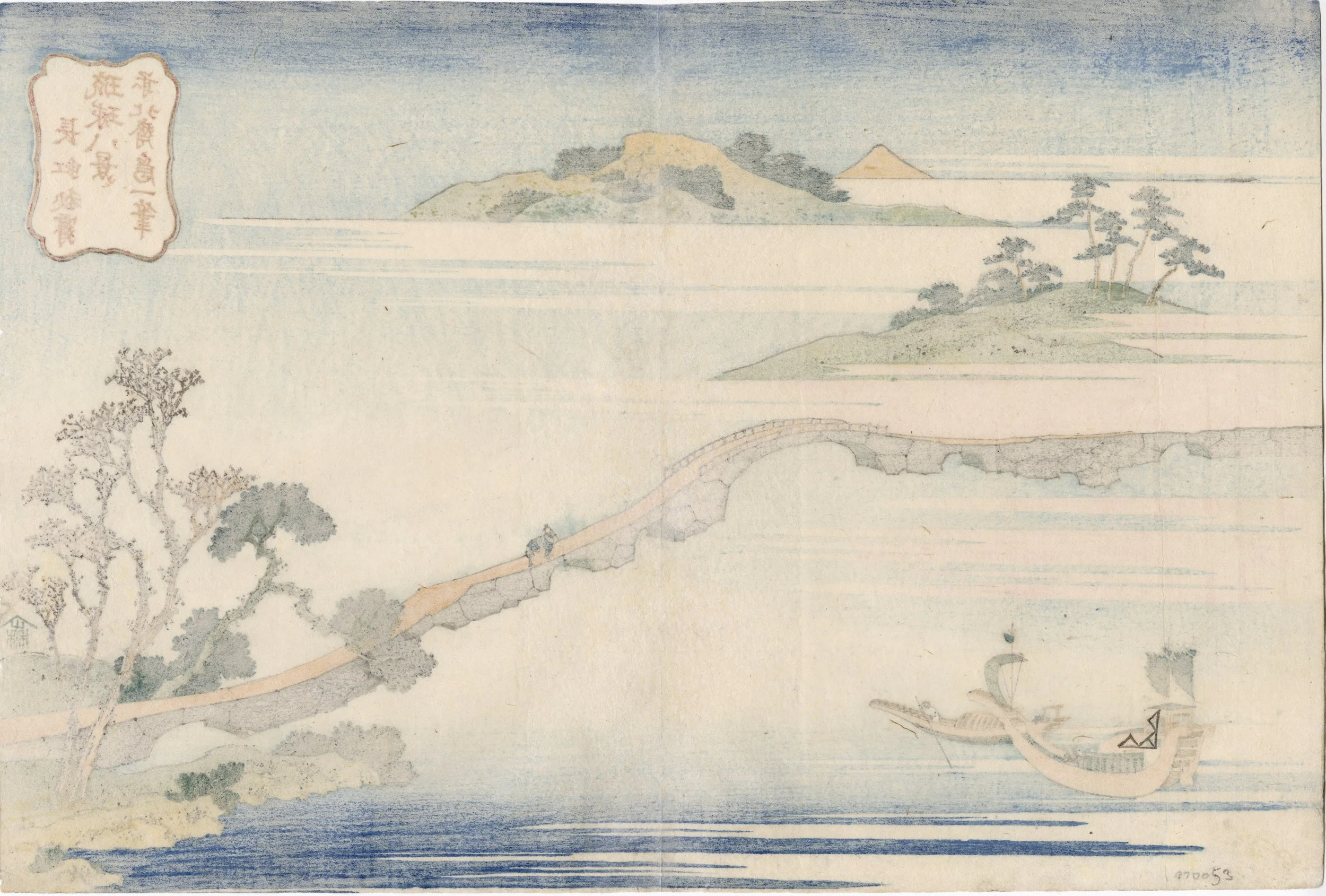
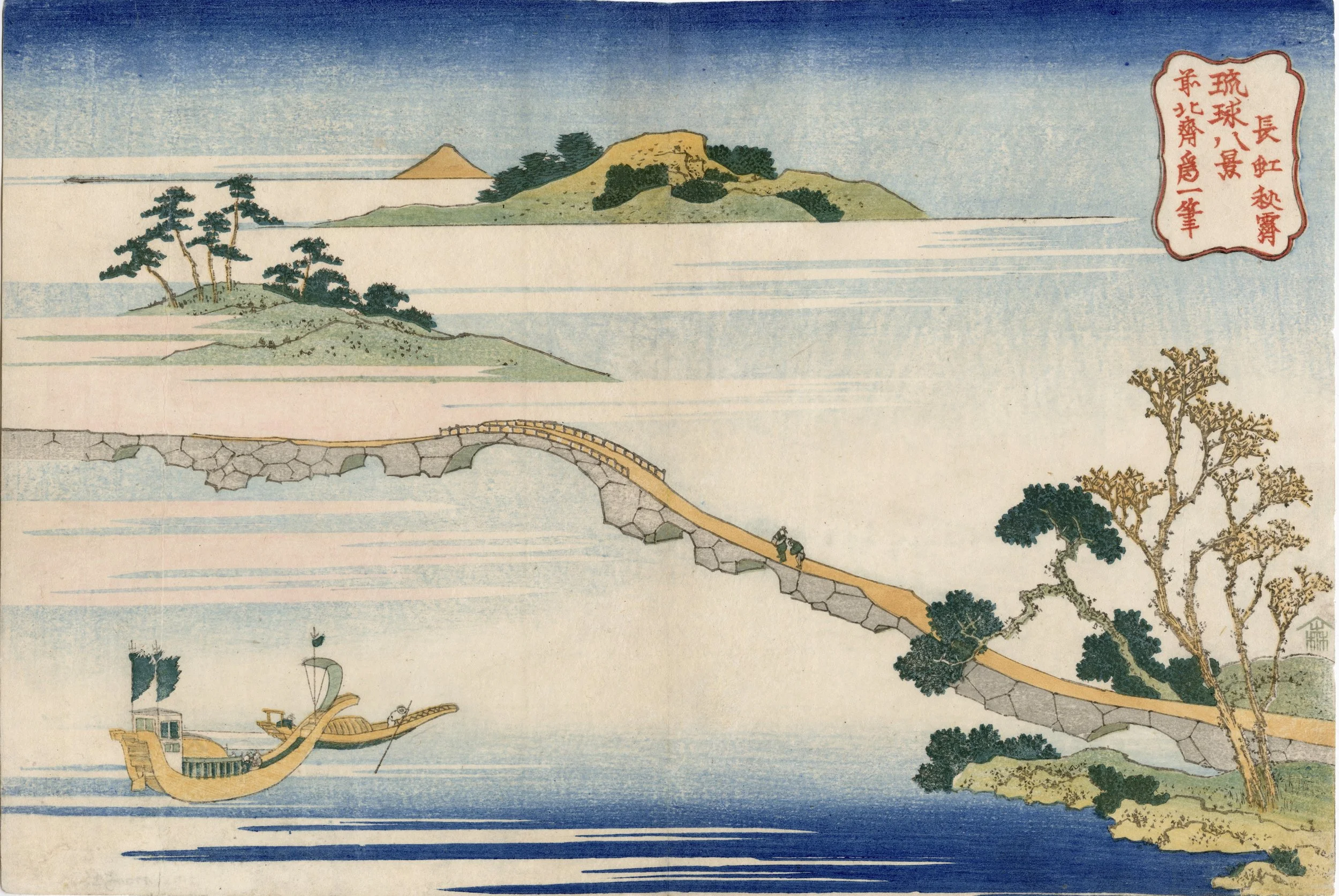
Here we see, in the distance, a cone-shaped mountain resembling Mount Fuji, a peak that does not exist in the Ryukyus. The design is almost all sky and sea, created with a healthy does of Prussian blue imported from the West. The gradient blues blend with autumn clouds and vast ocean waves, blurring the boundaries between heaven and earth, creating a vast, hazy autumn sky atmosphere.

On the water, two ancient and out-of-scale Chinese sailing junks drift on the clear waves, hinting at the ancient history of cross-sea trade between China and Ryukyu. The stone arch bridge and causeway stretching diagonally across the composition and being crossed by two pedestrians is the "Long Rainbow" of the title.

This print, which is in fine condition, is both a witness to Sino-Ryukuan trade and culture during the Edo period, and a classic work that allowed this creative genius to conjure foreign landscapes practically from thin air.

 本作属于北斋 1832 年创作的《琉球八景》系列版画,受当时江户琉球风物热潮影响,北斋参考古籍资料、民间传闻创作整套组画,终生无缘亲临琉球实地。

从未到过琉球的北斋靠传闻和史料想象为后世留下此作,画面远景矗立着形似富士山的锥形山岳,这座山峰在琉球本土实景里并不存在,是画家下意识将本土山岳审美融入异域景致的趣味细节。整幅画面以从西洋传入的普鲁士蓝铺陈水天,浓淡渐变的蓝调既是秋空流云,又是浩渺海波,苍茫水色模糊了天地边界,营造出辽阔空濛的秋日霁天氛围。

水面上两艘中式古帆船漂泊于碧波,在辽阔水天里如同枯叶,暗含古时中琉跨海通商的历史;斜向延伸的石拱桥便是题名里的长虹,桥面仅有两名行人,桥身蜿蜒隐入右侧林间,尽头伸向画外未知天地,留白悠远。

构图上北斋巧用西洋单点透视,长桥牵引视线层层递进,近树、中洲、远岛错落有致,融汇东方写意与西洋写实。依托史料辅以想象描摹异域风光的创作形式,让这幅作品意义特殊,既是江户时期中琉商贸文化交融的实物见证,也是北斋凭空描摹异国山河的经典之作。

Interested in purchasing?
Please contact us.

葛飾北齋 Katsushika Hokusai(1760-1849)

琉球八景 长虹秋霁
Clear Autumn Weather on the Rainbow Embankment, from the series Eight Views of the Ryukyu Islands

1832

木版画 | 横绘大判 | 26cm x 38.2cm
Woodblock-print | Oban yoko -e | 26cm x 38.2cm

早期的版次;颜色鲜艳;整体品相非常好;极其轻微的中间折痕
Early impression; strong color; very slight centerfold, otherwise in very good condition.

PRICE ON REQUEST

In November of 1832, on the 16th day, a group of 200 visitors from the semi-autonomous Ryukyu Islands south of Japan marched through Edo to pay homage to the Shogun, and created a stir as they did so. With Japan closed to the West, these tourists were the closest most Edoites came to seeing foreigners, and there was widespread interest.

That visit inspired the publisher Moriya Jihei to commission Hokusai, then enjoying the success of “36 Views of Mount Fuji,” to create a series devoted to the island chain, even though he had never visited.

Hokusai referenced ancient texts and folk legends – and a good deal of his legendary imagination – to complete the series.

Here we see, in the distance, a cone-shaped mountain resembling Mount Fuji, a peak that does not exist in the Ryukyus. The design is almost all sky and sea, created with a healthy does of Prussian blue imported from the West. The gradient blues blend with autumn clouds and vast ocean waves, blurring the boundaries between heaven and earth, creating a vast, hazy autumn sky atmosphere.

On the water, two ancient and out-of-scale Chinese sailing junks drift on the clear waves, hinting at the ancient history of cross-sea trade between China and Ryukyu. The stone arch bridge and causeway stretching diagonally across the composition and being crossed by two pedestrians is the "Long Rainbow" of the title.

This print, which is in fine condition, is both a witness to Sino-Ryukuan trade and culture during the Edo period, and a classic work that allowed this creative genius to conjure foreign landscapes practically from thin air.

 本作属于北斋 1832 年创作的《琉球八景》系列版画,受当时江户琉球风物热潮影响,北斋参考古籍资料、民间传闻创作整套组画,终生无缘亲临琉球实地。

从未到过琉球的北斋靠传闻和史料想象为后世留下此作,画面远景矗立着形似富士山的锥形山岳,这座山峰在琉球本土实景里并不存在,是画家下意识将本土山岳审美融入异域景致的趣味细节。整幅画面以从西洋传入的普鲁士蓝铺陈水天,浓淡渐变的蓝调既是秋空流云,又是浩渺海波,苍茫水色模糊了天地边界,营造出辽阔空濛的秋日霁天氛围。

水面上两艘中式古帆船漂泊于碧波,在辽阔水天里如同枯叶,暗含古时中琉跨海通商的历史;斜向延伸的石拱桥便是题名里的长虹,桥面仅有两名行人,桥身蜿蜒隐入右侧林间,尽头伸向画外未知天地,留白悠远。

构图上北斋巧用西洋单点透视,长桥牵引视线层层递进,近树、中洲、远岛错落有致,融汇东方写意与西洋写实。依托史料辅以想象描摹异域风光的创作形式,让这幅作品意义特殊,既是江户时期中琉商贸文化交融的实物见证,也是北斋凭空描摹异国山河的经典之作。

Interested in purchasing?
Please contact us.

Katsushika Hokusai (1760-1849)

In the annals of Ukiyo-e, no design is more iconic than “The Great Wave Off Kanagawa.”

This bold image of a gigantic, froth-tentacled wave enveloping both Mt. Fuji and crescent-shaped boats of huddled fishermen has burst out of the world of Japanese woodblock prints and into the mainstream of global culture. It appears on Swatch watches, in political ads, on record albums and yes, even on sexual devices. There are believed to be about 200 originals of them left on the planet. In March 2023, one sold in auction for $2.76 million, a record for Ukiyo-e. Meiji-era reprints can, absurdly, sell for as much as $5,000.

The fame of this undisputed masterpiece is a mixed blessing for lovers and collectors of Japanese woodblock prints. On the one hand, its notoriety brings attention to the form. But on the other it can take up all the oxygen in the room. New collectors chase it. But it can overshadow all the other arguably comparable masterworks by its creator – such as “Red Fuji” or “Rainstorm Beneath the Summit.”

And it can also overshadow its creator himself. And that would be a shame, for there are few characters more legendary, more prolific, more influential and more just all around interesting in the Ukiyo-e universe than Katsushika Hokusai.

Born in 1760 and living until 1849 – a long life in Edo times – he produced untold thousands of works, from intricate color prints to luxurious paintings to books upon books of drawings and sketches. His designs were boldly modern and instantly recognizable, in several cases deeply influencing Western art.

His voluminous sketchbooks are the clear forerunners of today’s manga comic books and Japanese animated movies. His lines were clever and precise. He was the subject of a major 2020 movie in Japan.

Alas, his personal life was a bit of a mess. Despite his fame, he often lived in squalor. Later in life, he referred to himself as “Old Man Mad About Drawing.”

Muneshige Narazaki, a scholar of Ukiyo-e, wrote:

Hokusai’s life spanned almost the whole of that golden age. His art progressed in gradual stages from the imitation of others to mature independence and the development of new forms, then went on to new heights while the form itself was lapsing into decadence, and finally survived to see itself become old-fashioned in its turn, and to be superseded.

He was born in Edo as Tokitaro Kawamura and was adopted by a mirror maker. Showing early promise, he studied with several Ukiyo-e greats, with varying levels of success. He’d changed his name repeatedly throughout his life. He began by doing designs for illustrated books.

His greatest series is undoubtably “36 Views of Mt. Fuji,” which was published by Yohachi from 1823 to 1832 and which includes “The Great Wave Off Kanazawa” as its centerpiece.

Many of the designs in this landmark series, which helped introduce the landscape genre to the thriving print marketplace, are exquisitely simple. It featured considerable use of Prussian Blue, just then introduced to Japan; the key blocks of the first 36 are in this pigment. I say “the first” because the series was so successful that 10 more were produced, and you can tell those designs because those key blocks are in black. So really, 46 Views of Mt. Fuji.

He followed up with three books of black-and-white only prints called “100 Views of Mount Fuji.” They are wonderful. Hokusai just couldn’t stop.

Until he did. Hokusai wanted to live to 100 years old but didn’t make it.

He had a daughter, Katsushika Oi, who worked as his assistant and turned out to be a talent in her own right. Some scholars have even attributed some of his works to her. And she had something in common with her more famous father: she was also the focus of a recent blockbuster movie in Japan.

Partial citation: Narazaki, Muneshige, Hokusai: Masterworks of Ukiyo-e (Kodansha; 1968); Marks, Andreas, Japanese Woodblock Prints, Artists, Publishers and Masterworks: 1680-1900 (Tuttle; 2010); Forrer, Matthi, Hokusai (Prestel; 2015)