Hokusai | Poem by Sarumaru Dayu, One Hundred Poems Explained by the Nurse

$0.00

葛飾北齋 Katsushika Hokusai(1760-1849)

百人一首 乳母かゑとき 猿丸太夫
Poem by Sarumaru Dayu, from the series of One Hundred Poems Explained by the Nurse

1839

木版画 | 横绘大判 | 26cm x 37.5cm
Woodblock-print | Oban yoko -e | 26cm x 37.5cm

早期的版次;颜色鲜艳;整体品相非常好;随年代而出现的一些小污渍;极其轻微的中间折痕
Early impression; strong color; oxidation; very slight centerfold; some minor soiling commensurate with age; otherwise in good condition.

PRICE ON REQUEST

The “Hundred Poems Explained by the Nurse” was the great Katsushika Hokusai’s final single-sheet color woodblock print series; after this, he focused on paintings and his sketchbooks. Only 27 designs were completed, although there are also quite a few preparatory drawings known. The idea was classic Hokusai – famous poems (still beloved in Japan today) were simplified, as if being retold by an uneducated wet nurse. This allowed for mildly comic errors and misinterpretations.

This, the fifth design in the series, is based on a poem by Sarumaru Dayu, who was believed to have been active around 700-715 and lived in the woods outside of Kyoto. According to the scholar Peter Morse, “Dayu” is a title given to a commoner who was skilled in a given field, suggesting Sarumaru was not highly educated but, rather, a natural-born talent. The poem captures the melancholy autumn beauty in the mountains he obviously knew so well:

In the mountain depths,

Treading through the crimson leaves,

Cries the wandering stag.

When I hear the lonely cry,

Sad -- how sad – the autumn is.

Morse, in Hokusai: One Hundred Poets (Braziller; 1989) says, “This is an absolutely perfect print in many ways.” Yes: so much of what we love about Hokusai is demonstrated here.

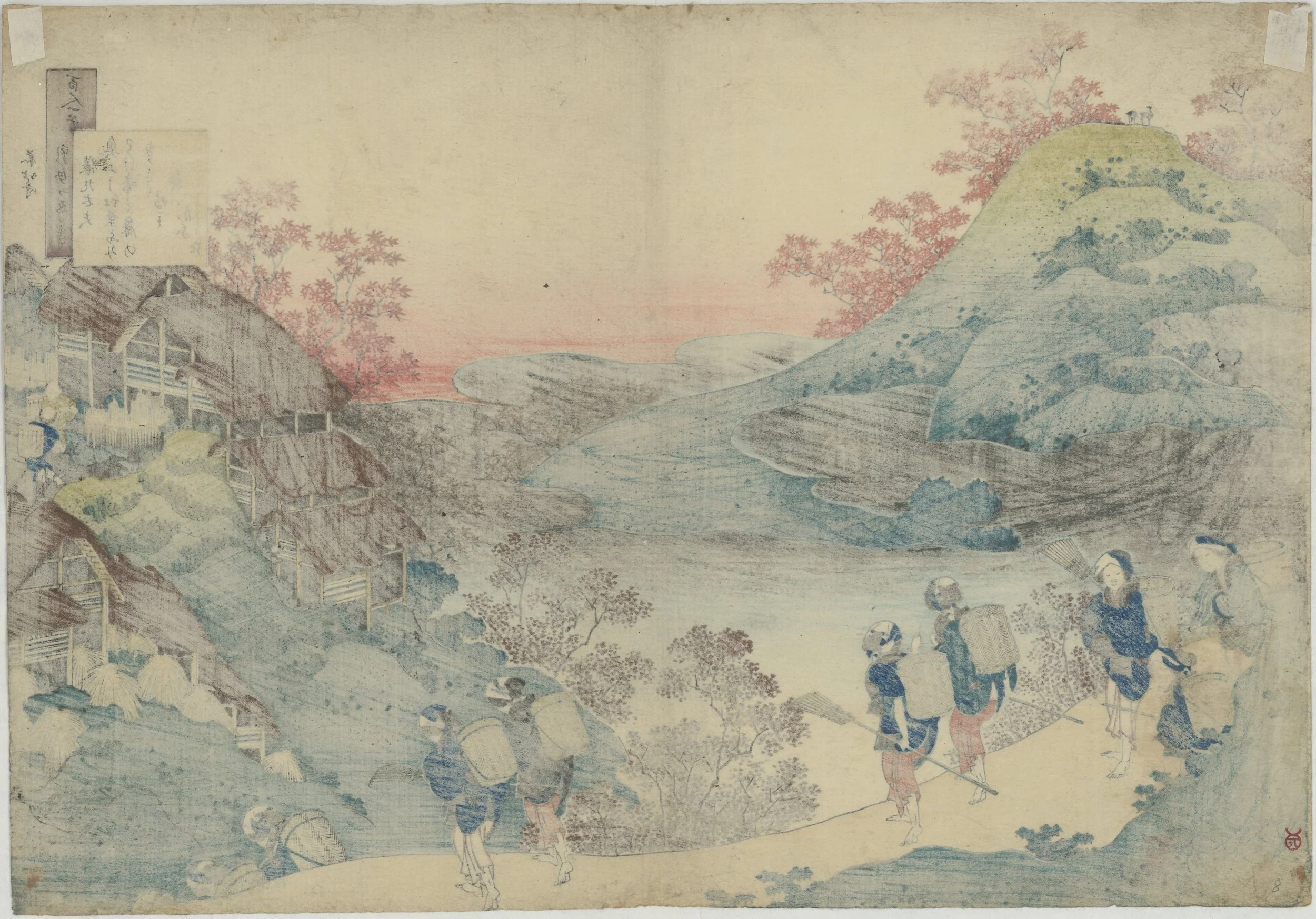
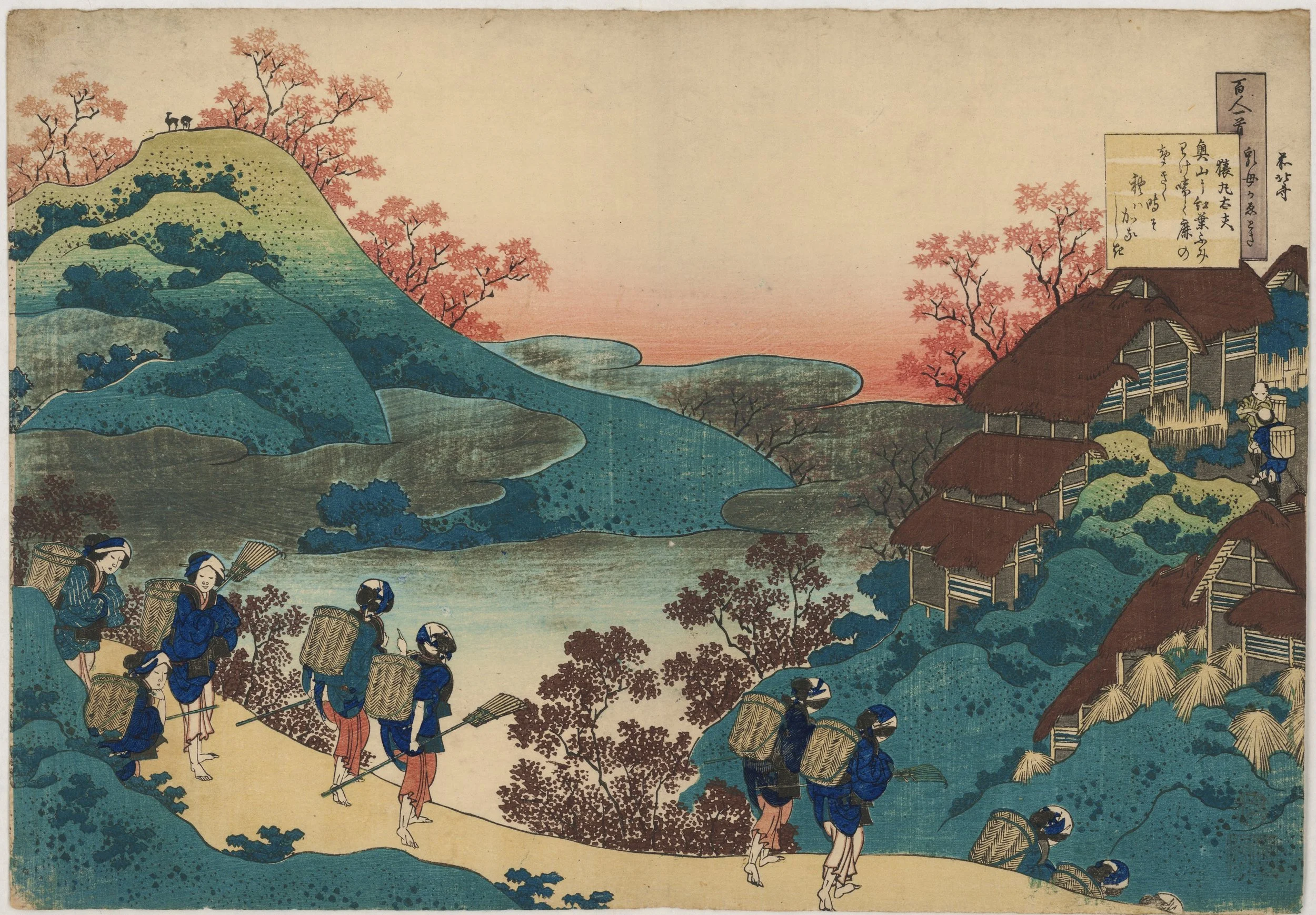
To begin with, the stag, and his mate, are relegated to tiny figures in the distant background, atop a hill, while the foreground comprises a lovely scene that has nothing to do with the poem: mountain woman return to the warmth of their thatched-roofed homes after gathering mushrooms. But somehow, through the body language of the peasants, one of them pointing, the master draws our attention to that distant stag and his “lonely cry.”

Meanwhile, an autumnal night descends, promising to soon cloak the orange maple leaves in darkness. A cold winter is not far behind. Sad, indeed.

We also see some stylized low-lying clouds, a device Hokusai often used to mask unnecessary elements – to give his compositions breathing space, in other words. These include extensive oxidation, which occurred as lead red pigment transformed after being exposed to the air. When this first occurred in Ukiyoe, it was an accident, but by the time this print was published it was likely a conscious and clever design element, adding another somber note to this wonderful and atmospheric scene.

Interested in purchasing?
Please contact us.

葛飾北齋 Katsushika Hokusai(1760-1849)

百人一首 乳母かゑとき 猿丸太夫
Poem by Sarumaru Dayu, from the series of One Hundred Poems Explained by the Nurse

1839

木版画 | 横绘大判 | 26cm x 37.5cm
Woodblock-print | Oban yoko -e | 26cm x 37.5cm

早期的版次;颜色鲜艳;整体品相非常好;随年代而出现的一些小污渍;极其轻微的中间折痕
Early impression; strong color; oxidation; very slight centerfold; some minor soiling commensurate with age; otherwise in good condition.

PRICE ON REQUEST

The “Hundred Poems Explained by the Nurse” was the great Katsushika Hokusai’s final single-sheet color woodblock print series; after this, he focused on paintings and his sketchbooks. Only 27 designs were completed, although there are also quite a few preparatory drawings known. The idea was classic Hokusai – famous poems (still beloved in Japan today) were simplified, as if being retold by an uneducated wet nurse. This allowed for mildly comic errors and misinterpretations.

This, the fifth design in the series, is based on a poem by Sarumaru Dayu, who was believed to have been active around 700-715 and lived in the woods outside of Kyoto. According to the scholar Peter Morse, “Dayu” is a title given to a commoner who was skilled in a given field, suggesting Sarumaru was not highly educated but, rather, a natural-born talent. The poem captures the melancholy autumn beauty in the mountains he obviously knew so well:

In the mountain depths,

Treading through the crimson leaves,

Cries the wandering stag.

When I hear the lonely cry,

Sad -- how sad – the autumn is.

Morse, in Hokusai: One Hundred Poets (Braziller; 1989) says, “This is an absolutely perfect print in many ways.” Yes: so much of what we love about Hokusai is demonstrated here.

To begin with, the stag, and his mate, are relegated to tiny figures in the distant background, atop a hill, while the foreground comprises a lovely scene that has nothing to do with the poem: mountain woman return to the warmth of their thatched-roofed homes after gathering mushrooms. But somehow, through the body language of the peasants, one of them pointing, the master draws our attention to that distant stag and his “lonely cry.”

Meanwhile, an autumnal night descends, promising to soon cloak the orange maple leaves in darkness. A cold winter is not far behind. Sad, indeed.

We also see some stylized low-lying clouds, a device Hokusai often used to mask unnecessary elements – to give his compositions breathing space, in other words. These include extensive oxidation, which occurred as lead red pigment transformed after being exposed to the air. When this first occurred in Ukiyoe, it was an accident, but by the time this print was published it was likely a conscious and clever design element, adding another somber note to this wonderful and atmospheric scene.

Interested in purchasing?
Please contact us.

Katsushika Hokusai (1760-1849)

In the annals of Ukiyo-e, no design is more iconic than “The Great Wave Off Kanagawa.”

This bold image of a gigantic, froth-tentacled wave enveloping both Mt. Fuji and crescent-shaped boats of huddled fishermen has burst out of the world of Japanese woodblock prints and into the mainstream of global culture. It appears on Swatch watches, in political ads, on record albums and yes, even on sexual devices. There are believed to be about 200 originals of them left on the planet. In March 2023, one sold in auction for $2.76 million, a record for Ukiyo-e. Meiji-era reprints can, absurdly, sell for as much as $5,000.

The fame of this undisputed masterpiece is a mixed blessing for lovers and collectors of Japanese woodblock prints. On the one hand, its notoriety brings attention to the form. But on the other it can take up all the oxygen in the room. New collectors chase it. But it can overshadow all the other arguably comparable masterworks by its creator – such as “Red Fuji” or “Rainstorm Beneath the Summit.”

And it can also overshadow its creator himself. And that would be a shame, for there are few characters more legendary, more prolific, more influential and more just all around interesting in the Ukiyo-e universe than Katsushika Hokusai.

Born in 1760 and living until 1849 – a long life in Edo times – he produced untold thousands of works, from intricate color prints to luxurious paintings to books upon books of drawings and sketches. His designs were boldly modern and instantly recognizable, in several cases deeply influencing Western art.

His voluminous sketchbooks are the clear forerunners of today’s manga comic books and Japanese animated movies. His lines were clever and precise. He was the subject of a major 2020 movie in Japan.

Alas, his personal life was a bit of a mess. Despite his fame, he often lived in squalor. Later in life, he referred to himself as “Old Man Mad About Drawing.”

Muneshige Narazaki, a scholar of Ukiyo-e, wrote:

Hokusai’s life spanned almost the whole of that golden age. His art progressed in gradual stages from the imitation of others to mature independence and the development of new forms, then went on to new heights while the form itself was lapsing into decadence, and finally survived to see itself become old-fashioned in its turn, and to be superseded.

He was born in Edo as Tokitaro Kawamura and was adopted by a mirror maker. Showing early promise, he studied with several Ukiyo-e greats, with varying levels of success. He’d changed his name repeatedly throughout his life. He began by doing designs for illustrated books.

His greatest series is undoubtably “36 Views of Mt. Fuji,” which was published by Yohachi from 1823 to 1832 and which includes “The Great Wave Off Kanazawa” as its centerpiece.

Many of the designs in this landmark series, which helped introduce the landscape genre to the thriving print marketplace, are exquisitely simple. It featured considerable use of Prussian Blue, just then introduced to Japan; the key blocks of the first 36 are in this pigment. I say “the first” because the series was so successful that 10 more were produced, and you can tell those designs because those key blocks are in black. So really, 46 Views of Mt. Fuji.

He followed up with three books of black-and-white only prints called “100 Views of Mount Fuji.” They are wonderful. Hokusai just couldn’t stop.

Until he did. Hokusai wanted to live to 100 years old but didn’t make it.

He had a daughter, Katsushika Oi, who worked as his assistant and turned out to be a talent in her own right. Some scholars have even attributed some of his works to her. And she had something in common with her more famous father: she was also the focus of a recent blockbuster movie in Japan.

Partial citation: Narazaki, Muneshige, Hokusai: Masterworks of Ukiyo-e (Kodansha; 1968); Marks, Andreas, Japanese Woodblock Prints, Artists, Publishers and Masterworks: 1680-1900 (Tuttle; 2010); Forrer, Matthi, Hokusai (Prestel; 2015)