
 Image 1 of 2
 Image 2 of 2
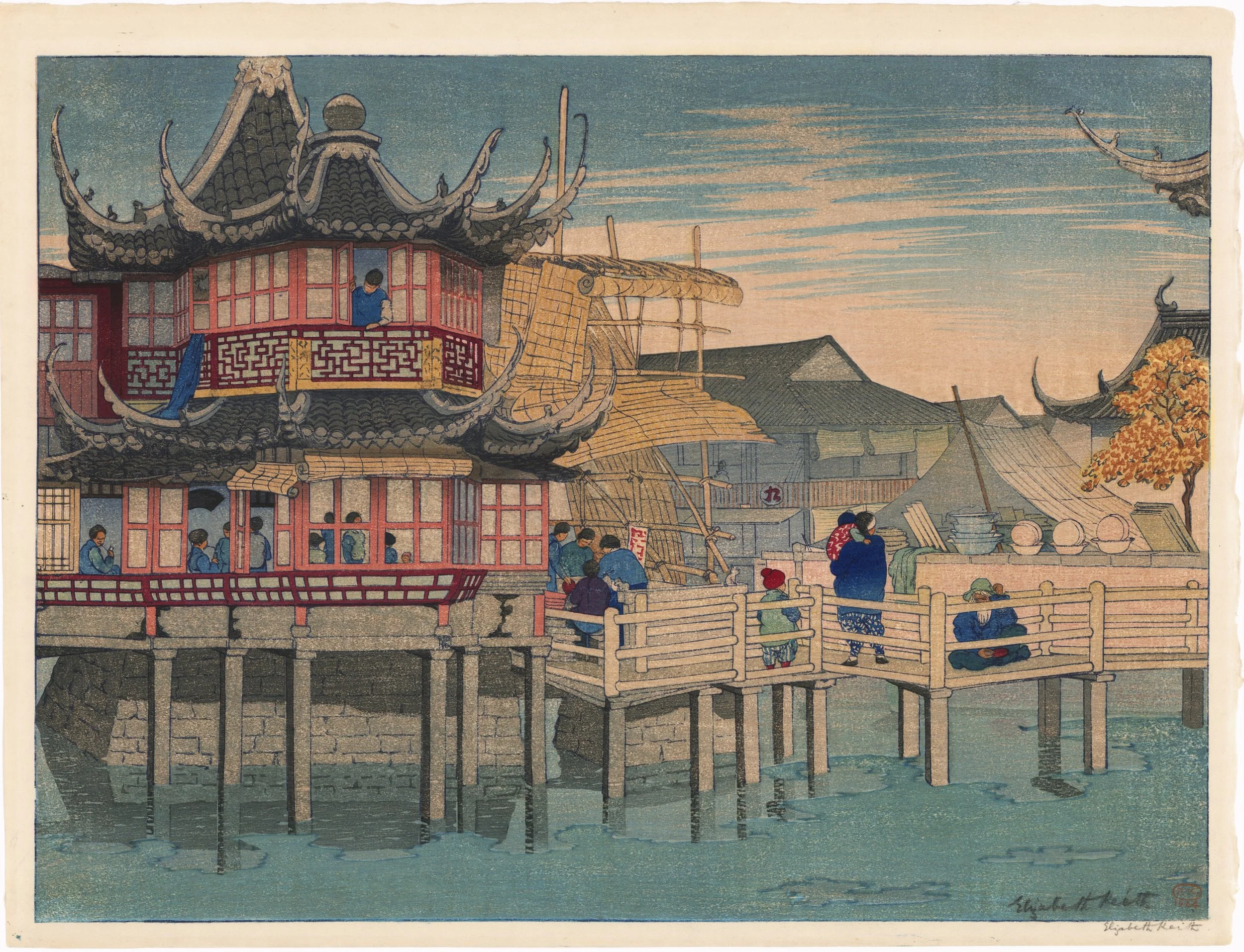
Elizabeth Keith (1887-1956)
Elizabeth Keith was born in Scotland and came to Japan in 1915 when she was 28 with her sister and brother-in-law; she ended up staying nine years. During that time, she used Tokyo as her home base while travelling extensively around Asia.
She was one of several Western women who participated in the Shin Hanga – New Print – movement, including Lillian May Miller and Bertha Lum. She became close with Shozaburo Watanabe, the father of Shin Hanga, and he published roughly 100 of her designs.
Keith was already a self-taught painter when she came to Japan; it was a show of her watercolors that attracted Watanabe’s attention. Her first print for him was “East Gate, Seoul” in Korea, which was then under Japanese occupation.
This was a time when the Western world was fascinated by all things Asian. To us Chinese it was just another day in the life. But Keith and her contemporaries were providing audiences back home with never-seen sites and views, as well as customs and traditions that must have seemed quite romantic. Prints allowed the artist to filter details and interpret the scene, to focus subjectively, as opposed to photography with its documentary qualities.
Keith travelled Asia by herself at a time when few “Gentlewomen” did so. She had striking red hair, so she must have attracted a great deal of attention at a time when Westerners were few and far between in this part of the world. She returned to England after the first nine-year stint and then went back to Japan, where she learned woodblock printing techniques. She also learned etching. And after World War II she returned again, working to help the grievously wounded nation.
Because of small runs, Keith's prints can be expensive, and some works with only 50 or even 30 copies published are especially rare. They were collected by the British Museum, the Guimet Museum in Paris and the National Gallery of Canada, among others; in 1937, a group of Asian-themed prints created by her were purchased by Queen Elizabeth. She died in 1956.
She never married – but who needs a husband with a life like that?