Kunisada (Toyokuni III) | A Parody of the Five Heroes: A Toast to Our Loyal Fans

$0.00

歌川国貞 Utagawa Kunisada

三代目歌川豐国 Utagawa Toyokuni III (1786–1865)

見立五人男 御贔屓恩指
A Parody of the Five Heroes: A Toast to Our Loyal Fans

1852

木版画 | 横绘中判 | 22.3cm × 29cm
Woodblock-print | Chuban yoko-e | 22.3cm × 29cm

早期版次;颜色鲜艳;品相非常好
Rare uncut fan. Early impression; fine color and condition.

$3,888

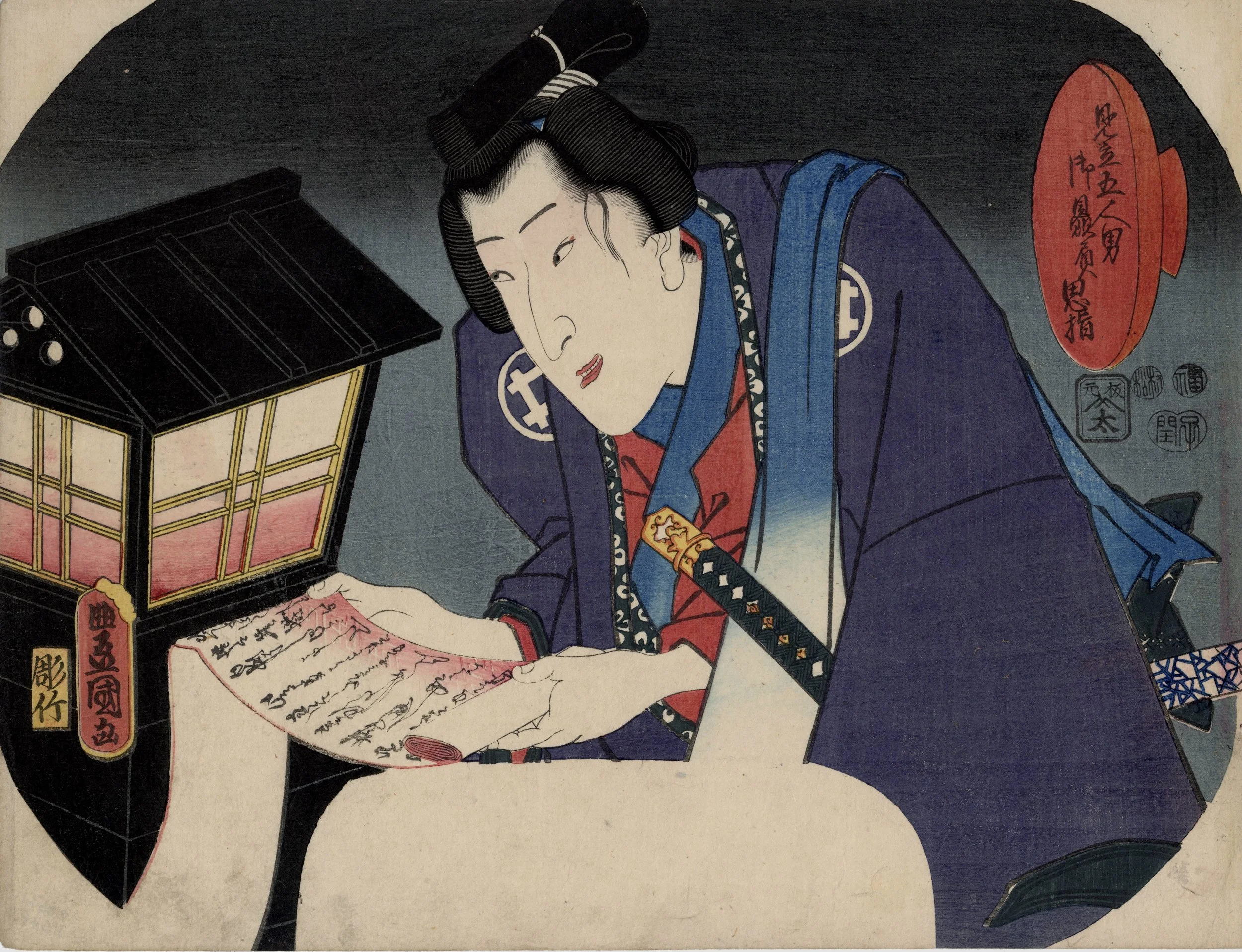
Ukiyoe was art – indeed, today it’s taken far more seriously as art than when it was created – but, back in Edo times, it was also advertising. This un-cut fan design by Kunisada is a wonderful example of art meeting commerce.

It depicts the Kabuki actor Hideka Bando playing the samurai Shirai Gonpachi, came from Tottori Prefecture and began his adventures when he was just 16. In time, he became renowned for his good looks, bravery, and swordsmanship, and his determination to right wrongs wherever he went.

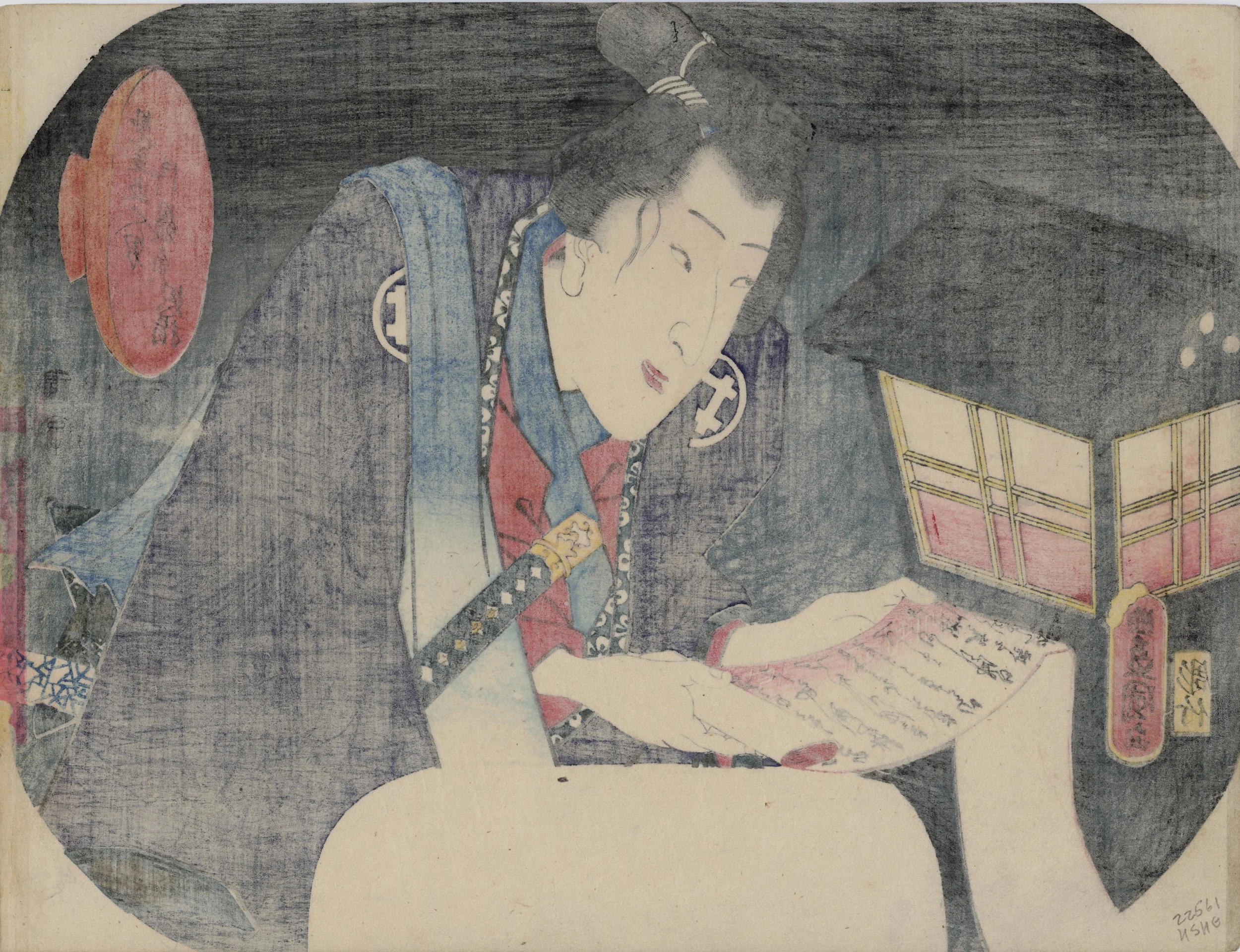
In this scene, Bando is reading a scroll in his hand. Warm light from a paper lamp illuminates his calm demeanor, with a lock of unkempt hair giving the scene a certain intimacy. His dark purple robe contrasts with the fading blue-to-white of his scarf.

In the upper right corner of the painting, the title of the series is in the shape of a sideways sake cup. The kanji represents an inside joke that would be known to all Kabuki-going Edoites. Basically, the characters mean that the audience is showing love for Bando and he is raising his glass in return.

So a fan of Bando could cool him or herself with this image. But this particular example is uncropped. The vast majority of fan prints were cut, of course, so un-croped fan designs are extremely rare. In addition, the purple of the kimono is very rich, and the whole design is given extra luster by a generous helping of mica in the black background.

江户时代没有摄影,浮世绘就是演员的 “宣传海报”。这幅扇面锦绘,正是当时最红的役者绘大师歌川国贞,为歌舞伎演员初代坂东秀佳打造的舞台形象作品。它出自系列《见立五人男 御贔屓恩指》,描绘了演员饰演江户侠客白井权八的一幕,也是江户商业浮世绘的代表之作。

画面中,坂东秀佳饰演的白井权八正低头专注阅读手中的卷轴,身旁立着一盏方形纸灯,暖光衬出他眉眼低垂的沉静神态。深蓝色的外袍层次分明,衣摆处的蓝白渐变在深黑色背景衬托下格外醒目。

画的右上角,系列标题被巧妙设计成一只清酒杯的形状,藏着江户浮世绘特有的巧思。标题名里,“御贔屓”代表观众对演员的偏爱与捧场,“恩指”则是演员举杯回馈、感念观众厚爱的意思,组合起来,就是为心仪的艺人举杯致意。这一设计,精准贴合当时江户剧场敬酒往来的日常风气。用酒杯外形承载标题,刚好和文字含义相互呼应,形式贴合内容,构思十分巧妙

系列名中的“见立”,是当时流行的创作手法:国贞将江户观众熟知的侠客形象,套在当红歌舞伎演员身上,组成“五人男”系列,让观众既能认出熟悉的侠义角色,也能为喜爱的演员买单。国贞笔下的演员,既保留了角色的江湖气质,又突出了演员本人的神韵,完整复刻舞台人物样貌。对当时的观众来说,它不只是一幅画,更是一次和喜爱演员的“隔空见面”。

本作整体品相非常好,画面完整无裁切,色彩鲜亮如初。上方黑色云母背景自带细碎光泽,质感高级,是同类传世扇绘里保存状态极佳的一例。

Interested in purchasing?
Please contact us.

歌川国貞 Utagawa Kunisada

三代目歌川豐国 Utagawa Toyokuni III (1786–1865)

見立五人男 御贔屓恩指
A Parody of the Five Heroes: A Toast to Our Loyal Fans

1852

木版画 | 横绘中判 | 22.3cm × 29cm
Woodblock-print | Chuban yoko-e | 22.3cm × 29cm

早期版次;颜色鲜艳;品相非常好
Rare uncut fan. Early impression; fine color and condition.

$3,888

Ukiyoe was art – indeed, today it’s taken far more seriously as art than when it was created – but, back in Edo times, it was also advertising. This un-cut fan design by Kunisada is a wonderful example of art meeting commerce.

It depicts the Kabuki actor Hideka Bando playing the samurai Shirai Gonpachi, came from Tottori Prefecture and began his adventures when he was just 16. In time, he became renowned for his good looks, bravery, and swordsmanship, and his determination to right wrongs wherever he went.

In this scene, Bando is reading a scroll in his hand. Warm light from a paper lamp illuminates his calm demeanor, with a lock of unkempt hair giving the scene a certain intimacy. His dark purple robe contrasts with the fading blue-to-white of his scarf.

In the upper right corner of the painting, the title of the series is in the shape of a sideways sake cup. The kanji represents an inside joke that would be known to all Kabuki-going Edoites. Basically, the characters mean that the audience is showing love for Bando and he is raising his glass in return.

So a fan of Bando could cool him or herself with this image. But this particular example is uncropped. The vast majority of fan prints were cut, of course, so un-croped fan designs are extremely rare. In addition, the purple of the kimono is very rich, and the whole design is given extra luster by a generous helping of mica in the black background.

江户时代没有摄影,浮世绘就是演员的 “宣传海报”。这幅扇面锦绘,正是当时最红的役者绘大师歌川国贞,为歌舞伎演员初代坂东秀佳打造的舞台形象作品。它出自系列《见立五人男 御贔屓恩指》,描绘了演员饰演江户侠客白井权八的一幕,也是江户商业浮世绘的代表之作。

画面中,坂东秀佳饰演的白井权八正低头专注阅读手中的卷轴,身旁立着一盏方形纸灯,暖光衬出他眉眼低垂的沉静神态。深蓝色的外袍层次分明,衣摆处的蓝白渐变在深黑色背景衬托下格外醒目。

画的右上角,系列标题被巧妙设计成一只清酒杯的形状,藏着江户浮世绘特有的巧思。标题名里,“御贔屓”代表观众对演员的偏爱与捧场,“恩指”则是演员举杯回馈、感念观众厚爱的意思,组合起来,就是为心仪的艺人举杯致意。这一设计,精准贴合当时江户剧场敬酒往来的日常风气。用酒杯外形承载标题,刚好和文字含义相互呼应,形式贴合内容,构思十分巧妙

系列名中的“见立”,是当时流行的创作手法:国贞将江户观众熟知的侠客形象,套在当红歌舞伎演员身上,组成“五人男”系列,让观众既能认出熟悉的侠义角色,也能为喜爱的演员买单。国贞笔下的演员,既保留了角色的江湖气质,又突出了演员本人的神韵,完整复刻舞台人物样貌。对当时的观众来说,它不只是一幅画,更是一次和喜爱演员的“隔空见面”。

本作整体品相非常好,画面完整无裁切,色彩鲜亮如初。上方黑色云母背景自带细碎光泽,质感高级,是同类传世扇绘里保存状态极佳的一例。

Interested in purchasing?
Please contact us.

Utagawa Kunisada (Toyokuni III) (1786–1865)

In the pantheon of Japanese woodblock prints, some names loom large and legendary – Hokusai, Hiroshige, Utamaro, to name a few. Each in his own way revolutionized his genre. But for sheer productivity and quality and longevity, no one rivals the great Utagawa Kunisada. He was without a doubt the most prolific Ukiyo-e artist of the Edo period, and the quality of his work was remarkably high throughout his lifetime.

His life caught the tail end of the early golden age of Ukiyo-e and ended during the final, halcyon days of Japanese woodblock printmaking. His legacy lived on with many famous pupils. In between, he produced countless designs of bijin (beautiful women), warriors, legends, Surimono, more bijin, the Tale of Genji, actors, landscapes, Shunga, fan prints and even more bijin. He led the Utagawa School, home to Hiroshige among others, for nearly 40 years.

His work embraced a subtle elegance and simplicity, a timelessness, when other woodblock artists often favored busy energy. Except when it didn’t. (Read on.)

He was born in 1796 and always had a steady income from his family’s ferry business – making him unusual in the world of Ukiyo-e, where so many struggled to make ends meet. He became a student of Toyokuni when he was 15. The master gave him the name Kunisada, using the tradition of a teacher starting a student’s name with the end of his own.

After getting his start doing book designs, Kunisada saw his first major successes in the 1820s. His initial specialties were bijin and warriors, as well as erotic books. He often put his subjects in well-drawn landscapes but rarely produced pure landscapes themselves.

One example of this occurred in the early 1830s when, reacting to the runaway success of Hiroshige’s Great Tokaido series, he began his own series that copied Hiroshige’s designs but placed a beautiful woman in the foreground. While Hiroshige’s prints were oban yoko-e (horizontal oban prints), Kunisada’s “copies” were smaller chuban-size prints, meaning two could be cut from a single oban-sized sheet. These little prints were phenomenally successful – as successful at least as Hiroshige’s – and eventually Kunisada was publishing his little Tokaido prints ahead of Hiroshige’s, and thus designing his own background landscapes.

Kunisada would later produce the “two-brush” Tokaido series with Hiroshige in the 1850s, in which he drew figures in the foreground while Hiroshige supplied beautiful little landscapes behind them. This was one of several notable woodblock print collaborations during his lifetime.

By then, Kunisada had taken the name Toyokuni III, to honor his master. (Toyokuni II had already been taken by Toyoshige, though Kunisada didn’t acknowledge the legitimacy. But that’s another story for another day.)

He kept going and going. In fact, in his long life, 1852 was his most productive year. His design skills were later matched by new technologies in woodblock prints, and some of his final series feature spectacular and intricate production, such as “Lasting Impressions of a Later Genji Collection” in 1859-61 and “A Contest of Magic Scenes by Toyokuni” in 1861-4. Okay – this series was not subtle: It featured over-the-top designs of Kabuki actors with fabled and ghostly beasts. Double-printing, mica, burnishing, raised printing, heavy paper, complex bokashi – no expense was spared for these deluxe editions.

Kunisada was generous with his students, many of whom went on to great success, including Kunichika, Kunisada II, Sadahide, and Kunihisa II. This last pupil, who among other projects designed the in-set landscapes in Kunisada’s wonderful “100 Famous Sights in Edo Matched with Beautiful Women” in 1857-1858, was a rarity among Ukiyo-e artists – a woman.

Kunisada died in 1865, just three years before the end of the Tokugawa epoch, leaving behind a body of work unmatched in his time.

Don’t believe me? Checkout The Kunisada Project. It’s all there. Just make sure you have some time.

Citation: Research for this brief biography included “Japanese Woodblock Prints” by Andreas Marks (Tuttle; 2010), among other sources.