Kunisada (Toyokuni III) | Maple-leaf Viewing

$0.00

歌川国貞(三代歌川豐国) Utagawa Kunisada (Toyokuni III) (1786–1865)

赏红叶图
Maple-leaf Viewing, from an untitled series of landscapes

1832

木版画 | 横绘大判 | 25.4cm x 37.3cm
Woodblock-print | Oban yoke-e | 25.4cm x 37.3cm

罕见;早期版次;颜色鲜艳;整体品相非常好;极其轻微的中间折痕
Rare; excellent impression and color; very slight centrefold, otherwise in very good condition

$8,000

Utagawa Kunisada was never known for landscapes – his true métier was people, whether they be beautiful women, warriors, or kabuki actors. For the most part, when he did produce a landscape, it was in the background and deliberately slight, so as not to distract from the subjects in the foreground.

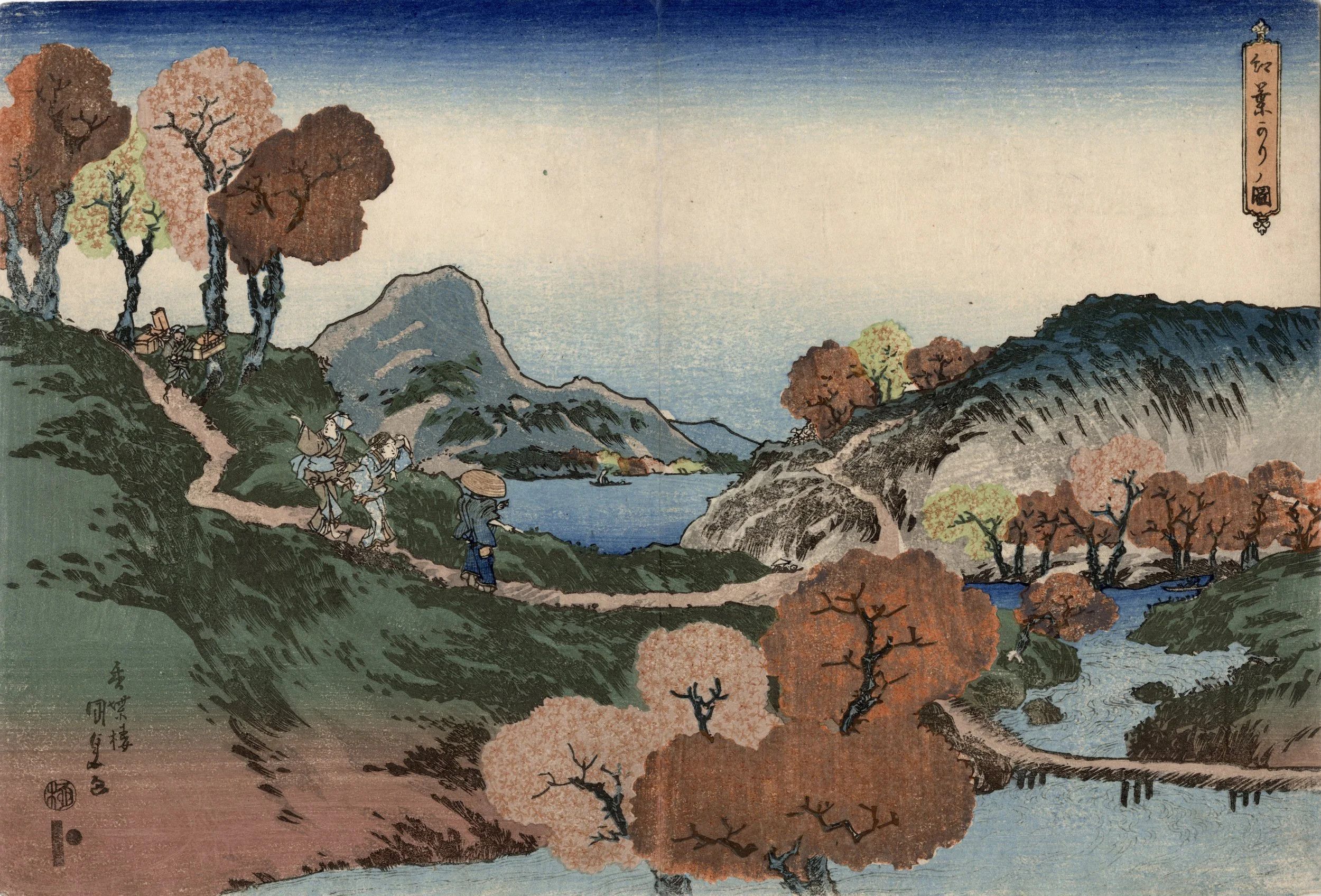
That’s what makes this design from 1832 so fascinating. It dates from early in his spectacularly prolific career. Here, nature is dominant, and the four travelers on the winding mountain path are secondary to it. There is an autumnal somberness to the scene, even a sadness.

It’s from an untitled series of 10 landscapes published by Yamaguchiya Tobei. The scholar Andreas Marks believes the series came in response to the run-away success of Hokusai’s 36 Views of Mt. Fuji, which first hit the shops in 1830 and which had created huge public interest in the genre. Marks notes that Kunisada abandoned landscapes soon after, perhaps because he was busy with book designs. (Although he did produce some of his own intricate landscape backgrounds in his chubantate-e series based on Hiroshige’s Hoeido Tokaido.)

This design, however, owes no stylistic debt to Hokusai or anyone else. It is all Kunisada’s. No location is given, but we know what time of year it is from the glowing red-leafed maple trees, their effect heightened by oxidation. You can almost feel the arrival of autumn’s first bracing chill, and anticipate winter’s looming darkness.

歌川国贞从来不是一位以风景画闻名的浮世绘师。他真正擅长的始终是人物——无论是美人、武者,还是歌舞伎役者。即使偶尔在作品中描绘风景,也大多只是作为人物背后的衬景。

也正因如此,这幅创作于1832年的作品显得格外特别。这是国贞创作生涯早期少见的风景画作品。山路蜿蜒穿过起伏的山野,四位旅人散落其间,与周围广阔的自然相比显得十分渺小。人物退居其次,风景反而成为了整幅画的主角。画面笼罩着深沉的秋意,也隐约带着几分萧瑟。

本作出自山口屋藤兵卫出版的一组无题风景画系列。学者 Andreas Marks 认为,这一系列的出现很可能与葛饰北斋《富岳三十六景》的巨大成功有关。后者自1830年前后陆续出版后,引起了公众对风景版画的强烈兴趣。在这样的背景下,一向以人物画见长的国贞也曾短暂尝试风景画创作。不过这段尝试并没有持续太久,Marks 推测,国贞后来可能因为忙于书籍插图等工作,逐渐停止了这类作品的创作。此后,风景依然时常出现在国贞的作品中,但像这一系列这样以风景为主的创作已十分少见。

但这幅作品本身并没有明显受到北斋或其他画家的影响。画中没有注明具体地点,季节却一目了然。山间的枫树已经染成红褐、橙红与淡粉色,沿着河谷一直延伸至远处。几位旅人走在曲折的山路上,溪水从山谷间穿过,大片天空笼罩着层层山峦。秋天最初的寒意仿佛已经来到,而更深、更冷的冬日,也正在这片绚烂的秋色之后慢慢逼近。

Interested in purchasing?
Please contact us.

歌川国貞(三代歌川豐国) Utagawa Kunisada (Toyokuni III) (1786–1865)

赏红叶图
Maple-leaf Viewing, from an untitled series of landscapes

1832

木版画 | 横绘大判 | 25.4cm x 37.3cm
Woodblock-print | Oban yoke-e | 25.4cm x 37.3cm

罕见;早期版次;颜色鲜艳;整体品相非常好;极其轻微的中间折痕
Rare; excellent impression and color; very slight centrefold, otherwise in very good condition

$8,000

Utagawa Kunisada was never known for landscapes – his true métier was people, whether they be beautiful women, warriors, or kabuki actors. For the most part, when he did produce a landscape, it was in the background and deliberately slight, so as not to distract from the subjects in the foreground.

That’s what makes this design from 1832 so fascinating. It dates from early in his spectacularly prolific career. Here, nature is dominant, and the four travelers on the winding mountain path are secondary to it. There is an autumnal somberness to the scene, even a sadness.

It’s from an untitled series of 10 landscapes published by Yamaguchiya Tobei. The scholar Andreas Marks believes the series came in response to the run-away success of Hokusai’s 36 Views of Mt. Fuji, which first hit the shops in 1830 and which had created huge public interest in the genre. Marks notes that Kunisada abandoned landscapes soon after, perhaps because he was busy with book designs. (Although he did produce some of his own intricate landscape backgrounds in his chubantate-e series based on Hiroshige’s Hoeido Tokaido.)

This design, however, owes no stylistic debt to Hokusai or anyone else. It is all Kunisada’s. No location is given, but we know what time of year it is from the glowing red-leafed maple trees, their effect heightened by oxidation. You can almost feel the arrival of autumn’s first bracing chill, and anticipate winter’s looming darkness.

歌川国贞从来不是一位以风景画闻名的浮世绘师。他真正擅长的始终是人物——无论是美人、武者,还是歌舞伎役者。即使偶尔在作品中描绘风景,也大多只是作为人物背后的衬景。

也正因如此,这幅创作于1832年的作品显得格外特别。这是国贞创作生涯早期少见的风景画作品。山路蜿蜒穿过起伏的山野,四位旅人散落其间,与周围广阔的自然相比显得十分渺小。人物退居其次,风景反而成为了整幅画的主角。画面笼罩着深沉的秋意,也隐约带着几分萧瑟。

本作出自山口屋藤兵卫出版的一组无题风景画系列。学者 Andreas Marks 认为,这一系列的出现很可能与葛饰北斋《富岳三十六景》的巨大成功有关。后者自1830年前后陆续出版后,引起了公众对风景版画的强烈兴趣。在这样的背景下,一向以人物画见长的国贞也曾短暂尝试风景画创作。不过这段尝试并没有持续太久,Marks 推测,国贞后来可能因为忙于书籍插图等工作,逐渐停止了这类作品的创作。此后,风景依然时常出现在国贞的作品中,但像这一系列这样以风景为主的创作已十分少见。

但这幅作品本身并没有明显受到北斋或其他画家的影响。画中没有注明具体地点,季节却一目了然。山间的枫树已经染成红褐、橙红与淡粉色,沿着河谷一直延伸至远处。几位旅人走在曲折的山路上,溪水从山谷间穿过,大片天空笼罩着层层山峦。秋天最初的寒意仿佛已经来到,而更深、更冷的冬日,也正在这片绚烂的秋色之后慢慢逼近。

Interested in purchasing?
Please contact us.

Utagawa Kunisada (Toyokuni III) (1786–1865)

In the pantheon of Japanese woodblock prints, some names loom large and legendary – Hokusai, Hiroshige, Utamaro, to name a few. Each in his own way revolutionized his genre. But for sheer productivity and quality and longevity, no one rivals the great Utagawa Kunisada. He was without a doubt the most prolific Ukiyo-e artist of the Edo period, and the quality of his work was remarkably high throughout his lifetime.

His life caught the tail end of the early golden age of Ukiyo-e and ended during the final, halcyon days of Japanese woodblock printmaking. His legacy lived on with many famous pupils. In between, he produced countless designs of bijin (beautiful women), warriors, legends, Surimono, more bijin, the Tale of Genji, actors, landscapes, Shunga, fan prints and even more bijin. He led the Utagawa School, home to Hiroshige among others, for nearly 40 years.

His work embraced a subtle elegance and simplicity, a timelessness, when other woodblock artists often favored busy energy. Except when it didn’t. (Read on.)

He was born in 1796 and always had a steady income from his family’s ferry business – making him unusual in the world of Ukiyo-e, where so many struggled to make ends meet. He became a student of Toyokuni when he was 15. The master gave him the name Kunisada, using the tradition of a teacher starting a student’s name with the end of his own.

After getting his start doing book designs, Kunisada saw his first major successes in the 1820s. His initial specialties were bijin and warriors, as well as erotic books. He often put his subjects in well-drawn landscapes but rarely produced pure landscapes themselves.

One example of this occurred in the early 1830s when, reacting to the runaway success of Hiroshige’s Great Tokaido series, he began his own series that copied Hiroshige’s designs but placed a beautiful woman in the foreground. While Hiroshige’s prints were oban yoko-e (horizontal oban prints), Kunisada’s “copies” were smaller chuban-size prints, meaning two could be cut from a single oban-sized sheet. These little prints were phenomenally successful – as successful at least as Hiroshige’s – and eventually Kunisada was publishing his little Tokaido prints ahead of Hiroshige’s, and thus designing his own background landscapes.

Kunisada would later produce the “two-brush” Tokaido series with Hiroshige in the 1850s, in which he drew figures in the foreground while Hiroshige supplied beautiful little landscapes behind them. This was one of several notable woodblock print collaborations during his lifetime.

By then, Kunisada had taken the name Toyokuni III, to honor his master. (Toyokuni II had already been taken by Toyoshige, though Kunisada didn’t acknowledge the legitimacy. But that’s another story for another day.)

He kept going and going. In fact, in his long life, 1852 was his most productive year. His design skills were later matched by new technologies in woodblock prints, and some of his final series feature spectacular and intricate production, such as “Lasting Impressions of a Later Genji Collection” in 1859-61 and “A Contest of Magic Scenes by Toyokuni” in 1861-4. Okay – this series was not subtle: It featured over-the-top designs of Kabuki actors with fabled and ghostly beasts. Double-printing, mica, burnishing, raised printing, heavy paper, complex bokashi – no expense was spared for these deluxe editions.

Kunisada was generous with his students, many of whom went on to great success, including Kunichika, Kunisada II, Sadahide, and Kunihisa II. This last pupil, who among other projects designed the in-set landscapes in Kunisada’s wonderful “100 Famous Sights in Edo Matched with Beautiful Women” in 1857-1858, was a rarity among Ukiyo-e artists – a woman.

Kunisada died in 1865, just three years before the end of the Tokugawa epoch, leaving behind a body of work unmatched in his time.

Don’t believe me? Checkout The Kunisada Project. It’s all there. Just make sure you have some time.

Citation: Research for this brief biography included “Japanese Woodblock Prints” by Andreas Marks (Tuttle; 2010), among other sources.