Kuniyoshi | Fan Print: Ebisu, Seven Gods of Good Fortune

$0.00

歌川国芳 Utagawa Kuniyoshi (1798–1861)

团扇绘:今样七喜妇人 惠比寿
Fan Print: Ebisu, from the series of Seven Gods of Good Fortune

1849-52

木版画 | 横绘中判 | 30cm x 22.5cm
Woodblock-print | Chuban yoko-e | 30cm x 22.5cm

早期版次;颜色鲜艳;整体品相非常好;非常轻微的中间折痕;左上方角落经修复
Early impression; strong color; very slight centrefold; upper left corner repaired, otherwise in very good condition.

$14,988

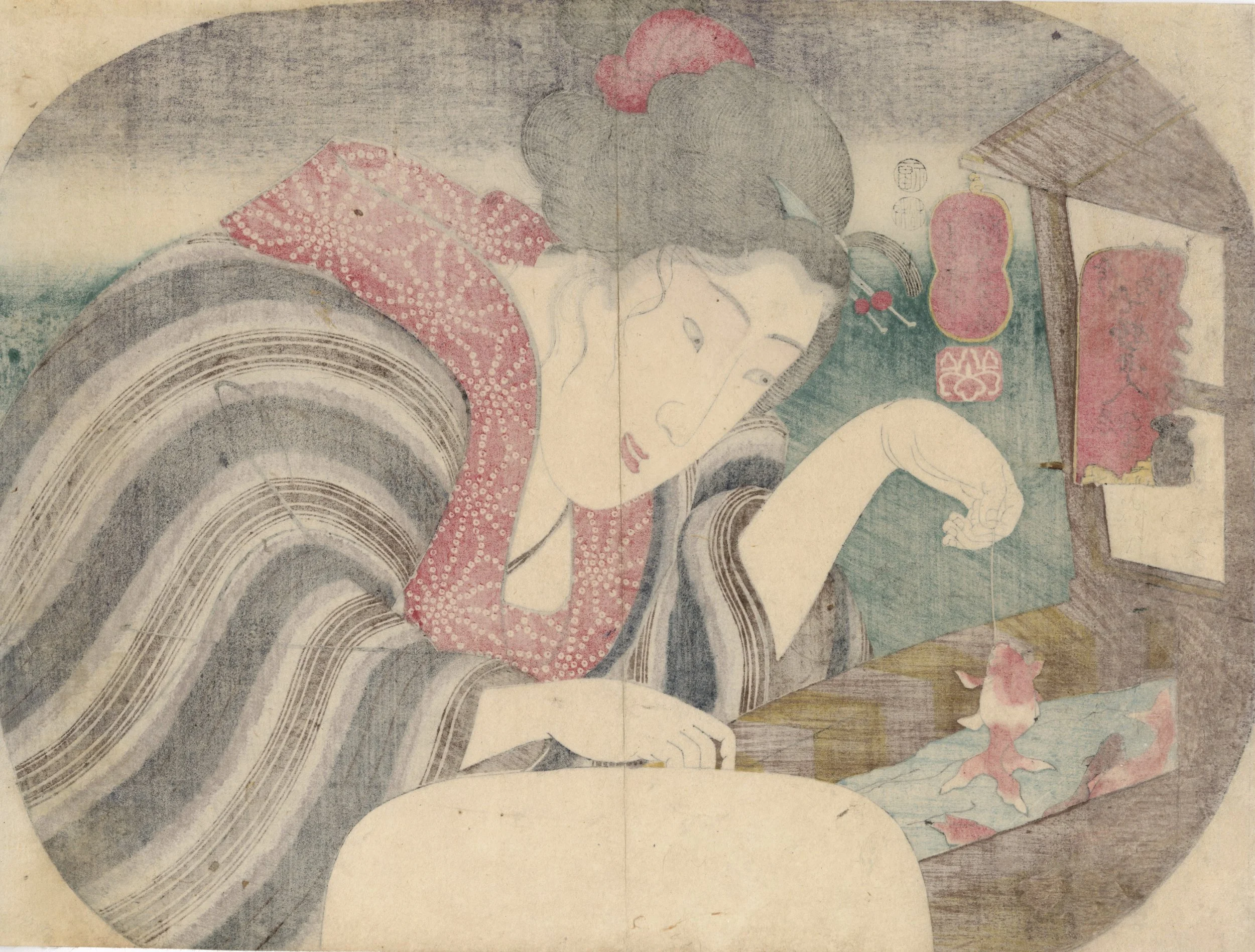
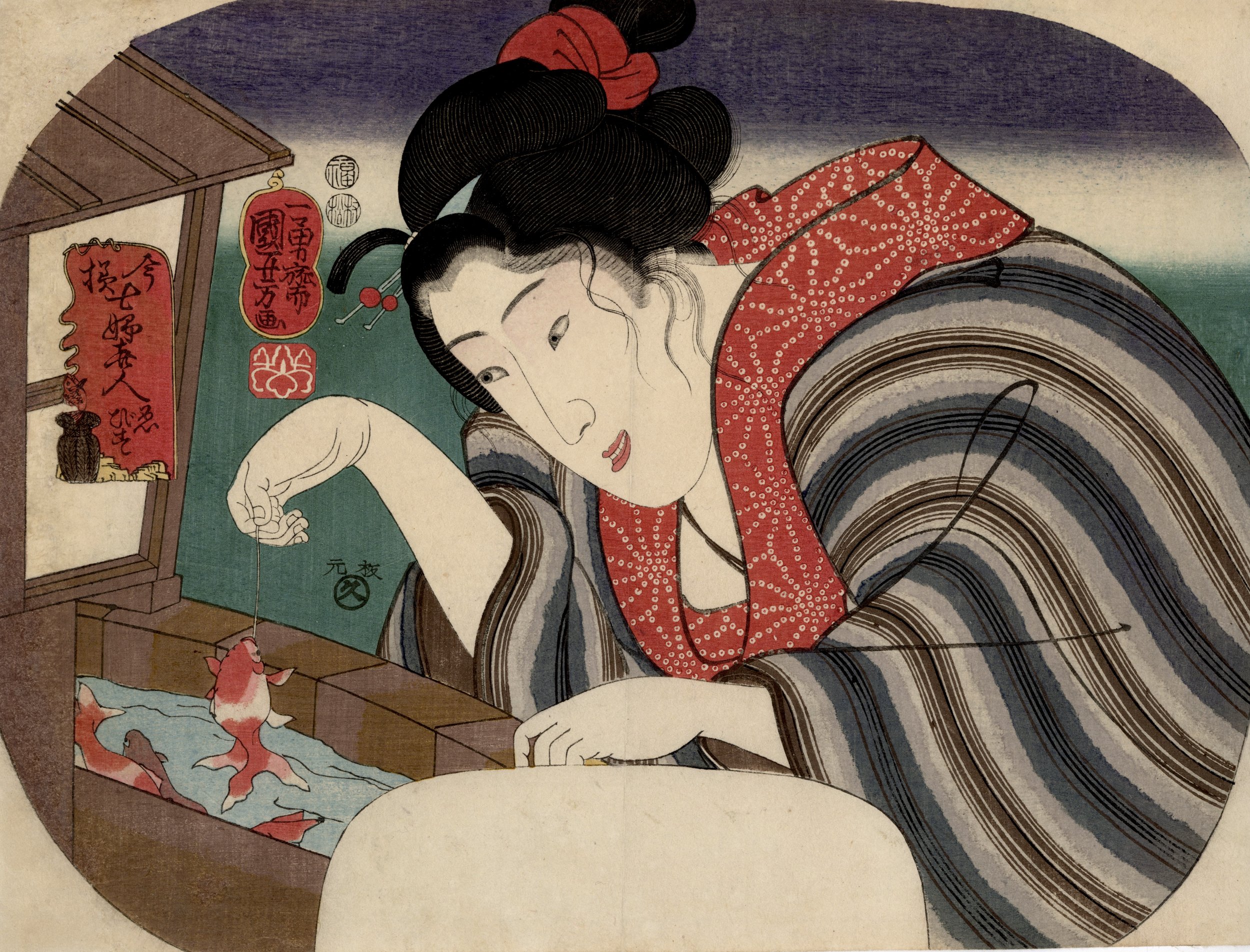
For Edoites, the uchiwa fan was part of everyday summer life. Kuniyoshi fills this one with another favorite of the season: goldfish. A woman bends over a large basin, playing with the fish on a fine thread held between her fingers. Several goldfish swim as one leaps from the water. Her eyes follow it—ours do the same.

This fan print belongs to Kuniyoshi’s Seven Gods of Good Fortune series, produced late in his career. Each design pairs a contemporary Edo woman with one of the Seven Gods of Good Fortune; in this case, Ebisu.

But Kuniyoshi does not show Ebisu in the form we might expect. Instead, the familiar god is recast as an Edo beauty amusing herself with goldfish, leaving the connection for the viewer to discover. This is mitate, a favorite device in ukiyo-e, in which familiar subjects were playfully reimagined in contemporary form.

团扇是江户人消暑的必需品,也是夏天最具代表性的风景之一。歌川国芳将夏日最熟悉的景象画在了团扇上:一位女子俯身望向水盆,轻轻牵动手中的细线,几尾金鱼悠然游动,其中一尾忽然跃出水面,立刻成为整幅作品最引人注目的焦点。女子的目光始终追随着游鱼,观者的视线也不自觉地随着她,一同落在那尾跃起的金鱼上。

《今样七喜妇人》是国芳晚年创作的一组团扇绘系列,每一位江户女子都对应七福神中的一位神明。本图所对应的,正是惠比寿。

国芳很少把典故直接摆在观者面前。他更喜欢把答案藏起来,让人先被画面吸引,再慢慢发现其中的巧思。在这幅作品中,他以一位逗弄金鱼的江户女子取代传统的惠比寿形象,正是浮世绘中常见的“见立”手法:借当代人物重新演绎古老题材。轻松的夏日场景与七福神的典故叠在一起,也正是国芳作品最有趣的地方。

*团扇绘 Uchiwa-e:夏季用于裱糊团扇的实用浮世绘。画面被特地设计成扇形,主题包括花鸟、美人、风景、役者等,大多包括夏季元素。制作数量多,但大部分被使用消耗,现存较少。

*见立绘 Mitate-e:利用当代男女重新演绎历史或传说故事的浮世绘,在美人画、役者绘中赋予了更深层的文化含义。画师在画面中加入传说里的经典元素作为提示,引导读者解读画面背后的典故。

Interested in purchasing?
Please contact us.

歌川国芳 Utagawa Kuniyoshi (1798–1861)

团扇绘:今样七喜妇人 惠比寿
Fan Print: Ebisu, from the series of Seven Gods of Good Fortune

1849-52

木版画 | 横绘中判 | 30cm x 22.5cm
Woodblock-print | Chuban yoko-e | 30cm x 22.5cm

早期版次;颜色鲜艳;整体品相非常好;非常轻微的中间折痕;左上方角落经修复
Early impression; strong color; very slight centrefold; upper left corner repaired, otherwise in very good condition.

$14,988

For Edoites, the uchiwa fan was part of everyday summer life. Kuniyoshi fills this one with another favorite of the season: goldfish. A woman bends over a large basin, playing with the fish on a fine thread held between her fingers. Several goldfish swim as one leaps from the water. Her eyes follow it—ours do the same.

This fan print belongs to Kuniyoshi’s Seven Gods of Good Fortune series, produced late in his career. Each design pairs a contemporary Edo woman with one of the Seven Gods of Good Fortune; in this case, Ebisu.

But Kuniyoshi does not show Ebisu in the form we might expect. Instead, the familiar god is recast as an Edo beauty amusing herself with goldfish, leaving the connection for the viewer to discover. This is mitate, a favorite device in ukiyo-e, in which familiar subjects were playfully reimagined in contemporary form.

团扇是江户人消暑的必需品,也是夏天最具代表性的风景之一。歌川国芳将夏日最熟悉的景象画在了团扇上:一位女子俯身望向水盆,轻轻牵动手中的细线,几尾金鱼悠然游动,其中一尾忽然跃出水面,立刻成为整幅作品最引人注目的焦点。女子的目光始终追随着游鱼,观者的视线也不自觉地随着她,一同落在那尾跃起的金鱼上。

《今样七喜妇人》是国芳晚年创作的一组团扇绘系列,每一位江户女子都对应七福神中的一位神明。本图所对应的,正是惠比寿。

国芳很少把典故直接摆在观者面前。他更喜欢把答案藏起来,让人先被画面吸引,再慢慢发现其中的巧思。在这幅作品中,他以一位逗弄金鱼的江户女子取代传统的惠比寿形象,正是浮世绘中常见的“见立”手法:借当代人物重新演绎古老题材。轻松的夏日场景与七福神的典故叠在一起,也正是国芳作品最有趣的地方。

*团扇绘 Uchiwa-e:夏季用于裱糊团扇的实用浮世绘。画面被特地设计成扇形,主题包括花鸟、美人、风景、役者等,大多包括夏季元素。制作数量多,但大部分被使用消耗,现存较少。

*见立绘 Mitate-e:利用当代男女重新演绎历史或传说故事的浮世绘,在美人画、役者绘中赋予了更深层的文化含义。画师在画面中加入传说里的经典元素作为提示,引导读者解读画面背后的典故。

Interested in purchasing?
Please contact us.

Utagawa Kuniyoshi (1798–1861)

Warriors, ghosts, crabs and cats.

The woodblock print designs of Utagawa Kuniyoshi, one of Ukiyo-e’s most vibrant and creative 19th Century masters, encompass more than that – he depicted landscapes and beautiful women, too – but those are the first genres that come to mind when contemplating this wonderful and eccentric genius and his sprawling, timeless body of work.

From an early age, the young Kuniyoshi was fascinated by drama and history – with a big helping of the supernatural. He loved nature and animals, too – especially cats: again and again they pop up in designs throughout his career (adding a premium to the prices those woodblock prints fetch today). Starting out as a relatively traditional student of the Utagawa school, he soon developed his hugely energetic style, full of dynamic action, and eventually passed it on to his many students – Yoshitoshi being the most famous. Along with Kunisada and Hiroshige, he was among the most prolific of all Ukiyo-e artists.

He was born Yoshisaburō on January 1, 1798 to a silk dyer. Some say his father’s rich patterns influenced his bold, colorful designs. He always loved legends and history. By age 12 he had shown a talent for drawing and become a student of the great Toyokuni, who gave him the name Kuniyoshi. He also studied the Tosa, Kano and Maruyama painting styles.

It took awhile for him to find his place in the thriving Ukiyo-e world. Then in the 1820s he produced his first epic warrior triptychs, and his career success was assured. He often gave legendary heroes fanciful and intricate tattoos of his own design, starting a style craze in Edo.

He eventually expanded genres to include animal studies and landscapes. His wonderful oban yoko-e series of “Famous Views of the Eastern Capital” is especially interesting for its use of Western motifs, such as shadows, billowing clouds and a low vantage point to create atmospheric perspective. While these efforts weren’t always entirely successful, they still resulted in wonderfully lively Ukiyo-e designs.

In all, he produced nearly 250 series for 150 publishers.

During the Tempo reforms of the 1840s, which dramatically censured woodblock prints, he boldly skirted rules barring depictions of actors by putting their faces on various animals, such as turtles.

He died at the age of 63 in April 1861 in his home in Genyadana.

Partial citation: Marks, Andreas, Japanese Woodblock Prints, Artists, Publishers and Masterworks: 1680-1900 (Tuttle; 2010)