Kuniyoshi | Fan Print: Hydrangeas, Summer Flower Festival

$0.00

歌川国芳 Utagawa Kuniyoshi (1798–1861)

团扇绘:夏景 花之日 绣球花
Fan Print: Hydrangeas, from the series of Summer Flower Festival

1842-46

木版画 | 横绘中判 | 29.2 x 22.2cm
Woodblock-print | Chuban yoko-e | 29.2 x 22.2cm

早期版次;颜色鲜艳;品相非常好
Fine impression, color and condition

$18,988

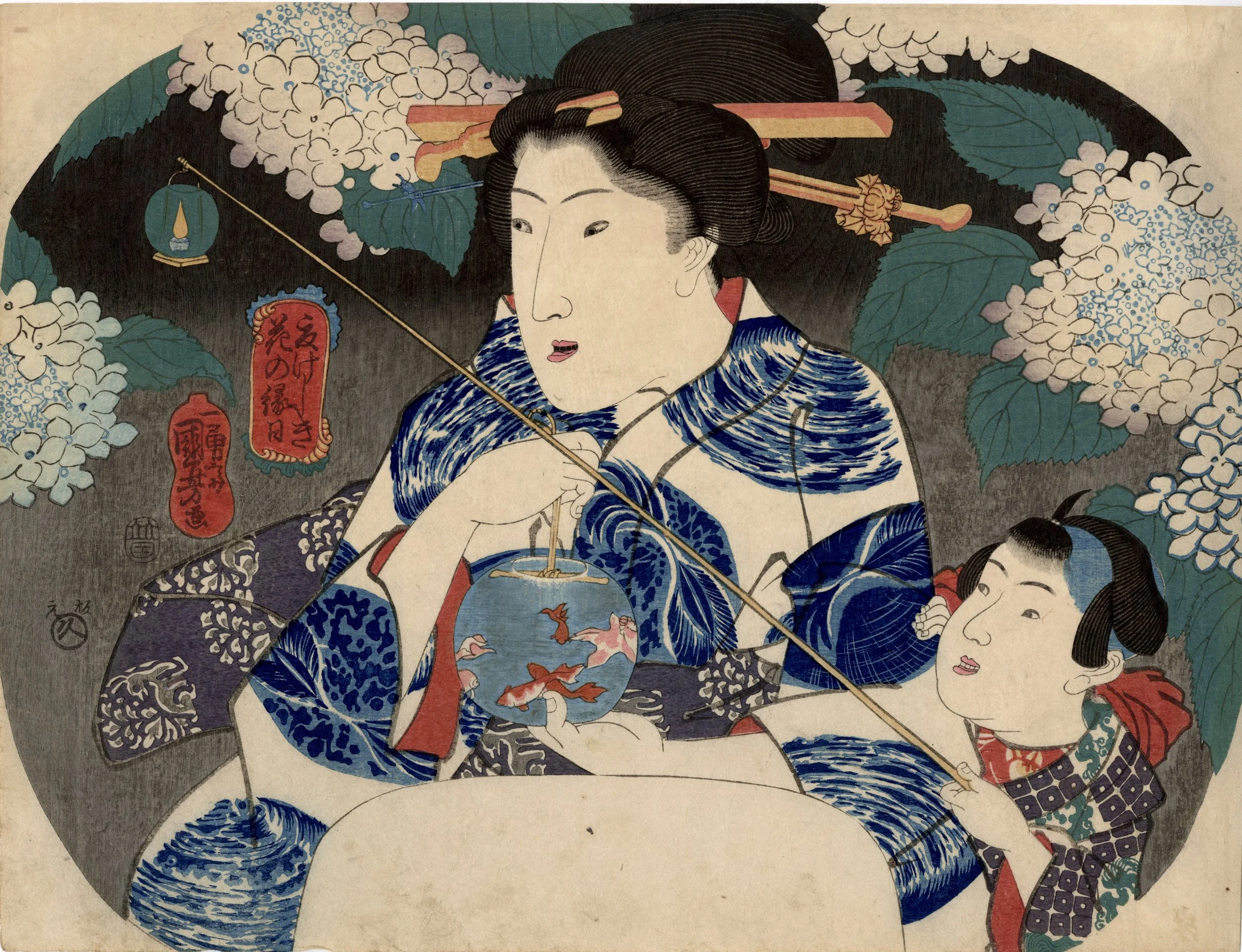
Few things are more closely associated with an Edo summer than hydrangeas, goldfish and a hand-held fan. Kuniyoshi brings all three together in this small uchiwa-e, a print designed to be mounted on a round fan; this one was actually used.

A woman carries a glass bowl of goldfish — the child at her side can hardly take his eyes off it. A few tiny fish swim inside as great clusters of hydrangeas bloom behind them, their blues and violets filling much of the background.

The design belongs to Kuniyoshi’s Summer Flower Festival series of around 1842–46. Known designs in the series feature hydrangeas, begonias, peonies, pinks, lilies, demon thistles and chrysanthemums, each paired with a different beauty.

Because uchiwa-e were made to be mounted on fans and used, rather than carefully stored away, relatively few have survived in fine condition. This impression is exceptionally well preserved, with fresh color and crisp detail throughout—from the layered blues and violets of the hydrangeas and the patterns of the woman’s kimono to the tiny goldfish in their glass bowl.

江户的夏天,总有一些东西会年复一年地出现。盛开的绣球花、清水中的金鱼、手中的团扇,还有午后树荫下乘凉的人们。国芳把这些属于夏天的景象,都画进了这幅小小的团扇绘里。

画面中央,一位女子提着装有金鱼的小鱼缸,身旁的孩子早已看得入神。几尾金鱼在水中游动,身后的绣球花层层盛开,几乎铺满整个画面。

本图出自歌川国芳(Utagawa Kuniyoshi)约1842至1846年创作的《夏景 花之日》团扇绘系列。目前已知的系列包括绣球花、秋海棠、牡丹、石竹、百合、鬼蓟、菊花等不同花卉,每幅皆以一种花卉为题,配以不同的美人,记录江户人熟悉的夏日景象。

团扇绘原本就是夏天使用的日用品,并不是为了长久保存而制作。正因如此,能够完整流传至今的作品并不算多。这件作品保存状态优异,颜色鲜艳,绣球花层层叠染的蓝紫色调、人物服饰的纹样,以及小金鱼缸中的细节都清晰可见。

*团扇绘 Uchiwa-e:夏季用于裱糊团扇的实用浮世绘。画面被特地设计成扇形,主题包括花鸟、美人、风景、役者等,大多包括夏季元素。制作数量多,但大部分被使用消耗,现存较少。

Interested in purchasing?
Please contact us.

歌川国芳 Utagawa Kuniyoshi (1798–1861)

团扇绘:夏景 花之日 绣球花
Fan Print: Hydrangeas, from the series of Summer Flower Festival

1842-46

木版画 | 横绘中判 | 29.2 x 22.2cm
Woodblock-print | Chuban yoko-e | 29.2 x 22.2cm

早期版次;颜色鲜艳;品相非常好
Fine impression, color and condition

$18,988

Few things are more closely associated with an Edo summer than hydrangeas, goldfish and a hand-held fan. Kuniyoshi brings all three together in this small uchiwa-e, a print designed to be mounted on a round fan; this one was actually used.

A woman carries a glass bowl of goldfish — the child at her side can hardly take his eyes off it. A few tiny fish swim inside as great clusters of hydrangeas bloom behind them, their blues and violets filling much of the background.

The design belongs to Kuniyoshi’s Summer Flower Festival series of around 1842–46. Known designs in the series feature hydrangeas, begonias, peonies, pinks, lilies, demon thistles and chrysanthemums, each paired with a different beauty.

Because uchiwa-e were made to be mounted on fans and used, rather than carefully stored away, relatively few have survived in fine condition. This impression is exceptionally well preserved, with fresh color and crisp detail throughout—from the layered blues and violets of the hydrangeas and the patterns of the woman’s kimono to the tiny goldfish in their glass bowl.

江户的夏天,总有一些东西会年复一年地出现。盛开的绣球花、清水中的金鱼、手中的团扇,还有午后树荫下乘凉的人们。国芳把这些属于夏天的景象,都画进了这幅小小的团扇绘里。

画面中央,一位女子提着装有金鱼的小鱼缸,身旁的孩子早已看得入神。几尾金鱼在水中游动,身后的绣球花层层盛开,几乎铺满整个画面。

本图出自歌川国芳(Utagawa Kuniyoshi)约1842至1846年创作的《夏景 花之日》团扇绘系列。目前已知的系列包括绣球花、秋海棠、牡丹、石竹、百合、鬼蓟、菊花等不同花卉,每幅皆以一种花卉为题,配以不同的美人,记录江户人熟悉的夏日景象。

团扇绘原本就是夏天使用的日用品,并不是为了长久保存而制作。正因如此,能够完整流传至今的作品并不算多。这件作品保存状态优异,颜色鲜艳,绣球花层层叠染的蓝紫色调、人物服饰的纹样,以及小金鱼缸中的细节都清晰可见。

*团扇绘 Uchiwa-e:夏季用于裱糊团扇的实用浮世绘。画面被特地设计成扇形,主题包括花鸟、美人、风景、役者等,大多包括夏季元素。制作数量多,但大部分被使用消耗,现存较少。

Interested in purchasing?
Please contact us.

Utagawa Kuniyoshi (1798–1861)

Warriors, ghosts, crabs and cats.

The woodblock print designs of Utagawa Kuniyoshi, one of Ukiyo-e’s most vibrant and creative 19th Century masters, encompass more than that – he depicted landscapes and beautiful women, too – but those are the first genres that come to mind when contemplating this wonderful and eccentric genius and his sprawling, timeless body of work.

From an early age, the young Kuniyoshi was fascinated by drama and history – with a big helping of the supernatural. He loved nature and animals, too – especially cats: again and again they pop up in designs throughout his career (adding a premium to the prices those woodblock prints fetch today). Starting out as a relatively traditional student of the Utagawa school, he soon developed his hugely energetic style, full of dynamic action, and eventually passed it on to his many students – Yoshitoshi being the most famous. Along with Kunisada and Hiroshige, he was among the most prolific of all Ukiyo-e artists.

He was born Yoshisaburō on January 1, 1798 to a silk dyer. Some say his father’s rich patterns influenced his bold, colorful designs. He always loved legends and history. By age 12 he had shown a talent for drawing and become a student of the great Toyokuni, who gave him the name Kuniyoshi. He also studied the Tosa, Kano and Maruyama painting styles.

It took awhile for him to find his place in the thriving Ukiyo-e world. Then in the 1820s he produced his first epic warrior triptychs, and his career success was assured. He often gave legendary heroes fanciful and intricate tattoos of his own design, starting a style craze in Edo.

He eventually expanded genres to include animal studies and landscapes. His wonderful oban yoko-e series of “Famous Views of the Eastern Capital” is especially interesting for its use of Western motifs, such as shadows, billowing clouds and a low vantage point to create atmospheric perspective. While these efforts weren’t always entirely successful, they still resulted in wonderfully lively Ukiyo-e designs.

In all, he produced nearly 250 series for 150 publishers.

During the Tempo reforms of the 1840s, which dramatically censured woodblock prints, he boldly skirted rules barring depictions of actors by putting their faces on various animals, such as turtles.

He died at the age of 63 in April 1861 in his home in Genyadana.

Partial citation: Marks, Andreas, Japanese Woodblock Prints, Artists, Publishers and Masterworks: 1680-1900 (Tuttle; 2010)