
 Image 1 of 2
 Image 2 of 2
Ito Shinsui (1898-1972)
Born into poverty in 1898, Ito Shinsui was forced to take a job with the Tokyo Printing Co. when he was just 12. This bad luck turned out to be good luck for him, and for anyone who loves art and Japanese woodblock prints.
Naturally talented, but also a determined hard worker, he continued his education and studied Nihonga painting in the evenings. His talent was recognized at work, and he was moved to the company’s drawing section, where he became an illustrator – a skill he used throughout his life. But fine art exerted an irresistible pull. He became a student of the Ukiyoe painter Kaburagi Kiyokata and began winning prizes.
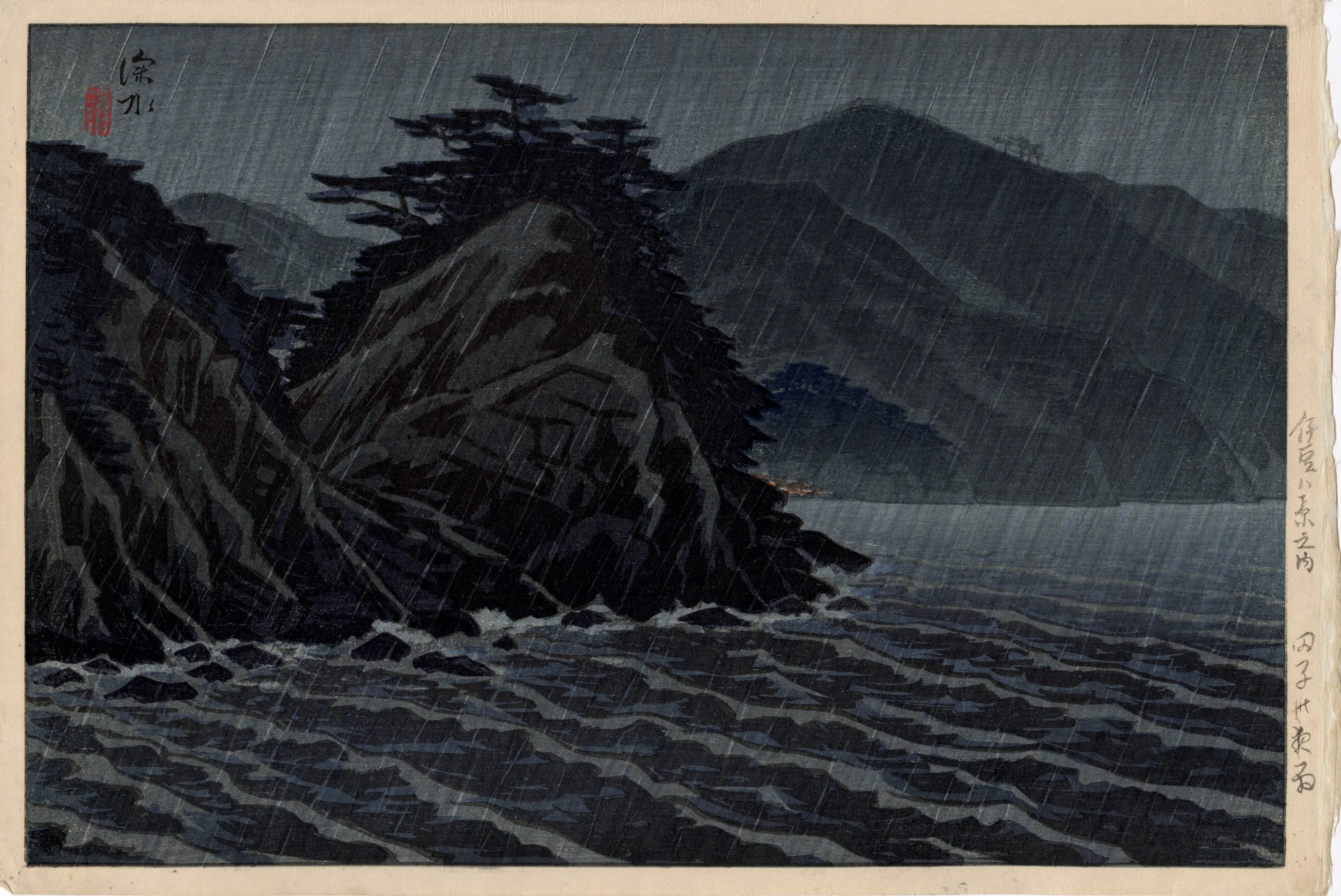
Like so many Shin Hanga artists, his connection with the great publisher Watanabe Shozaburo cemented his career and reputation. His first print for Watanabe was “Before the Mirror” in 1916. But here’s the twist: we know Shinsui as the great artist of beauties – bijin. But his first love actually was landscapes, and his wonderful, atmospheric and tonalist “Eight Views of Omi” remains a highpoint of early Shin Hanga landscape designs.
In fact, those early views were so well received that they prompted Hiroshi Yoshida and another Kiyotaka pupil, none other than Kawase Hasui, to pursue landscapes themselves. This, in turn, contributed to Shinsui’s switch to female portraits. Perhaps the landscape genre felt too crowded. But this became his true fame. His women were often caught at private moments, at the mirror or after the bath, gazing introspectively, deep in thought. Other times, they were out in the world, dressed elegantly, beautiful in the pouring rain or in the swirling snow. They are captured for all time in his greatest collections — the first and second, “Series of Modern Beauties" and "Twelve Images of Modern Beauties."
In the end, he and Watanabe executed 60 landscape prints and 100 portrait prints together, in addition to the occasional work Shinsui did for others. Throughout it all, he continued to paint. In his later years was acclaimed as a national treasure, his work embraced around the world. A long journey from the day that little 12-year-old boy started his first day in the noisy, dirty printing shop.