Shinsui | The Floating Pavilion at Katata, Eight Views of Omi

$0.00

伊東深水Ito Shinsui(1898-1972)

近江八景之内 三井寺坚田浮御堂
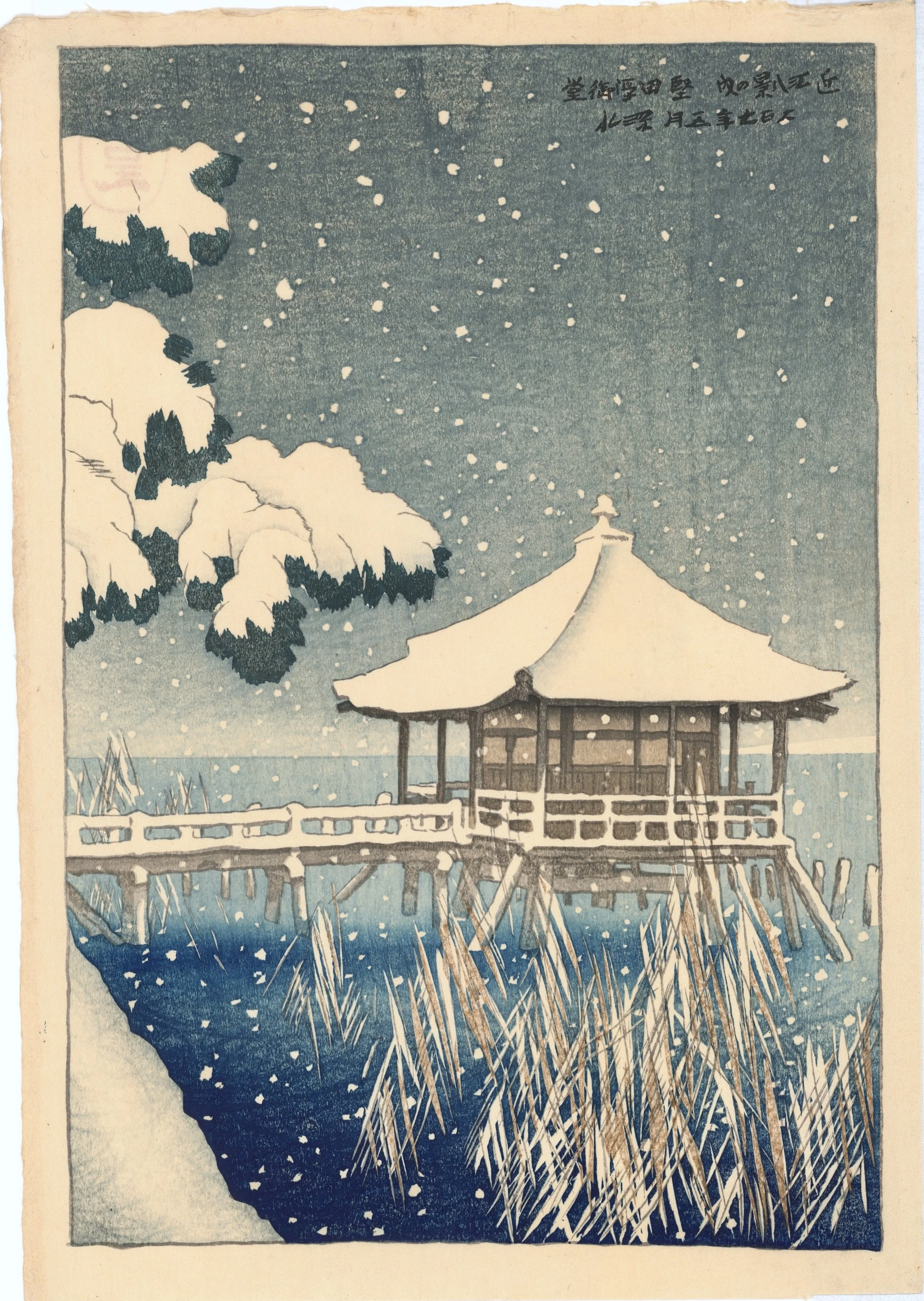
The Floating Pavilion at Katata, from the series of Eight Views of Omi

1918

木版画|纵绘间判|31.5cm × 22.5cm
Woodblock-print |Aiban tate-e|31.5cm × 22.5cm

地震前作品;限量版200枚;整体品相非常好
Pre-earthquake design with beautiful woodgrain in the sky; limited edition of 200; faded tape residue verso, otherwise fine condition.

$9,500

正如历代中国画家常以“潇湘八景”寄托笔墨意趣,日本画家亦多以“近江八景”为题,借景抒怀。而在尚未满二十岁之时,伊东深水便已完成了一组属于他自己的近江八景。

创作于1917至1918年间的《近江八景》,是美人画名家伊东深水艺术生涯中最重要的风景画系列之一。由于完成时间早于关东大地震,这一系列的印量与今日存世数量都极为有限,在其创作中占有特殊位置。

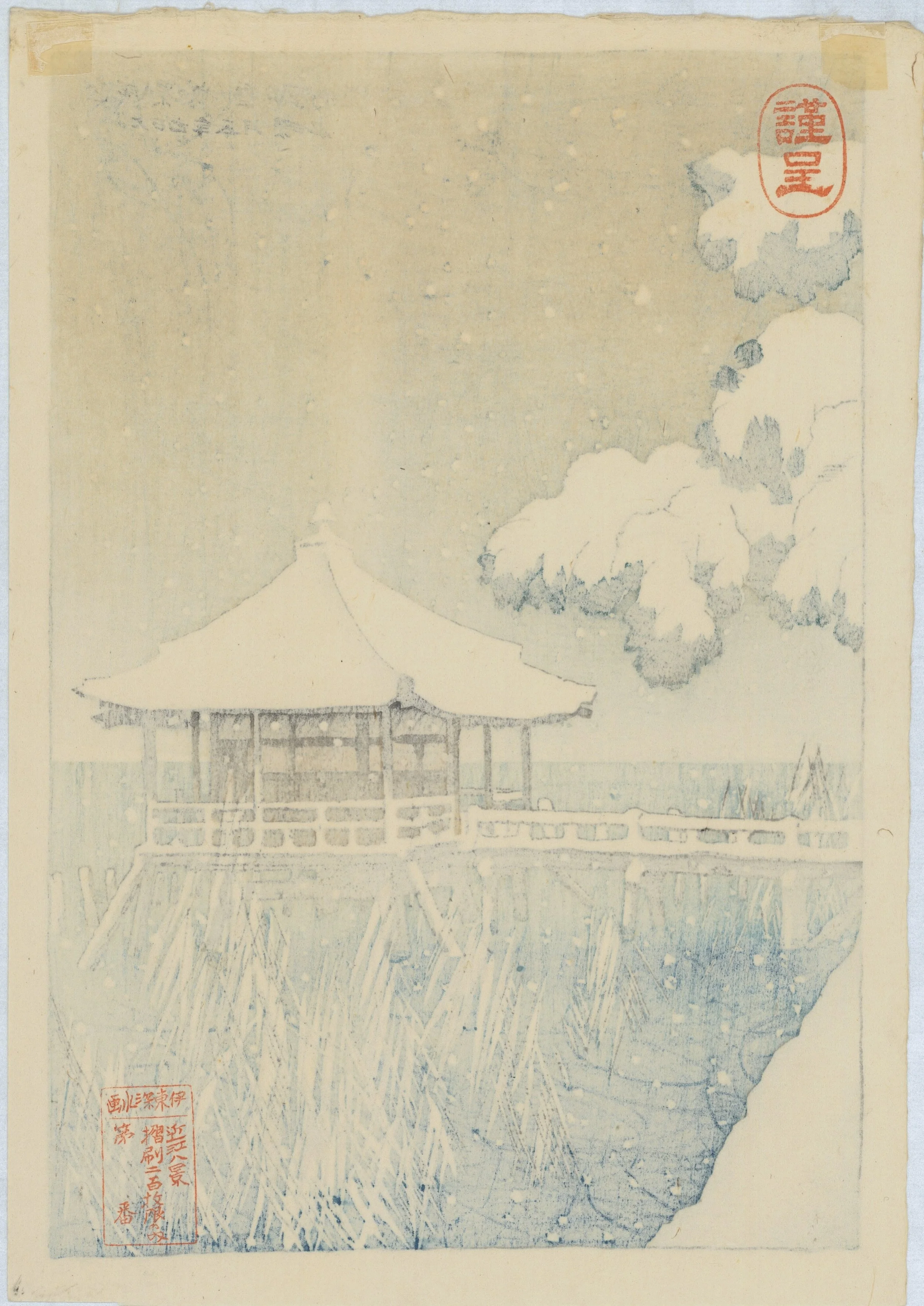
画面中,浮御堂伫立于湖岸,屋檐、栏杆与远处的树影在纷飞的大雪中逐渐模糊。湖面空旷,无舟亦无人,雪片自灰暗的天空中密密落下,几乎填满整个画面空间。建筑清晰的垂直线条在雪幕中显得愈发孤立,也强化了冬日景象中特有的静谧与寒意。细看之下,天空与湖面中隐约浮现的木纹,为画面增添了一层含蓄而微妙的质感。

This lovely Shin Hanga demonstrates that everything old is new again when it comes to Japanese woodblock prints.

It comes from Ito Shinsui’s, Eight Views of Omi, the second series the artist produced for the legendary publisher Shozaburo Watanabe. Omi is the storied region around Lake Biwa between Kyoto and Nagoya that was long a favorite of Ukiyoe Japanese woodblock print artists, especially Hiroshige.

The idea of “eight views” comes from Chinese traditions in poetry and painting. So it is quite ancient. And grouping landscape and other genres of woodblock prints together in a set was standard for Ukiyoe artists and publishers. But this series, especially this example, “The Floating Pavillion, Katada,” is strikingly modern.

Rather than embrace traditional (stereotypical?) tropes, Shinsui took hold of the modern conceit of landscape painting by visiting the locations around Biwa himself, and recording what he saw. For example, images of Omi, including this small waterfront temple, are often accompanied by a flock of geese slicing diagonally through the sky. Not here. Here we see a wintry snowscape with nary a person – nor a bird – in sight. The large flakes drift down from an ominous gray sky. (Note the wonderful woodgrain in this example.)

‍In another break with tradition, while all the prints in the series are diminutive aiban-sized, some are horizontal and some are vertical. Katada  of course is vertical, or tate-e. In other words, Shinsui used the format that suited each design, as opposed to letting the format dictate the way in which the image was portrayed.

‍Some say the great Kawase Hasui was inspired by this series to turn his talents to landscapes, which led Shinsui to focus more on bijin-e, or beauty prints. But not before he completed this modest masterpiece.

Interested in purchasing?
Please contact us.

伊東深水Ito Shinsui(1898-1972)

近江八景之内 三井寺坚田浮御堂
The Floating Pavilion at Katata, from the series of Eight Views of Omi

1918

木版画|纵绘间判|31.5cm × 22.5cm
Woodblock-print |Aiban tate-e|31.5cm × 22.5cm

地震前作品;限量版200枚;整体品相非常好
Pre-earthquake design with beautiful woodgrain in the sky; limited edition of 200; faded tape residue verso, otherwise fine condition.

$9,500

正如历代中国画家常以“潇湘八景”寄托笔墨意趣,日本画家亦多以“近江八景”为题,借景抒怀。而在尚未满二十岁之时,伊东深水便已完成了一组属于他自己的近江八景。

创作于1917至1918年间的《近江八景》,是美人画名家伊东深水艺术生涯中最重要的风景画系列之一。由于完成时间早于关东大地震,这一系列的印量与今日存世数量都极为有限,在其创作中占有特殊位置。

画面中,浮御堂伫立于湖岸,屋檐、栏杆与远处的树影在纷飞的大雪中逐渐模糊。湖面空旷,无舟亦无人,雪片自灰暗的天空中密密落下,几乎填满整个画面空间。建筑清晰的垂直线条在雪幕中显得愈发孤立,也强化了冬日景象中特有的静谧与寒意。细看之下,天空与湖面中隐约浮现的木纹,为画面增添了一层含蓄而微妙的质感。

This lovely Shin Hanga demonstrates that everything old is new again when it comes to Japanese woodblock prints.

It comes from Ito Shinsui’s, Eight Views of Omi, the second series the artist produced for the legendary publisher Shozaburo Watanabe. Omi is the storied region around Lake Biwa between Kyoto and Nagoya that was long a favorite of Ukiyoe Japanese woodblock print artists, especially Hiroshige.

The idea of “eight views” comes from Chinese traditions in poetry and painting. So it is quite ancient. And grouping landscape and other genres of woodblock prints together in a set was standard for Ukiyoe artists and publishers. But this series, especially this example, “The Floating Pavillion, Katada,” is strikingly modern.

Rather than embrace traditional (stereotypical?) tropes, Shinsui took hold of the modern conceit of landscape painting by visiting the locations around Biwa himself, and recording what he saw. For example, images of Omi, including this small waterfront temple, are often accompanied by a flock of geese slicing diagonally through the sky. Not here. Here we see a wintry snowscape with nary a person – nor a bird – in sight. The large flakes drift down from an ominous gray sky. (Note the wonderful woodgrain in this example.)

‍In another break with tradition, while all the prints in the series are diminutive aiban-sized, some are horizontal and some are vertical. Katada  of course is vertical, or tate-e. In other words, Shinsui used the format that suited each design, as opposed to letting the format dictate the way in which the image was portrayed.

‍Some say the great Kawase Hasui was inspired by this series to turn his talents to landscapes, which led Shinsui to focus more on bijin-e, or beauty prints. But not before he completed this modest masterpiece.

Interested in purchasing?
Please contact us.

Ito Shinsui (1898-1972)

Born into poverty in 1898, Ito Shinsui was forced to take a job with the Tokyo Printing Co. when he was just 12. This bad luck turned out to be good luck for him, and for anyone who loves art and Japanese woodblock prints.

Naturally talented, but also a determined hard worker, he continued his education and studied Nihonga painting in the evenings. His talent was recognized at work, and he was moved to the company’s drawing section, where he became an illustrator – a skill he used throughout his life. But fine art exerted an irresistible pull. He became a student of the Ukiyoe painter Kaburagi Kiyokata and began winning prizes.

Like so many Shin Hanga artists, his connection with the great publisher Watanabe Shozaburo cemented his career and reputation. His first print for Watanabe was “Before the Mirror” in 1916. But here’s the twist: we know Shinsui as the great artist of beauties – bijin. But his first love actually was landscapes, and his wonderful, atmospheric and tonalist “Eight Views of Omi” remains a highpoint of early Shin Hanga landscape designs.

In fact, those early views were so well received that they prompted Hiroshi Yoshida and another Kiyotaka pupil, none other than Kawase Hasui, to pursue landscapes themselves. This, in turn, contributed to Shinsui’s switch to female portraits. Perhaps the landscape genre felt too crowded. But this became his true fame. His women were often caught at private moments, at the mirror or after the bath, gazing introspectively, deep in thought. Other times, they were out in the world, dressed elegantly, beautiful in the pouring rain or in the swirling snow. They are captured for all time in his greatest collections — the first and second, “Series of Modern Beauties" and "Twelve Images of Modern Beauties."

In the end, he and Watanabe executed 60 landscape prints and 100 portrait prints together, in addition to the occasional work Shinsui did for others. Throughout it all, he continued to paint. In his later years was acclaimed as a national treasure, his work embraced around the world. A long journey from the day that little 12-year-old boy started his first day in the noisy, dirty printing shop.