
 Image 1 of 2
 Image 2 of 2
奥村利信 Okumura Toshinobu (active about 1717–1750)
漆绘:市川团十郎二代与初代山下金作
Urushi-e: Ichikawa Danjuro II & Yamashita Kinsaku I
1727
木版画 | 细判|29cm x 16cm
Woodblock-print | Hosoban | 29cm x 16cm
非常罕见的红绘;早期版次;颜色保存非常好;有轻微虫洞修补
Very rare Beni-e; fine impression; strong color; slight wormholes repairs, otherwise in good condition.
$4,200
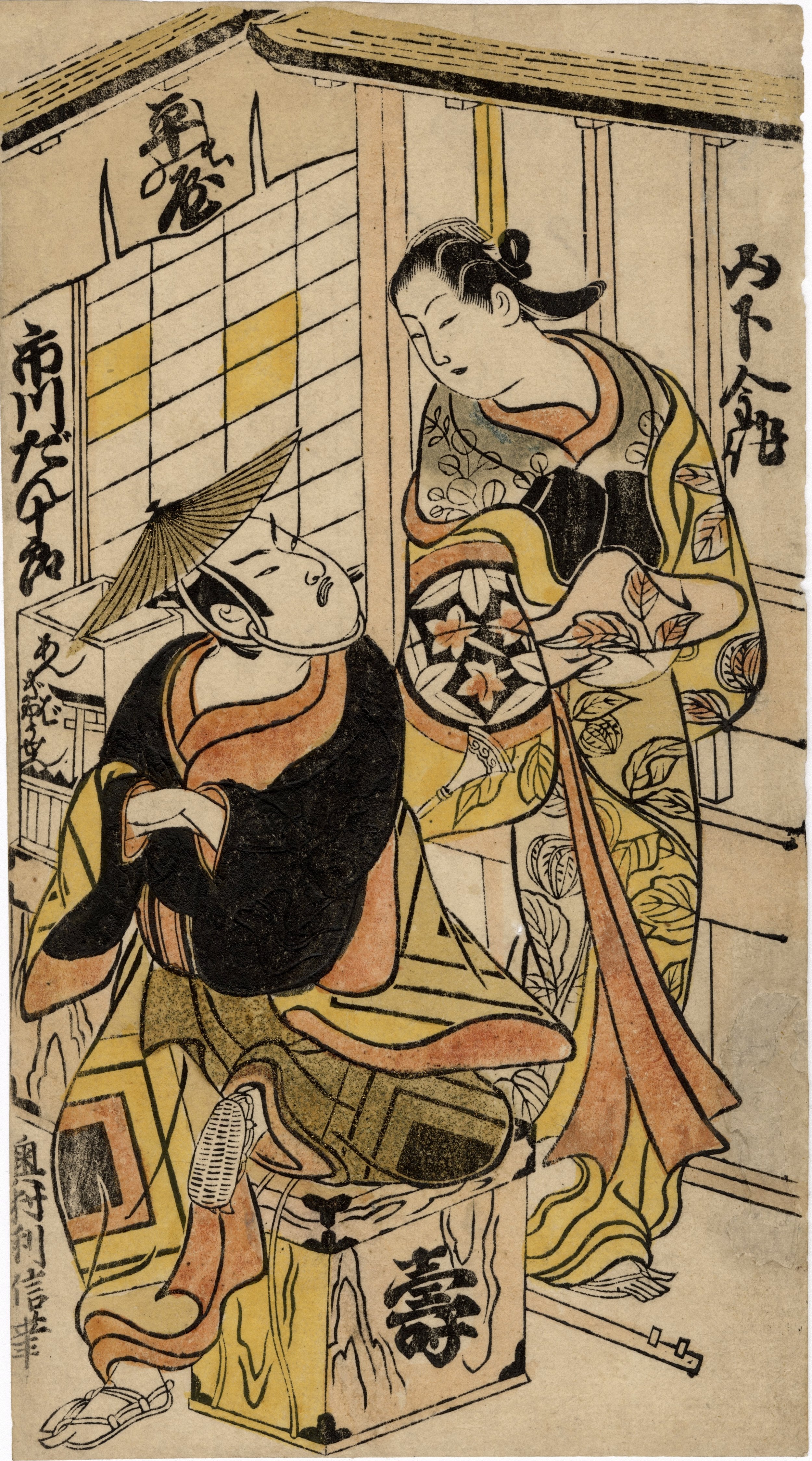
Here we see an early ukiyoe that not only depicts a kabuki superstar of the day, but showcases the techniques and tricks that print makers used at the time to help an image literally jump off the paper.
Okumura Toshinobu's "Ichikawa Danjuro" was created in the 1727s, decades before the maturity of the multicolor woodblock printing of so-called brocade prints (nishiki-e). In this early production method the lines were printed and then the colors applied by hand. Some areas are enhanced with the urushi-e (lacquer-print) technique to add gloss and thickness. Remarkably, some three hundred years later, the color scheme of this early work remains quite intact.
Urushi-e (lacquer prints) continued the hand-coloring practice of so-called beni-e, which used safflower-derived red colorant, and used animal glue to give the black a richness that caused it to rise slightly off the paper. The subtle patterns on the black robe and the gold patterns on the lower garment appear to be treated with glue-enriched black ink and metallic powder respectively. The thickness and texture left by these handmade techniques are especially discernable in person.
Okumura Toshinobu was active in the first half of the Eighteenth Century and was a disciple of Okumura Masanobu, specializing in prints of actors and beauties. His lines are soft and expansive.
The subject is described as Ichikawa Danjuro II, the second in a long line of similarly named Kabuki actors. In any event, he’s wearing a straw hat and is looking up, while the actor Yamashita Kinsaku I, bows his head to meet his gaze. By placing them one above the other, with a diagonal line connecting their eyes, Toshinobu took full advantage of vertical and narrow hosoban format, which was popular in ukiyoe’s early days.
浮世绘的历史,并非一开始就是满纸绚丽的色彩。奥村利信的这件《市川团十郎》来自作于十八世纪二十年代,距离多色套印锦绘的成熟尚有数十年。它保留着更早的制作方式:木版印出墨线,颜色由手工添染,局部再通过“漆绘”工艺增加光泽与厚度。难得的是,近三百年后,这张早期作品的设色仍保存得相当完整。
漆绘由红绘的手工设色方式发展而来。红绘以红花颜料为主,在墨印的线条上添染红、黄、绿等色;漆绘则进一步在黑墨中加入动物胶,使墨色浓稠饱满,在纸上形成近似漆器的光泽与轻微凸起,还常用铜粉掺胶上色,呈现金色的装饰效果。本作黑色衣袍中的暗纹,以及下身衣饰上的金色纹样,分别运用了胶墨与铜粉的处理。这些手工施作留下的厚度与质感,面对实物时尤其清楚。
奥村利信活跃于十八世纪前半叶,是奥村政信的门人,以演员画与美人画见长。他笔下的线条柔和舒展,在这张画中,人物转身的姿态与衣袖的曲线便颇能体现这一特点。画中市川团十郎二代头戴草笠,回身仰望,山下金作则微微俯首与他对望;两人的身姿一低一高,宽大的衣袖与衣摆交叠,将舞台上的互动收在狭长的画面里。
奥村利信 Okumura Toshinobu (active about 1717–1750)
漆绘:市川团十郎二代与初代山下金作
Urushi-e: Ichikawa Danjuro II & Yamashita Kinsaku I
1727
木版画 | 细判|29cm x 16cm
Woodblock-print | Hosoban | 29cm x 16cm
非常罕见的红绘;早期版次;颜色保存非常好;有轻微虫洞修补
Very rare Beni-e; fine impression; strong color; slight wormholes repairs, otherwise in good condition.
$4,200
Here we see an early ukiyoe that not only depicts a kabuki superstar of the day, but showcases the techniques and tricks that print makers used at the time to help an image literally jump off the paper.
Okumura Toshinobu's "Ichikawa Danjuro" was created in the 1727s, decades before the maturity of the multicolor woodblock printing of so-called brocade prints (nishiki-e). In this early production method the lines were printed and then the colors applied by hand. Some areas are enhanced with the urushi-e (lacquer-print) technique to add gloss and thickness. Remarkably, some three hundred years later, the color scheme of this early work remains quite intact.
Urushi-e (lacquer prints) continued the hand-coloring practice of so-called beni-e, which used safflower-derived red colorant, and used animal glue to give the black a richness that caused it to rise slightly off the paper. The subtle patterns on the black robe and the gold patterns on the lower garment appear to be treated with glue-enriched black ink and metallic powder respectively. The thickness and texture left by these handmade techniques are especially discernable in person.
Okumura Toshinobu was active in the first half of the Eighteenth Century and was a disciple of Okumura Masanobu, specializing in prints of actors and beauties. His lines are soft and expansive.
The subject is described as Ichikawa Danjuro II, the second in a long line of similarly named Kabuki actors. In any event, he’s wearing a straw hat and is looking up, while the actor Yamashita Kinsaku I, bows his head to meet his gaze. By placing them one above the other, with a diagonal line connecting their eyes, Toshinobu took full advantage of vertical and narrow hosoban format, which was popular in ukiyoe’s early days.
浮世绘的历史,并非一开始就是满纸绚丽的色彩。奥村利信的这件《市川团十郎》来自作于十八世纪二十年代,距离多色套印锦绘的成熟尚有数十年。它保留着更早的制作方式:木版印出墨线,颜色由手工添染,局部再通过“漆绘”工艺增加光泽与厚度。难得的是,近三百年后,这张早期作品的设色仍保存得相当完整。
漆绘由红绘的手工设色方式发展而来。红绘以红花颜料为主,在墨印的线条上添染红、黄、绿等色;漆绘则进一步在黑墨中加入动物胶,使墨色浓稠饱满,在纸上形成近似漆器的光泽与轻微凸起,还常用铜粉掺胶上色,呈现金色的装饰效果。本作黑色衣袍中的暗纹,以及下身衣饰上的金色纹样,分别运用了胶墨与铜粉的处理。这些手工施作留下的厚度与质感,面对实物时尤其清楚。
奥村利信活跃于十八世纪前半叶,是奥村政信的门人,以演员画与美人画见长。他笔下的线条柔和舒展,在这张画中,人物转身的姿态与衣袖的曲线便颇能体现这一特点。画中市川团十郎二代头戴草笠,回身仰望,山下金作则微微俯首与他对望;两人的身姿一低一高,宽大的衣袖与衣摆交叠,将舞台上的互动收在狭长的画面里。