Yoshida | Lugano

$0.00

吉田博 Hiroshi Yoshida (1876-1950)

卢加诺
Lugano

1925

木版画 | 横绘大大判 | 26.5cm x 39.3cm
Woodblock-print | Large Oban Yoko-e | 26.5cm x 39.3cm

自摺;铅笔亲笔签名;品相非常好
Signed in brush and in pencil, with jizuri seal; fine condition

$9,288

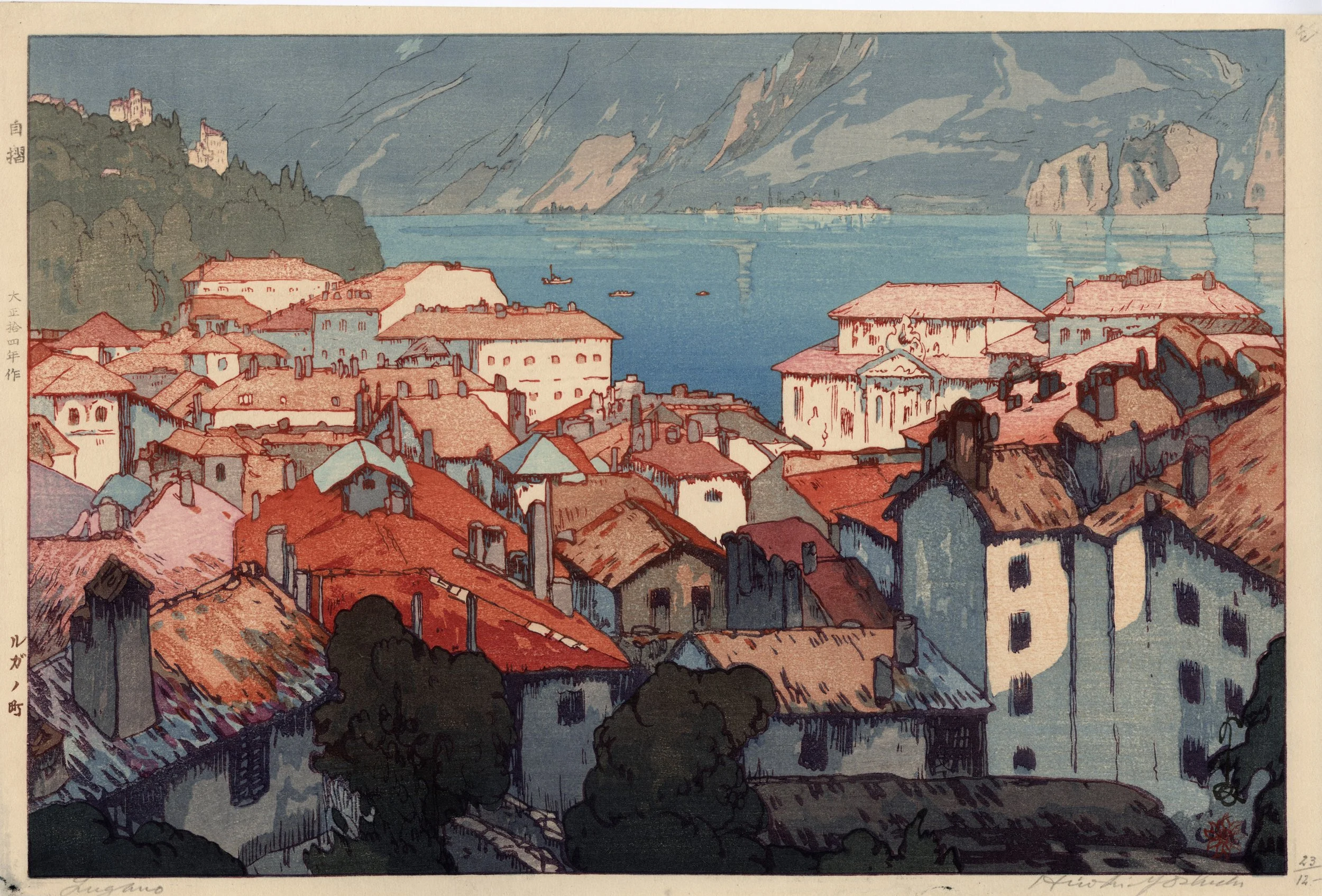
Two fascinating thru-lines of Hiroshi’s Yoshida’s incomparable career come together in this wonderful view of Lugano, a town nestled on the border of Italy and Switzerland, that he produced following his third trip to Europe in the 1920s.

To begin with, despite his lasting fame as a Shin Hanga print designer, Yoshida was first and foremost a painter, with considerable skill at both watercolors and oils, and a firm handle on western techniques. Secondly, he was among the first Japanese artists to travel the world and capture famous views far and wide.

Here we see a rich painterly view of this truly European town, which was in the Italian-speaking region of Southern Switzerland. Note how the dark shadow in the foreground directs our eye to the vibrant middle ground of red, orange and pink rooftops, and shimmering Lake Lugano beyond. Note, also, how the shadow itself is blue, a discovery made some 100 years before by Jean Baptiste-Camille Corot’s in his legendary Bridge at Narni. (See the shadow under the bridge.)

This particular example has only had one owner since it was purchased in Japan and has remained in the comfortable darkness of its folder. You can practically feel the warmth of the sun.  

在这幅描绘卢加诺(一座镶嵌在意瑞边境的小镇)的动人画作中,吉田博传奇生涯里的两道高光完美交汇。这是他在1920年代完成第三次留欧之旅后的心血之作。

究其魅力,其一在于吉田博虽以“新版画”巨匠闻名于世,但他骨子里首先是一位画家。他在水彩与油画领域造诣极深,对西方绘画技法有着炉火纯青的掌控力。其二,他是大正时期少数拥有全球视野的日本艺术家,敢于远赴重洋,将世界各地的胜景尽收笔端。

画中对这座意式风情小镇的刻画,充满了浓郁的绘画韵味。前景那一抹深邃的阴影如序幕般拉开,精准地将观者的视线引向中景——那里簇拥着明艳生动的红、橙、粉色屋顶,更远处则是波光粼粼的卢加诺湖。尤为精妙的是,阴影本身透着一种静谧的蓝色,这种对色彩的敏锐捕捉,正是在致敬百年前让-巴蒂斯特·卡米耶·柯罗在《纳尔尼桥》中所开启的视觉革命。

这件作品自日本购入后便由同一位藏家悉心收藏,一直避光保存在画夹中。当你凝视画面时,那抹百年前的暖阳似乎穿透了纸张,依然余温尚存。

Interested in purchasing?
Please contact us.

吉田博 Hiroshi Yoshida (1876-1950)

卢加诺
Lugano

1925

木版画 | 横绘大大判 | 26.5cm x 39.3cm
Woodblock-print | Large Oban Yoko-e | 26.5cm x 39.3cm

自摺;铅笔亲笔签名;品相非常好
Signed in brush and in pencil, with jizuri seal; fine condition

$9,288

Two fascinating thru-lines of Hiroshi’s Yoshida’s incomparable career come together in this wonderful view of Lugano, a town nestled on the border of Italy and Switzerland, that he produced following his third trip to Europe in the 1920s.

To begin with, despite his lasting fame as a Shin Hanga print designer, Yoshida was first and foremost a painter, with considerable skill at both watercolors and oils, and a firm handle on western techniques. Secondly, he was among the first Japanese artists to travel the world and capture famous views far and wide.

Here we see a rich painterly view of this truly European town, which was in the Italian-speaking region of Southern Switzerland. Note how the dark shadow in the foreground directs our eye to the vibrant middle ground of red, orange and pink rooftops, and shimmering Lake Lugano beyond. Note, also, how the shadow itself is blue, a discovery made some 100 years before by Jean Baptiste-Camille Corot’s in his legendary Bridge at Narni. (See the shadow under the bridge.)

This particular example has only had one owner since it was purchased in Japan and has remained in the comfortable darkness of its folder. You can practically feel the warmth of the sun.  

在这幅描绘卢加诺(一座镶嵌在意瑞边境的小镇)的动人画作中,吉田博传奇生涯里的两道高光完美交汇。这是他在1920年代完成第三次留欧之旅后的心血之作。

究其魅力,其一在于吉田博虽以“新版画”巨匠闻名于世,但他骨子里首先是一位画家。他在水彩与油画领域造诣极深,对西方绘画技法有着炉火纯青的掌控力。其二,他是大正时期少数拥有全球视野的日本艺术家,敢于远赴重洋,将世界各地的胜景尽收笔端。

画中对这座意式风情小镇的刻画,充满了浓郁的绘画韵味。前景那一抹深邃的阴影如序幕般拉开,精准地将观者的视线引向中景——那里簇拥着明艳生动的红、橙、粉色屋顶,更远处则是波光粼粼的卢加诺湖。尤为精妙的是,阴影本身透着一种静谧的蓝色,这种对色彩的敏锐捕捉,正是在致敬百年前让-巴蒂斯特·卡米耶·柯罗在《纳尔尼桥》中所开启的视觉革命。

这件作品自日本购入后便由同一位藏家悉心收藏,一直避光保存在画夹中。当你凝视画面时,那抹百年前的暖阳似乎穿透了纸张,依然余温尚存。

Interested in purchasing?
Please contact us.

Hiroshi Yoshida (1876-1950)

From middle school in Kyushu to travelling the globe.

Little Hiroshi Ueda was only 15 when Kasaburo Yoshida, his art teacher in Fukuoka, recognized his talent. So what did he do? He adopted him. Soon enough, young Hiroshi was studying painting in the fast-moving whirl of Meiji Tokyo, a world away.

But that was only the beginning. In time the young man would rise to fame as a Shin Hanga (New Print) master, focusing mostly on landscapes, second in reputation only to Kawase Hasui. But unlike Hasui, who’s views were all set in Japan, Yoshida travelled the world to find compositions and to learn and experiment with Western painting techniques. His fine eye would capture scenes as disparate as the Matterhorn, Venice, The Golden Temple in Rangoon – even Pittsburgh, a gritty industrial city that he would imbue with smoky mystery and romance.

And it wasn’t only his designs that focused on the West. Yoshida was also one of the first Japanese woodblock print artists to gain a reputation beyond Japan.

At first, it was his paintings that were recognized. He had a show at the Detroit Museum of Art in 1899, one in Paris in 1900 and had his work featured at the St Louis World’s Fair in 1903, among other places.

Back in Japan, when he was 44, Yoshida met a man who’d have as big an effect on his career as his middle school art teacher --  Shōzaburō Watanabe, the father of Shin Hanga. Watanabe published several of Yoshida’s works, but their partnership was cut short when his workshop was destroyed in the Kanto earthquake of 1923. Nonetheless, the die was cast. That same year, Yoshida again visited the United States and noticed the burgeoning interest in Japanese prints – and all things Japanese.

He returned home and put together his own studio. His firm control of the process -- from preparatory sketch to final printing -- was one reason his prints have such a singular quality; there is nothing quite like them. Another is his painterly approach. Some works appear almost as if they fell off the tip of a watercolor brush, while others have the muscular values of oils. Looking at his many paintings and then his print designs, it’s easy to see how one grew into the other.

Yoshida started something of a family dynasty. His wife Fujio was a talented painter and printmaker, as was his elder son, Toshi, and his wife, Kiso. His younger son, Hodaka – named for Hiroshi Yoshida’s favorite mountain -- was a modernist designer in the Sosako Hanga print movement in the 20th Century, as were his wife and daughter.

Hiroshi Yoshida’s first editions are usually (but not always) identified by his pencil-drawn signatures and the jizuri (self-printed) seal, usually in the upper left margin. Other scholars and dealers have shared a few interesting tidbits. One is that it was his wife who signed the prints for Western export (prints to be sold in Japan didn’t have a hand-drawn signature), and the other is that his key blocks were made of zinc, so they never wore down.

Hiroshi Yoshida died on April 15, 1950, leaving behind a legacy in art and artists. His key blocks will never fade, nor will his wondrous body of work.