
 Image 1 of 2
 Image 2 of 2
Hiroshi Yoshida (1876-1950)
From middle school in Kyushu to travelling the globe.
Little Hiroshi Ueda was only 15 when Kasaburo Yoshida, his art teacher in Fukuoka, recognized his talent. So what did he do? He adopted him. Soon enough, young Hiroshi was studying painting in the fast-moving whirl of Meiji Tokyo, a world away.
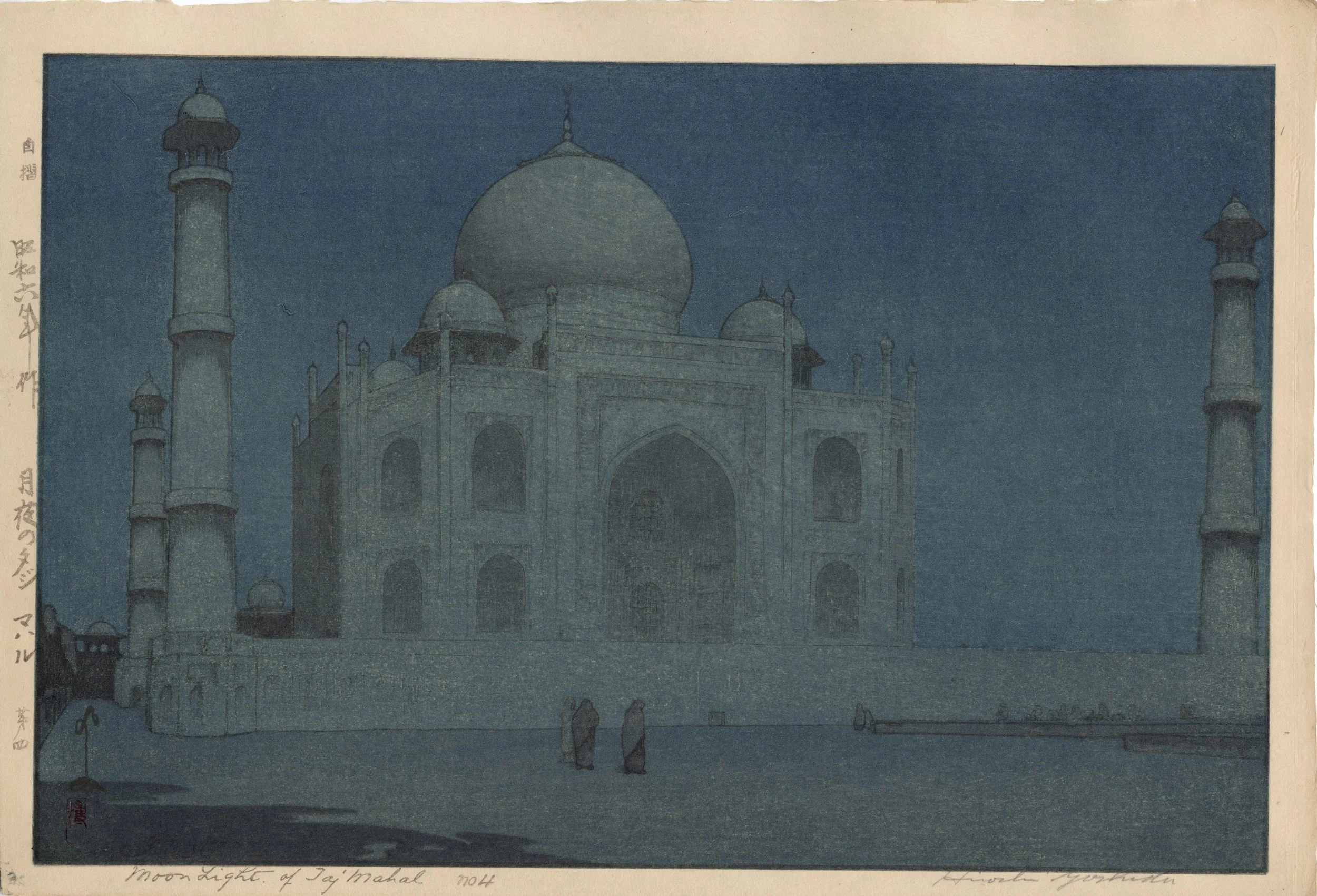
But that was only the beginning. In time the young man would rise to fame as a Shin Hanga (New Print) master, focusing mostly on landscapes, second in reputation only to Kawase Hasui. But unlike Hasui, who’s views were all set in Japan, Yoshida travelled the world to find compositions and to learn and experiment with Western painting techniques. His fine eye would capture scenes as disparate as the Matterhorn, Venice, The Golden Temple in Rangoon – even Pittsburgh, a gritty industrial city that he would imbue with smoky mystery and romance.
And it wasn’t only his designs that focused on the West. Yoshida was also one of the first Japanese woodblock print artists to gain a reputation beyond Japan.
At first, it was his paintings that were recognized. He had a show at the Detroit Museum of Art in 1899, one in Paris in 1900 and had his work featured at the St Louis World’s Fair in 1903, among other places.
Back in Japan, when he was 44, Yoshida met a man who’d have as big an effect on his career as his middle school art teacher -- Shōzaburō Watanabe, the father of Shin Hanga. Watanabe published several of Yoshida’s works, but their partnership was cut short when his workshop was destroyed in the Kanto earthquake of 1923. Nonetheless, the die was cast. That same year, Yoshida again visited the United States and noticed the burgeoning interest in Japanese prints – and all things Japanese.
He returned home and put together his own studio. His firm control of the process -- from preparatory sketch to final printing -- was one reason his prints have such a singular quality; there is nothing quite like them. Another is his painterly approach. Some works appear almost as if they fell off the tip of a watercolor brush, while others have the muscular values of oils. Looking at his many paintings and then his print designs, it’s easy to see how one grew into the other.
Yoshida started something of a family dynasty. His wife Fujio was a talented painter and printmaker, as was his elder son, Toshi, and his wife, Kiso. His younger son, Hodaka – named for Hiroshi Yoshida’s favorite mountain -- was a modernist designer in the Sosako Hanga print movement in the 20th Century, as were his wife and daughter.
Hiroshi Yoshida’s first editions are usually (but not always) identified by his pencil-drawn signatures and the jizuri (self-printed) seal, usually in the upper left margin. Other scholars and dealers have shared a few interesting tidbits. One is that it was his wife who signed the prints for Western export (prints to be sold in Japan didn’t have a hand-drawn signature), and the other is that his key blocks were made of zinc, so they never wore down.
Hiroshi Yoshida died on April 15, 1950, leaving behind a legacy in art and artists. His key blocks will never fade, nor will his wondrous body of work.