落合芳幾 Ochiai Yoshiiku (1833-1904)
時世粧年中行事之内 一陽来復花姿湯
Long waited beautiful bath, from the series of Annual customs of the present day
1868
木版画 | 三联续绘-纵绘大判 | 37cm x 26cm x 3
Woodblock-print | Triptych-Oban-tate-e | 37cm x 26cm x 3
早期版次;颜色鲜艳;品相非常好
Fine impression, color and condition
$6,800
Naked ladies! Naked ladies everywhere!
The bathhouse print was something of a sub-genre in Ukiyoe, linking traditional woodblock print designs with shunga, or erotic prints. It allowed artists to display the female form – often in many poses – without being explicitly sexual, which could get the artists and publishers in trouble. (Shunga, for example, which were produced by most of the great names in Ukiyoe, including Utamaro and Hokusai, were often unsigned.)
But of course, when we fill a design with many naked women, it can’t help but be a little sexy, or at least hint at eroticism.
In this wonderful and raucous bathhouse triptych by Ochiai Yoshiiku (1833-1904), we see 16 naked woman, one topless woman, seven elaborately clothed woman, three children and three men (!!!) -- likely the proprietor and attendants -- all cavorting in a sento, or the neighborhood baths that were shared by both sexes in Edo times.
The traditions of the sento remain in place today, although they are no longer mixed (that ended with the arrival of Westerners in the 1850s and 1860s). One washes oneself thoroughly, as all the women in the foreground are doing, before slipping into the scalding water of the tub, as the women in the upper right hand of the right-hand sheet have done.
Then one soaks in the steamy, blissful water, catching up on local news with bathmates, and perhaps sharing gossip.
An early such design came from Tori Kiyonaga, who’s 1787 “Interior of a bathhouse” gave us a view of eight women in various states of undress preparing for or enjoying their baths. Later, Toyohara Kunichika would also provide his take on the crowded bath house scene, often with a healthy dose of comedy, such a nude woman pratfalling or two naked women getting into a hair-pulling catfight as the male attendants struggle to resolve the fracas.
The use of multi-sheet designs allows for the maximum number of unclothed female bodies. But they are never entirely unclothed, unlike shunga. Look closely (if you haven’t already). The artists creatively used a variety of angles, tenugi, limbs, oke wooden bath buckets and architectural elements to protect at least a little of the women’s modesty.
Fun times.
Interested in purchasing?
Please contact us.
落合芳幾 Ochiai Yoshiiku (1833-1904)
時世粧年中行事之内 一陽来復花姿湯
Long waited beautiful bath, from the series of Annual customs of the present day
1868
木版画 | 三联续绘-纵绘大判 | 37cm x 26cm x 3
Woodblock-print | Triptych-Oban-tate-e | 37cm x 26cm x 3
早期版次;颜色鲜艳;品相非常好
Fine impression, color and condition
$6,800
Naked ladies! Naked ladies everywhere!
The bathhouse print was something of a sub-genre in Ukiyoe, linking traditional woodblock print designs with shunga, or erotic prints. It allowed artists to display the female form – often in many poses – without being explicitly sexual, which could get the artists and publishers in trouble. (Shunga, for example, which were produced by most of the great names in Ukiyoe, including Utamaro and Hokusai, were often unsigned.)
But of course, when we fill a design with many naked women, it can’t help but be a little sexy, or at least hint at eroticism.
In this wonderful and raucous bathhouse triptych by Ochiai Yoshiiku (1833-1904), we see 16 naked woman, one topless woman, seven elaborately clothed woman, three children and three men (!!!) -- likely the proprietor and attendants -- all cavorting in a sento, or the neighborhood baths that were shared by both sexes in Edo times.
The traditions of the sento remain in place today, although they are no longer mixed (that ended with the arrival of Westerners in the 1850s and 1860s). One washes oneself thoroughly, as all the women in the foreground are doing, before slipping into the scalding water of the tub, as the women in the upper right hand of the right-hand sheet have done.
Then one soaks in the steamy, blissful water, catching up on local news with bathmates, and perhaps sharing gossip.
An early such design came from Tori Kiyonaga, who’s 1787 “Interior of a bathhouse” gave us a view of eight women in various states of undress preparing for or enjoying their baths. Later, Toyohara Kunichika would also provide his take on the crowded bath house scene, often with a healthy dose of comedy, such a nude woman pratfalling or two naked women getting into a hair-pulling catfight as the male attendants struggle to resolve the fracas.
The use of multi-sheet designs allows for the maximum number of unclothed female bodies. But they are never entirely unclothed, unlike shunga. Look closely (if you haven’t already). The artists creatively used a variety of angles, tenugi, limbs, oke wooden bath buckets and architectural elements to protect at least a little of the women’s modesty.
Fun times.
Interested in purchasing?
Please contact us.

 Image 1 of 8
 Image 2 of 8
 Image 3 of 8
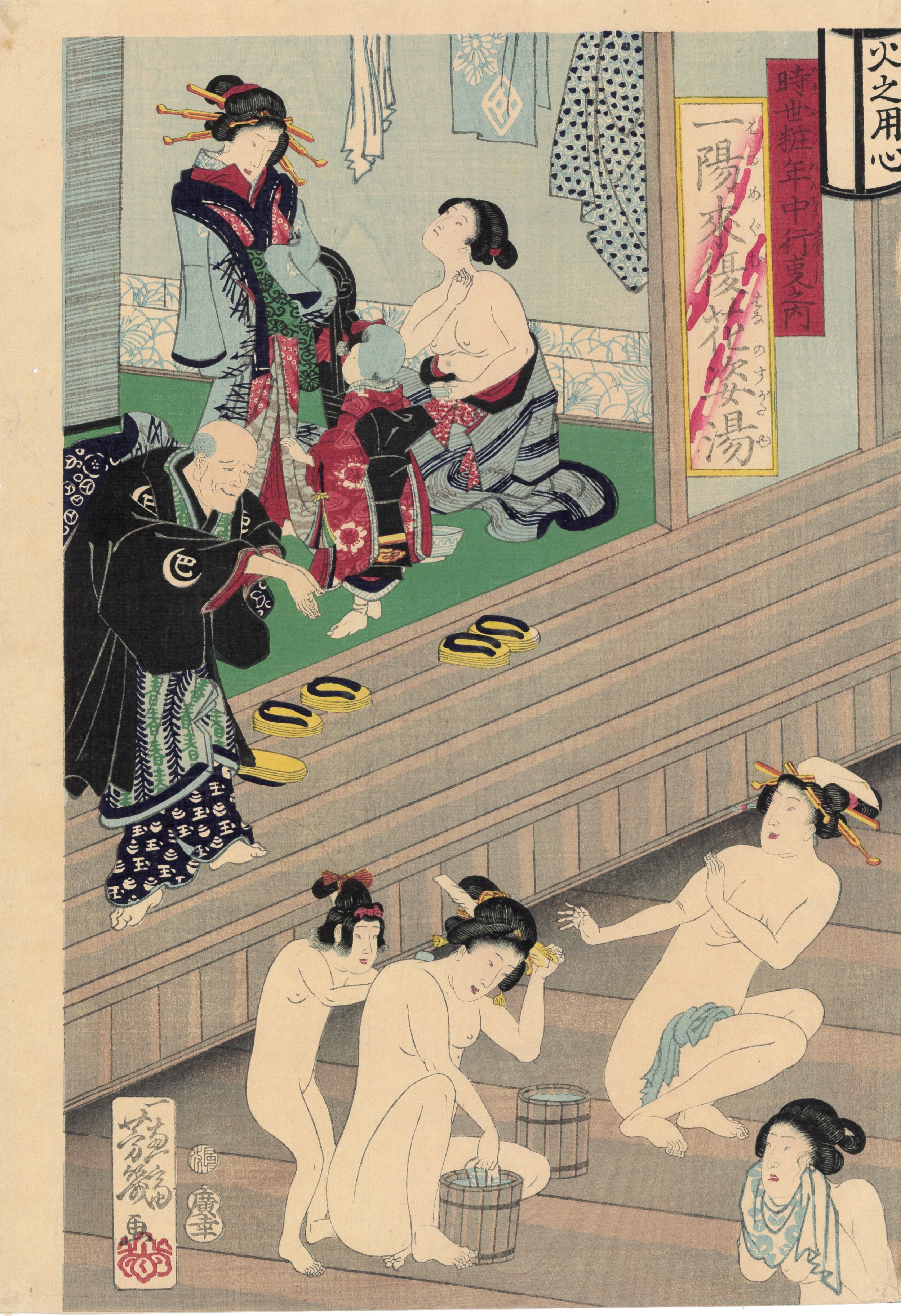 Image 4 of 8
 Image 5 of 8
 Image 6 of 8
 Image 7 of 8
 Image 8 of 8