
Series: 100 Famous Views of Edo
Created near the end of Utagawa Hiroshige's life, between 1856 and 1858, this celebrated ukiyo-e series ultimately comprised 118 woodblock prints depicting scenes across Edo (modern Tokyo) through the four seasons. Hiroshige captured everyday city life—bridges, temples, teahouses, festivals, snowy villages—using striking compositions: dramatic foreground framing, bold verticals, and unusual perspectives.
Lorem ipsum dolor sit amet, consectetur adipiscing elit, sed do eiusmod tempor incididunt ut labore et dolore magna aliqua. Imperdiet sed euismod nisi porta lorem mollis aliquam ut porttitor. Mi sit amet mauris commodo quis imperdiet massa tincidunt nunc. Quis varius quam quisque id diam vel. Elit ullamcorper dignissim cras tincidunt lobortis feugiat vivamus. Sagittis nisl rhoncus mattis rhoncus urna neque viverra. Sit amet nisl purus in mollis. Vitae sapien pellentesque habitant morbi tristique. Etiam dignissim diam quis enim. Ut sem viverra aliquet eget sit amet. Sed id semper risus in hendrerit gravida rutrum quisque non. Viverra mauris in aliquam sem fringilla. Sollicitudin nibh sit amet commodo nulla facilisi nullam. A iaculis at erat pellentesque adipiscing commodo elit at imperdiet.
View more in the series: 100 Famous Views of Edo
歌川広重 Utagawa Hiroshige (1797-1858)
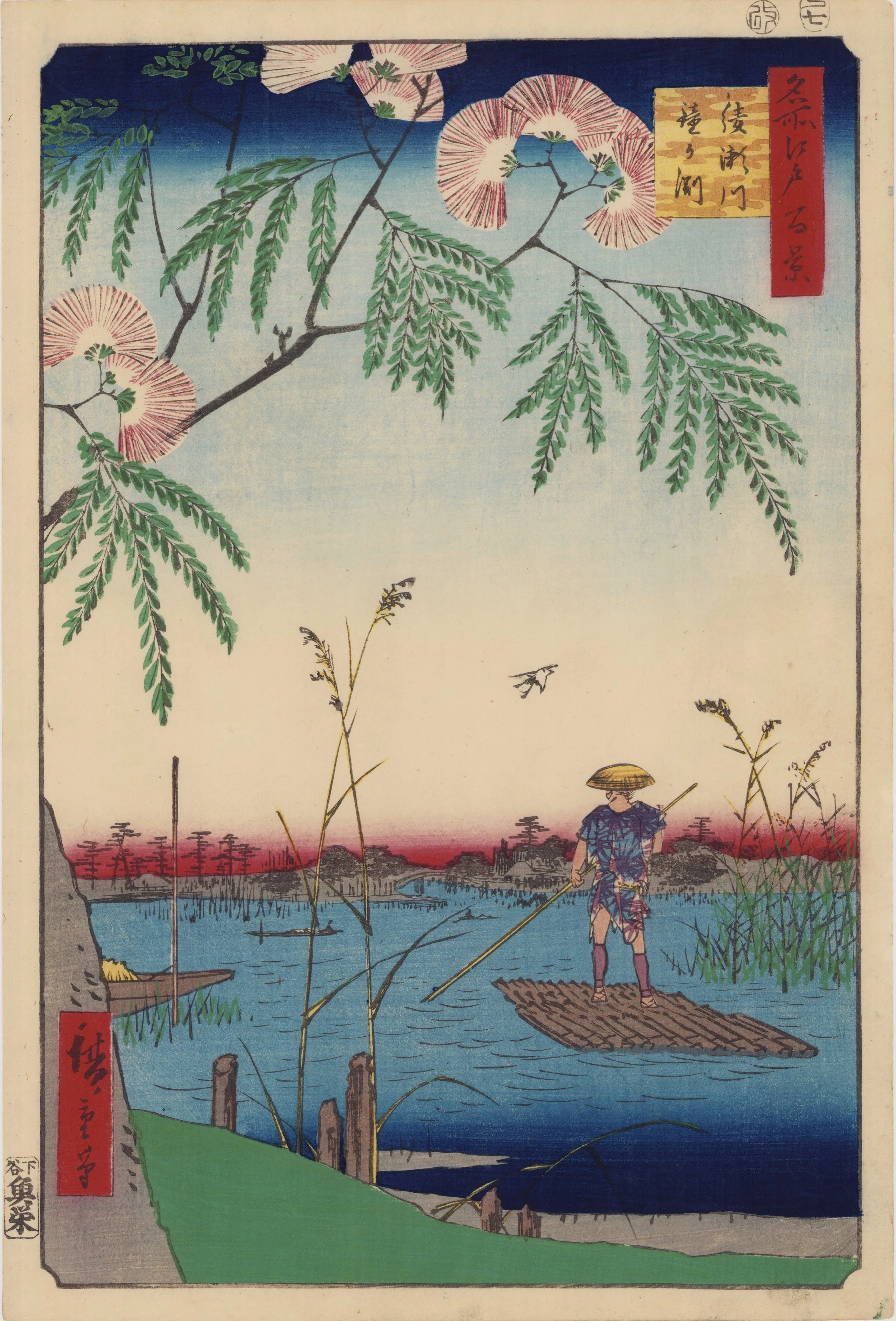
名所江戸百景 綾瀬川鐘が淵
Ayase River and Kanegafuchi, from the series of 100 Famous Views of Edo
1857
木版画 | 纵绘大判 | 36.5cm x 24cm
Woodblock-print | Oban tate-e | 36.5cm x 24cm
中期版次;颜色鲜艳;整体品相非常好
Mid state impression; strong color and good condition.
The Sumida River was often portrayed, by Hiroshige and other Ukiyoe and Shin Hanga artists, as a sprawling, panoramic waterway with great distances between banks. But in this surface-level vantage point from “100 Famous Views of Edo,” we see the moody, marshy river and its reedy shores in close-up detail, just like the paddler on the raft to the right.
We are standing at the spot where the river turns south after flowing east. Many designs in this legendary series include strong foreground elements, and this example is no exception: the top of the print is devoted to a closeup of the flowering mimosa tree, its blooms forming engaging half-circles.
In the distance we see the modest span of the Asaye Bridge, over the canal of the same name. Even though we are practically in the center of what was then the most populous city in the world, we get a visceral sense of how rural many sections were, and now nature mixed with humanity. (Note the alighting Heron — a classic touch.)
This example – with very strong color – was published somewhere near the midpoint of this print’s production lifespan. You can tell from the flowers, which are fully colored in, and the yellow-on-yellow cartouche.
Supplentary information from “Hirshoge’s 100 Views of Edo: The Definitive Collectors’ Edition” by the fine scholar Andreas Marks. (Tuttle, 2024)
Interested in purchasing?
Please contact us.

歌川広重 Utagawa Hiroshige (1797-1858)
名所江户百景 浅草川大川端宫戸川
Asakusa River, Great Riverbank, Miyato River, from the series of 100 Famous Views of Edo
1857
木版画 | 纵绘大判 | 36cm x 25cm
Woodblock-print | Oban tate-e | 36cm x 25cm
非常早期的版次;品相非常好
Very early impression; great condition
$7,200
Ukiyoe woodblock print designers, and Hiroshige especially, were masters of "negative space" -- focusing on the areas and spaces around the main subject matter of a print. And you will find few better examples of the bold use of negative space than in this print. Here the focus at the center appears to be, well, nothing. It's just a beautiful sky, without a cloud in sight. But look around the periphery: so much is happening. This print depicts a spot near the Ryogoku Bridge where pilgrims come to rinse themselves in the waters of the Sumida River. But we don't see that. Instead, we see the tenugui-wrapped heads of the pilgrims in the lower left, and, above that but still practically in the margin, the veritable bouquets of paper strips they hoist aloft as part of their ritual. Other pilgrims arrive by boat. In the distance we see the jagged peaks of Mount Tsukuba, which appears from time to time in 100 Famous Views of Edo. And in the middle: nothing.
Interested in purchasing?
Please contact us.
歌川広重 Utagawa Hiroshige (1797-1858)
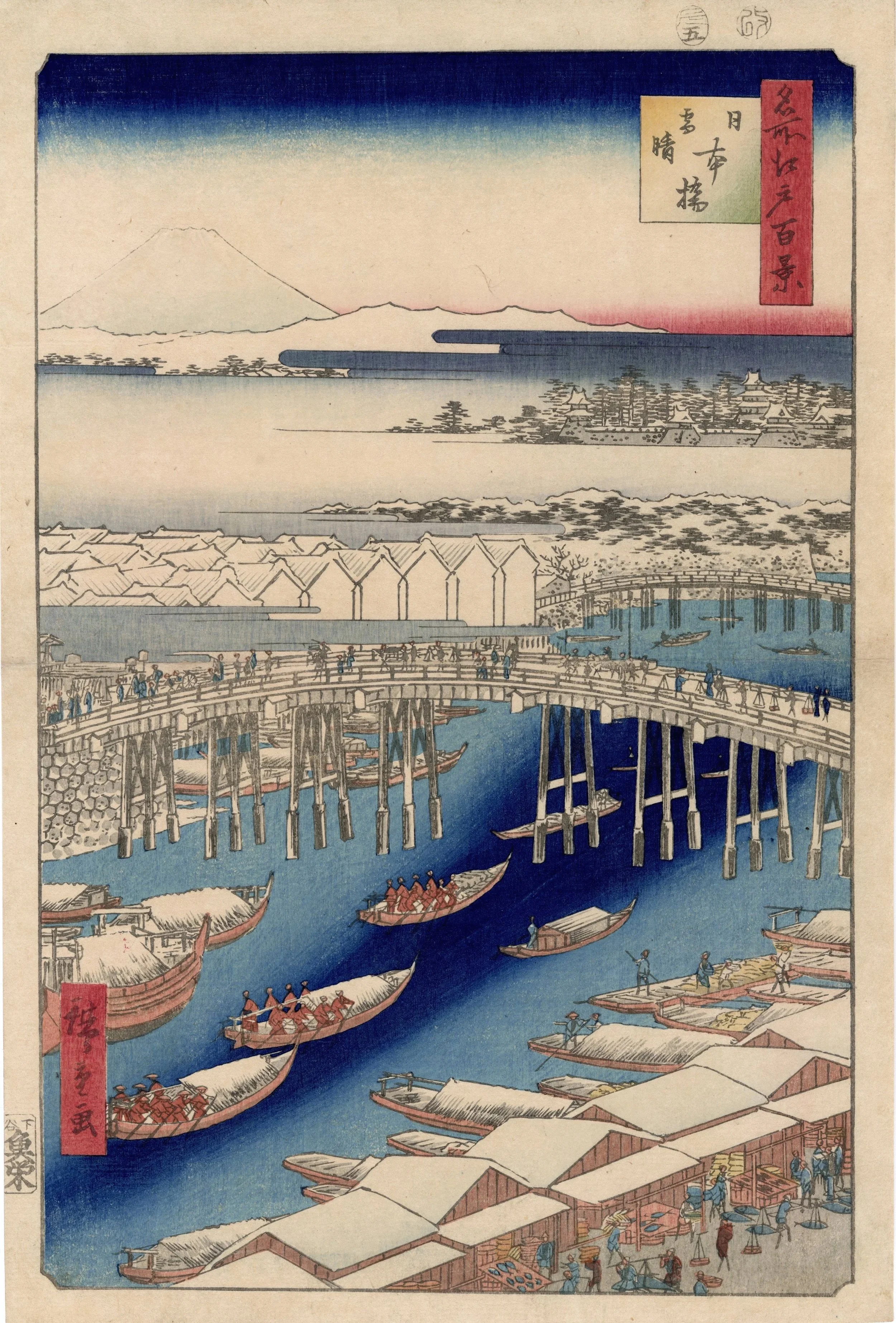
名所江户百景 日本桥雪晴
Clearing after Snow, from the series of 100 Famous Views of Edo
1856
木版画 | 纵绘大判 | 36.5cm x 25.4cm
Woodblock-print | Oban tate-e | 36.5cm x 25.4cm
非常早期的版本、版次;颜色鲜艳;非常轻微的中间折痕
Very early edition and impression with great color; very slight centerfold
PRICE ON REQUEST
《名所江户百景》,是歌川广重于1856至1858年创作的竖版名所绘系列,为广重晚年乃至整个创作生涯中艺术水准最高的代表作之一。全系列包括目录在内共计119幅,以四季为主题,分为了春夏秋冬四部。本作分属于其中的春之部,是全系列的首图。
一如《东海道五十三次》《木曾街道六拾九次之内》等成功系列的开篇,画中的主角也是大名鼎鼎的日本桥。身为东海道、中山道、日光街道、奥州街道与甲州街道五条陆上干道的共同起点,日本桥的重要性不言而喻。其周边区域自江户时代起即人口众多,商业繁荣,堪称江户城乃至全日本的CBD。瑞雪兆丰年。正月里一个雪晴的晨间,从日本桥东北侧的鱼河岸上向西眺望,由近至远,将鱼河岸、日本桥、一石桥、江户城本丸御殿与富岳尽收眼底。
在江户时代的每个清早,鱼河岸都是全江户城最热闹的区域。一排排被雪覆盖屋顶的店铺鳞次栉比,数不清的鱼商与菜贩店前去来,算不尽的货船与渡舟铺后往返,“朝千两(一早交易额超过千两)”的名头,确是要如此的盛况才能保证。广重立足于“江户城的厨房”,以最生活化的场景,展现着城中的富足繁华。从这儿游上百姓餐桌的一尾尾鲜鱼,即是新年必不可少的风物诗。
On a snowy morning we look west from the northeast side of Nihonbashi Bridge, taking in the elegant curve of the span itself, Edo Castle, Honmaru Palace and all the panoramic energy and bustle of Edo during this, the first month of the year. Auspicious snow heralds a good harvest, so joy mixes with the icy air. Rows of shops with snow-covered roofs stand side by side near shouting fish mongers and vegetable vendors as cargo boats and ferries ply the river.
This is the first design from "One Hundred Views of Famous Places in Edo," generally held to be Hiroshige’s late-career masterpiece, which included 119 woodblock prints divided into four sections: spring, summer, autumn and winter. Nihonbashi was the starting point for the famed Tokaido and Kiso highways, and the heart of Edo and thus a great place to start any journey, or story.
This is a deluxe version with a gorgeous cartouche with subtle bokashi, and rich and vibrant colors. The juxtaposition of the blue of the sky and the water against the white of the snow is especially dynamic; you can almost feel the first hint of the sun’s warmth touching your skin as night brightens to day.
Interested in purchasing?
Please contact us.
歌川広重 Utagawa Hiroshige (1797-1858)
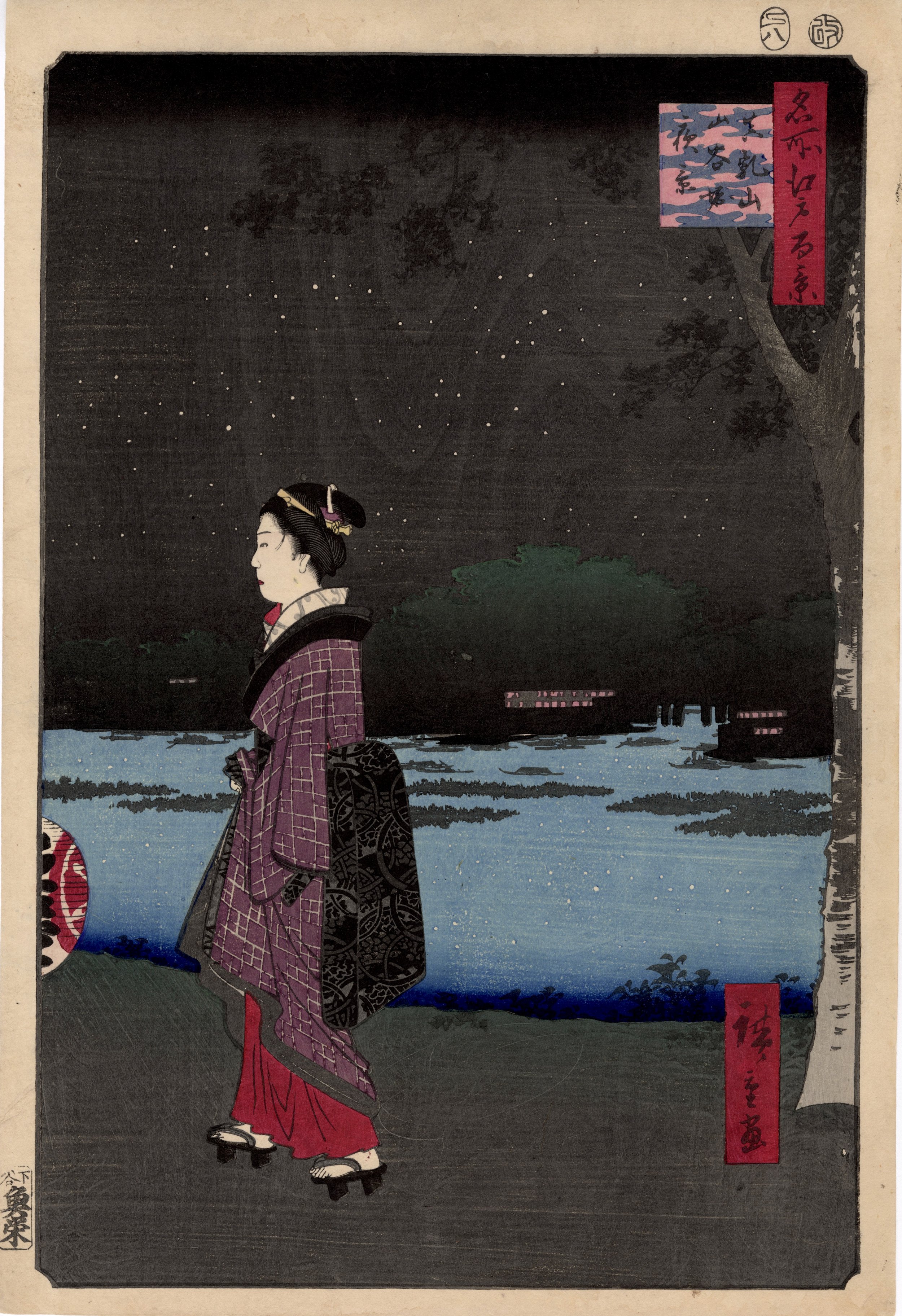
名所江户百景 真乳山山谷堀夜景
Night View of Matsuchiyama and the San'ya Canal from the series of 100 Famous Views of Edo
1858
木版画 | 纵绘大判 | 36.5cm x 25.4cm
Woodblock-print | Oban tate-e | 36.5cm x 25.4cm
早期版次;颜色鲜艳;品相非常好
Strong, rich color; woodgrain and mica and fine bokashi; great condition
$7,200
In this nocturnal, dream-like vision from Hiroshige’s last great series, we gaze across the Sumida River to Matsuchiyama Hill, the San'ya Canal and Imado Bridge. The lights of two restaurants, evocatively rendered in relief, becken us. The sky is an inky black, and the stars shine brightly — and in the river water. You can almost hear the distant laughter of a boozy night in Edo.
In the foreground, on our shore, a geisha walks behind her unseen attendant, who lights her way with a lantern. Some posit that it could be Koman, a favorite of Hiroshige, but others suggest that’s not possible because she’s too vulger — as suggested by the bright red of her inner skirt. In any event, she is one of very few full-length portraits in “100 Famous Views of Edo.”