川瀨巴水 Kawase Hasui ( 1883–1957)
旅みやげ第二集 丹後の宮津
Miyazu in Tango, from the series of Souvenirs of TraveI, Second Series
1921 (pre-earthquake)
木版画 | 纵绘大大判 | 39cm x 26.5cm
Woodblock-print | Large Oban tate-e | 39cm x 26.5cm
初摺;品相非常好
First edition; great condition
The monstrous temblor – soon to be called “The Great Kanto Earthquake” – shocked the region around Tokyo in three massive jolts on Sept. 1, 1923, demolishing houses and buildings, sending trains off their tracks, severing fuel and electric lines, and tossing cooking fires into the piles of wood that had once been kitchens. The flames spread, fed by typhoon-strength winds. Lost was so much – as many as 140,000 lives.
In the history of Japanese woodblock prints, especially Shin Hanga or “New Prints,” the earthquake stands as a dark line between then and now, a crucial marker in time for collectors. The quake and fires destroyed the studio of the great publisher Watenabe Shozaburo, along with countless blocks used to make the prints, the popularity of which had been steadily on the rise.
Suddenly, these designs could never be made again. This has given considerable value to “pre-earthquake” prints, especially those of the great Kawase Hasui, like this one, Miyazu in Tango, from the series “Souvenirs of Travel II” in 1921. (Pre-earthquake prints by Ito Shinsui and Shotei, such as thisand this, are also quite sought-after.)
But the quake also marked something of a stylistic break. Yes, Shin Hanga were “new” prints, but in the years before the earthquake they leaned heavily on Ukiyoe traditions, even as they embraced certain Western elements. Afterwards, the prints became more polished and intricate and, yes, Western.
In this lovely print we see a classic Japanese snow view of Miyazu, which is nestled on the often-snowbound west coast of Japan. The design with its lone figure is quite simple, with its roots and tradition in Edo times, despite the telephone poles (a favorite Hasui device).
Negative space abounds. The falling snow is stylized, and the rooftops fade away in diminishing perspective, just likein this Hiroshige view of Shinagawa. The black key-block lines are much in evidence, including around the snow on the trees where, really, no lines should exist, just white. In many future snow scenes, such as the wonderful Hatakudari in Shiobara from 1946, for example, the snow will exist in relief, without Ukiyoe-style white lines deliniating it.
Here in Miyazu, Hasui’s sense of the season is palpable. Unlike many Ukiyoe artists, Hasui sketched directly from nature. He travelled Japan extensively and constantly, at Watanabe’s urging. This comes from one of his earlier series, a second set of designs from his travels around the country. The great tragedy of the quake froze it forever in time.
大雪之中,宫津的街道几乎空无一人。屋顶、树木与远山在雪幕中逐渐失去轮廓,只留下电线与房屋的线条,将视线轻轻牵引向画面深处。雪安静而持续地落下,一位旅人独自穿行其间。
这幅《丹后·宫津》创作于1921年,出自川濑巴水《旅行纪念品第二集》系列。这一系列取材于巴水在日本各地的旅行经历,宫津是其中极具代表性的一站。位于京都府北部、日本海沿岸的宫津冬季多雪,气候清寒,这种沿海城镇特有的湿冷与空旷,在画中被准确地呈现出来。
与传统浮世绘雪景偏重装饰性的处理不同,巴水更多依靠写生经验与对光影、空间关系的观察来构成画面。雪的层次、水面的暗色倒影以及远山在雪雾中的虚化,都显得自然而真实。画面中出现的电线杆等现代元素,也清楚地标示出这是一个已经进入近代的日本。
《旅行纪念品》系列是巴水风景画创作中极为重要系列作品之一。由于关东大地震摧毁了大量原版版木,使得震前出版的作品在今天不仅存世稀少、难以遇见,价格也长期居高,成为市场上最受追逐的一类作品。《丹后·宫津》正是这一时期遗留下来的代表性雪景作品。
Interested in purchasing?
Please contact us.
川瀨巴水 Kawase Hasui ( 1883–1957)
旅みやげ第二集 丹後の宮津
Miyazu in Tango, from the series of Souvenirs of TraveI, Second Series
1921 (pre-earthquake)
木版画 | 纵绘大大判 | 39cm x 26.5cm
Woodblock-print | Large Oban tate-e | 39cm x 26.5cm
初摺;品相非常好
First edition; great condition
The monstrous temblor – soon to be called “The Great Kanto Earthquake” – shocked the region around Tokyo in three massive jolts on Sept. 1, 1923, demolishing houses and buildings, sending trains off their tracks, severing fuel and electric lines, and tossing cooking fires into the piles of wood that had once been kitchens. The flames spread, fed by typhoon-strength winds. Lost was so much – as many as 140,000 lives.
In the history of Japanese woodblock prints, especially Shin Hanga or “New Prints,” the earthquake stands as a dark line between then and now, a crucial marker in time for collectors. The quake and fires destroyed the studio of the great publisher Watenabe Shozaburo, along with countless blocks used to make the prints, the popularity of which had been steadily on the rise.
Suddenly, these designs could never be made again. This has given considerable value to “pre-earthquake” prints, especially those of the great Kawase Hasui, like this one, Miyazu in Tango, from the series “Souvenirs of Travel II” in 1921. (Pre-earthquake prints by Ito Shinsui and Shotei, such as thisand this, are also quite sought-after.)
But the quake also marked something of a stylistic break. Yes, Shin Hanga were “new” prints, but in the years before the earthquake they leaned heavily on Ukiyoe traditions, even as they embraced certain Western elements. Afterwards, the prints became more polished and intricate and, yes, Western.
In this lovely print we see a classic Japanese snow view of Miyazu, which is nestled on the often-snowbound west coast of Japan. The design with its lone figure is quite simple, with its roots and tradition in Edo times, despite the telephone poles (a favorite Hasui device).
Negative space abounds. The falling snow is stylized, and the rooftops fade away in diminishing perspective, just likein this Hiroshige view of Shinagawa. The black key-block lines are much in evidence, including around the snow on the trees where, really, no lines should exist, just white. In many future snow scenes, such as the wonderful Hatakudari in Shiobara from 1946, for example, the snow will exist in relief, without Ukiyoe-style white lines deliniating it.
Here in Miyazu, Hasui’s sense of the season is palpable. Unlike many Ukiyoe artists, Hasui sketched directly from nature. He travelled Japan extensively and constantly, at Watanabe’s urging. This comes from one of his earlier series, a second set of designs from his travels around the country. The great tragedy of the quake froze it forever in time.
大雪之中,宫津的街道几乎空无一人。屋顶、树木与远山在雪幕中逐渐失去轮廓,只留下电线与房屋的线条,将视线轻轻牵引向画面深处。雪安静而持续地落下,一位旅人独自穿行其间。
这幅《丹后·宫津》创作于1921年,出自川濑巴水《旅行纪念品第二集》系列。这一系列取材于巴水在日本各地的旅行经历,宫津是其中极具代表性的一站。位于京都府北部、日本海沿岸的宫津冬季多雪,气候清寒,这种沿海城镇特有的湿冷与空旷,在画中被准确地呈现出来。
与传统浮世绘雪景偏重装饰性的处理不同,巴水更多依靠写生经验与对光影、空间关系的观察来构成画面。雪的层次、水面的暗色倒影以及远山在雪雾中的虚化,都显得自然而真实。画面中出现的电线杆等现代元素,也清楚地标示出这是一个已经进入近代的日本。
《旅行纪念品》系列是巴水风景画创作中极为重要系列作品之一。由于关东大地震摧毁了大量原版版木,使得震前出版的作品在今天不仅存世稀少、难以遇见,价格也长期居高,成为市场上最受追逐的一类作品。《丹后·宫津》正是这一时期遗留下来的代表性雪景作品。
Interested in purchasing?
Please contact us.

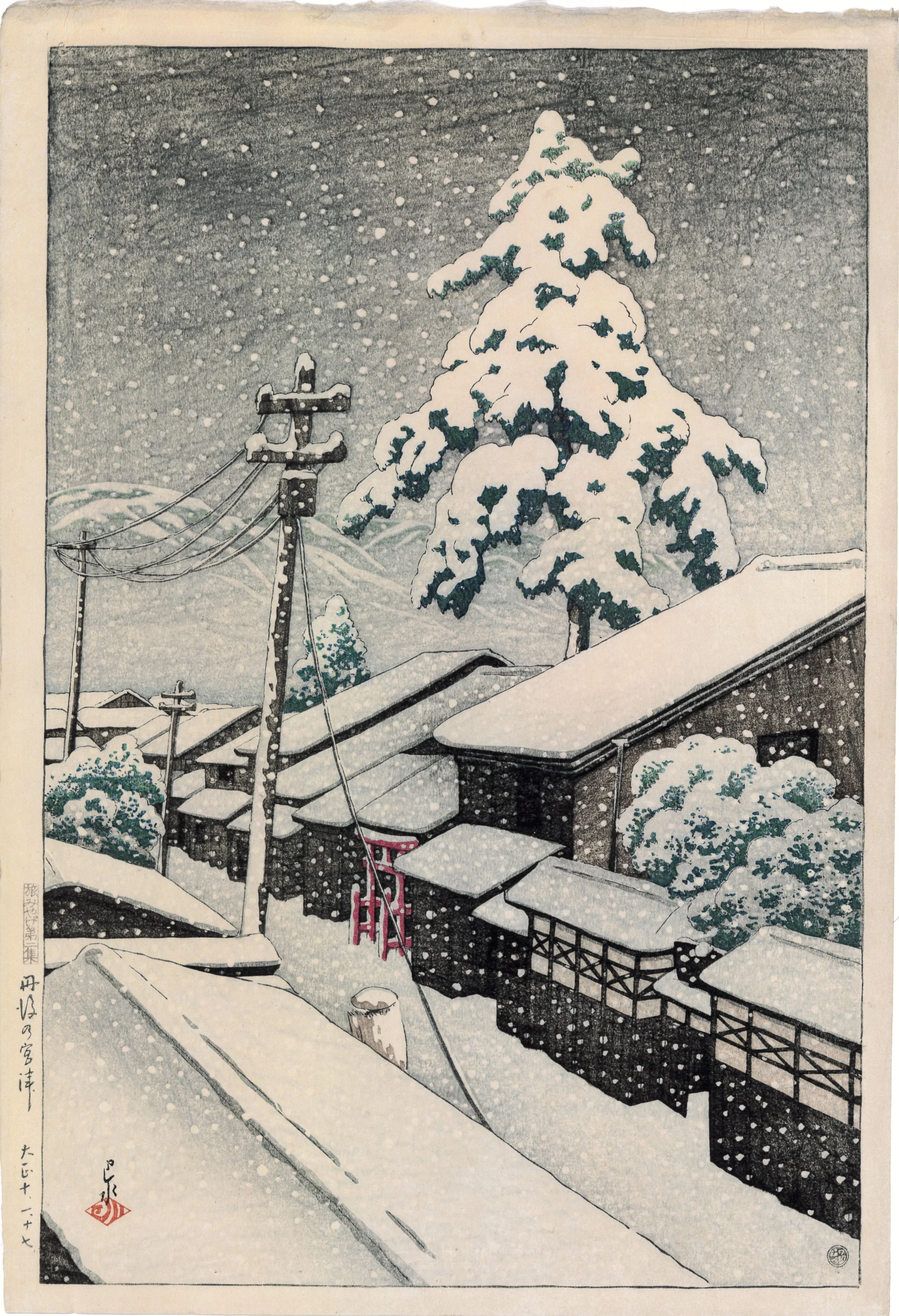 Image 1 of 2
 Image 2 of 2