Hiroshige II | Seven-Mile Beach in Sagami Province, 100 views of Famous Places in the Provinces

$0.00

二代目歌川広重 Utagawa Hiroshige II (active 1826–1869)

诸国名所百景 相州 七里滨
Seven-Mile Beach in Sagami Province, from the series One Hundred Views of Famous Places in the Provinces

1859

木版画 | 纵绘大判 | 37cm x 24.5cm
Woodblock-print | Oban tate-e | 37cm x 24.5cm

早期版次;颜色鲜艳;品相非常好
Fine impression, color and condition.

$6,500

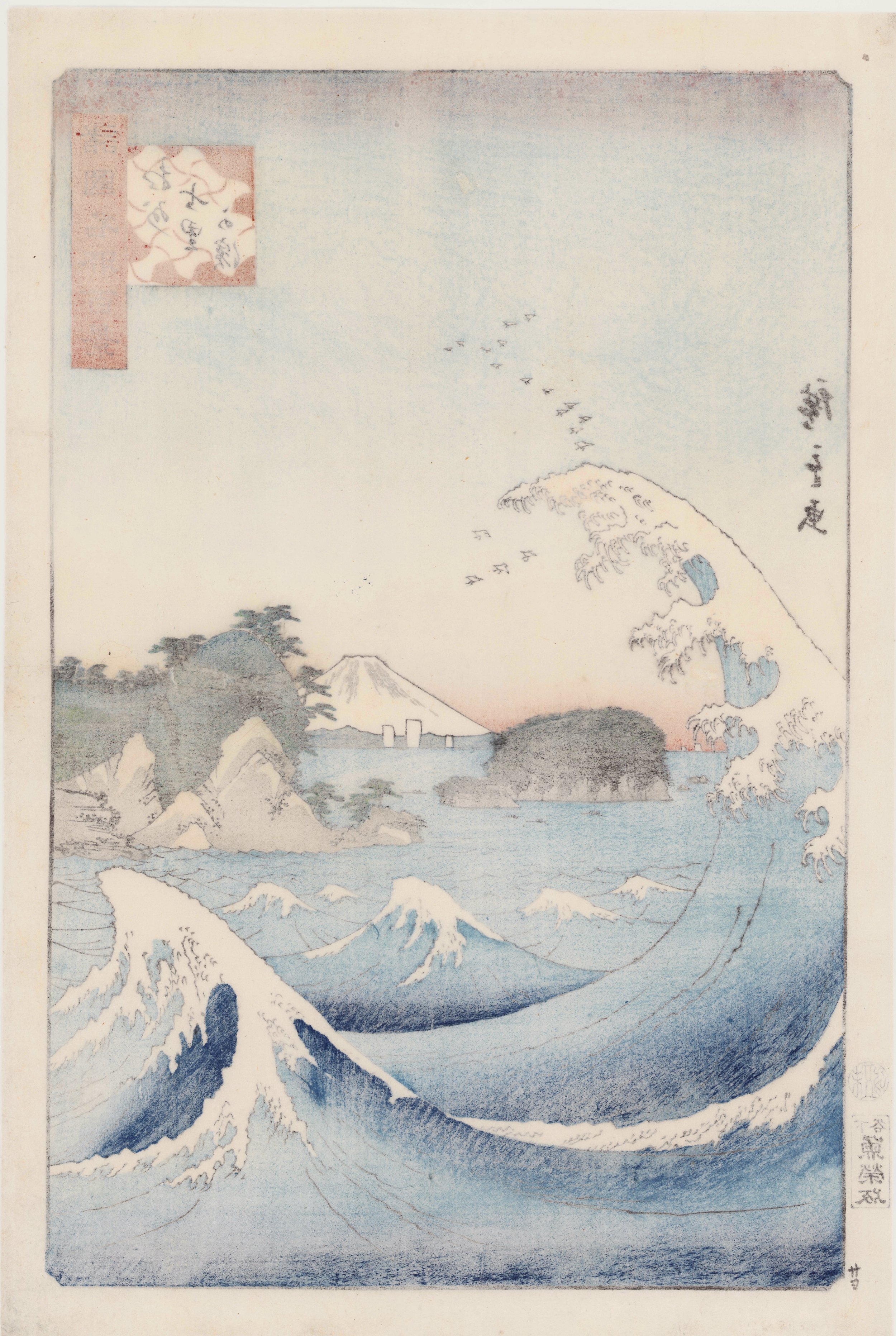
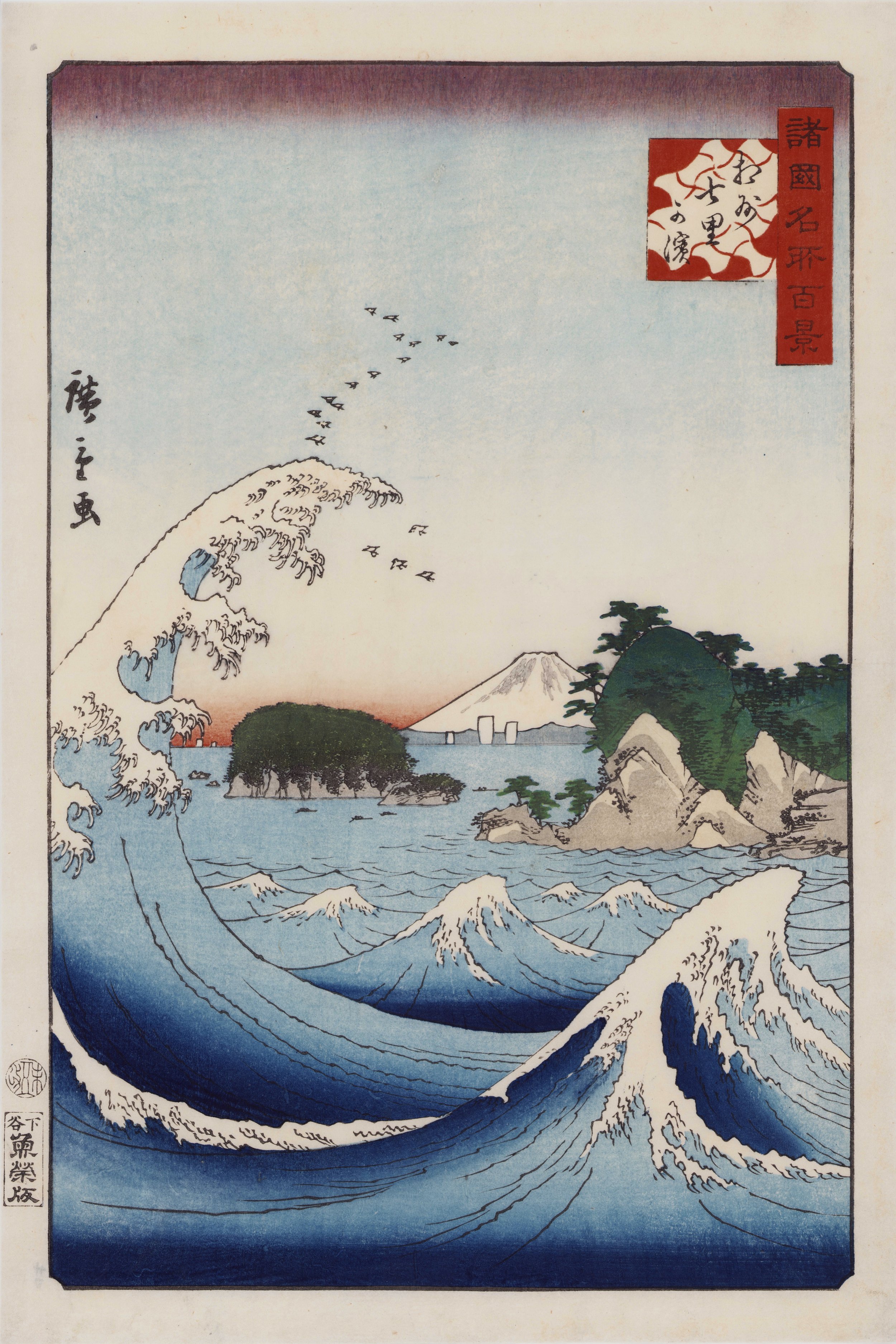
In this extraordinary design by Hiroshige II, we see the unmistakable influences of both the great Hokusai and Hiroshige himself, as well as the highly skilled printing that marked the sunset of the Ukiyoe epoch.

A giant, cresting wave is poised to engulf Mount Fuji, as it did in Hokusai’s “Great Wave off Kanagawa” from 1832 and Hiroshige’s “Hota Coast” from 1858. In all three cases, tentacled white water tops the crashing surf, seemingly dwarfing via perspective the distant mountain. Here too, the wave seems ready to drench the tiny, tree-adorned island of Enoshima, the popular pilgrimage destination near Edo.

As Hokusai’s Great Wave is perhaps the most famous Japanese woodblock print ever produced – and was certainly a bestseller in Edo times – it’s no surprise that subsequent generations of artists sought to emulate him and, perhaps, capitalize on his fame. Yet each brought his own talents to the venture.

“One Hundred Views of the Provinces” was Hiroshige II’s homage to his master, a project embarked upon so soon after the first Hiroshige’s death that the signature on this print simply says “Hiroshige.” The series was a clear sequel to “100 Famous Views of Edo” but with a wider lens that included all of Japan. It was published by the same publisher, Uoya Eikichi. In all, 81 designs are known.

The series was the highpoint of Hiroshige II’s career, with famous designs including “Snow on the Kiso Gorge” and “Kintai Bridge at Iwakumi,” in addition to this one. The printing quality is remarkable – look at the wonderful geometric design in the cartouche, a hallmark of this series. The undulating waves are set apart with elegant bokashi as they grow smaller and smaller in the distance. At the same time, this example is in pristine condition.

Interested in purchasing?
Please contact us.

二代目歌川広重 Utagawa Hiroshige II (active 1826–1869)

诸国名所百景 相州 七里滨
Seven-Mile Beach in Sagami Province, from the series One Hundred Views of Famous Places in the Provinces

1859

木版画 | 纵绘大判 | 37cm x 24.5cm
Woodblock-print | Oban tate-e | 37cm x 24.5cm

早期版次;颜色鲜艳;品相非常好
Fine impression, color and condition.

$6,500

In this extraordinary design by Hiroshige II, we see the unmistakable influences of both the great Hokusai and Hiroshige himself, as well as the highly skilled printing that marked the sunset of the Ukiyoe epoch.

A giant, cresting wave is poised to engulf Mount Fuji, as it did in Hokusai’s “Great Wave off Kanagawa” from 1832 and Hiroshige’s “Hota Coast” from 1858. In all three cases, tentacled white water tops the crashing surf, seemingly dwarfing via perspective the distant mountain. Here too, the wave seems ready to drench the tiny, tree-adorned island of Enoshima, the popular pilgrimage destination near Edo.

As Hokusai’s Great Wave is perhaps the most famous Japanese woodblock print ever produced – and was certainly a bestseller in Edo times – it’s no surprise that subsequent generations of artists sought to emulate him and, perhaps, capitalize on his fame. Yet each brought his own talents to the venture.

“One Hundred Views of the Provinces” was Hiroshige II’s homage to his master, a project embarked upon so soon after the first Hiroshige’s death that the signature on this print simply says “Hiroshige.” The series was a clear sequel to “100 Famous Views of Edo” but with a wider lens that included all of Japan. It was published by the same publisher, Uoya Eikichi. In all, 81 designs are known.

The series was the highpoint of Hiroshige II’s career, with famous designs including “Snow on the Kiso Gorge” and “Kintai Bridge at Iwakumi,” in addition to this one. The printing quality is remarkable – look at the wonderful geometric design in the cartouche, a hallmark of this series. The undulating waves are set apart with elegant bokashi as they grow smaller and smaller in the distance. At the same time, this example is in pristine condition.

Interested in purchasing?
Please contact us.

Utagawa Hiroshige II (active 1826-1869)

Born Chinpei Suzuki in 1826, Hiroshige II was given the name of Shigenobu after becoming one of Hiroshige’s very few students. In his career he hewed so closely to the master’s style, focusing on landscapes and the romantic interactions between human beings and the natural world, that it’s hard to determine whether he had a style of his own. He had a firm grasp of composition and color, yes, but the quality of his lines didn’t always match that of his teacher. (On occasion his people look sadly like stick figures.)

He took the name Hiroshige II after marrying Hiroshige’s 16-year-old daughter, Otatsu. He even completed his father-in-law’s final series – at least one, and possibly two, prints in “100 Famous Views of Edo” are attributed to Hiroshige II, done presumably after Hiroshige’s death in 1858.

But Hiroshige II produced some memorable works of his own, especially in the magnificent, “100 Famous Views of the Provinces” which he designed between 1859 and 1862. This includes “Kintai Bridge at Iwakuni in Suo Province,” which shows this legendary bridge of stone spans slashing across the paper on a left-to-right downward diagonal, a mirror of Hiroshige’s famed “Squall at Ohashi.”

During the time this series was produced, woodblock printing technology reached its zenith, and the printing quality of some of his prints is extraordinary. The “Deluxe” editions of these include wonderfully elaborate cartouches.

In the 1860s Hiroshige II was extremely prolific, including contributing to the “Processional Tokaido” with practically every other major Ukiyo-e artist of the day. Other series of varying quality focused on Edo and its environs. He was, like his teacher, especially adept at rain and snow scenes – some of his rain views, such as in “Eight Views of the Sumida River” in 1861, give a sense of a sudden downpour that is perhaps even more palpable than those of Hiroshige’s.

As this was just at the time of the “opening” of Japan, many of these prints are notable for the glimpses of western culture they provide, including ominous “Black Ships” riding at anchor, and Western men with giant noses, bushy eyebrows and ridiculous mustaches and beards, which the Japanese of the time must have found fascinating – amusing? – indeed.

Alas, things didn’t work out too well for our friend Hiroshige II. He and Otatsu divorced and he fell into alcoholism. He was last known to earn a meagre sum by decorating lanterns, kites and tea chests.

As for Otatsu, well, she married another painter and student of her late father’s named Goto Torakichi, who became Hiroshige III.

One woman, two Hiroshiges. Honestly, I’d like to know more about her – she sounds like a real number.