司馬江漢 Shiba Kokan (Suzuki Harushige) (1747–1818)
楼阁檐廊边的美人
A Beauty by the Balcony Eaves
18C
木版画|纵绘中判|27.5cm x 20.6cm
Woodblock-print| Chuban tate-e|27.5cm x 20.6cm
早期版次;轻微褪色;轻微氧化;轻微褶皱;右边边缘处有几个先前册页小洞
Fine impression; minor fading and oxidation, as well as a few slight creases and, along the top margin, tiny binding holes.
$15,088
In this marvelous print, we see a classic bijin view from a strikingly modern viewpoint, one embracing Western artistic ideas long before they’d been fully embraced in Japan.
Shiba Kokan (he went by several other names), was a painter who studied at the Kano School before he became familiar with the Nishiki-e woodblock prints of Suzuki Harunobu. There are conflicting accounts of whether they met but in any event, he began to copy Harunobu’s style — gentle, oval-faced and childlike young woman, draped in elegant kimonos, moving through the world as if in a dream.
After Harunobu died unexpectedly at 46, Kokan produced several works that were deliberately so similar to Harunnobu's that they were mistaken for his, a fact of which Kokan was apparently proud.
This print is one of them. We see a lovely, Harunobu-esque bijin on the right side. She possesses all the dreamy elegance, seemingly floating on air, as if she fell from the brush of the master himself. But it’s the beauty’s placement in the print, as well as the detailed left side, that is perhaps even more interesting.
The eaves beneath which she stands fall away in diminishing perspective, as do the balcony railings. So do the rooms of the teahouse from which she is groggily emerging. And whereas Harunobu gave his figures only the sketchiest backgrounds – perhaps better to make them the main focus -- here Kokan gives us a fully realized landscape – a river, distant houses, trees that get smaller the farther away they are, and a flock of geese. It is a work of true depth of perspective.
After leaving the world of Ukiyoe, Kokan moved to Nagasaki and focused on Western-style paintings – especially landscapes – and copperplate etching techniques; this made him something of an outlier in feudal Edo times. As hinted at in this print, he was especially taken with the use of shading and perspective to create a sense of depth.
There is a modern expression used by photographers -- "A picture is worth 1,000 words." Well, roughly two hundred and fifty or so years ago, Kokan said, "A realistic landscape is worth 10,000 words."
How right he was. He was a man ahead of his time, for sure.
司马江汉(1747-1818)原名安藤吉次郎或安藤峻,是活跃于江户中晚期的画师,他初学狩野派,后学南蘋派唐画,此后在日本首创铜版画与油画,是最早探索西洋艺术并将其与日本绘画相结合的开拓者。
在江汉20岁前后,经友人介绍与铃木春信相识,并在其去世后,以春信、二代春信、铃木春重的笔名,创作并出版了一系列完美继承春信画风的锦绘佳作。由于这个系列大概率与春信共用了同一个制作团队,不仅画风肖似,且在雕刻、印刷、用色方面也十分和谐,是当时浮世绘制作技法的集大成之作。
与春信相比,江汉在消化西洋技法、追求写实主义方面走的更远。这幅画名为《楼阁檐廊边的美人》,画面右侧1/3处沾着一位和服美人,她一手持书信,一手推开纸拉门,眺望着廊外的风景。美人脸型柔和,姿势优雅,身量纤细,是典型的“春信美人”,只是春信的美人画极少描绘背景,更注重表现人物,司马江汉却将画面左侧2/3的空间都用在了描绘户外景色上。屋檐和栏杆构成了自然的延伸线,引导人们看向画面深处,远处的河岸、建筑和林木则以符合透视的方式形成了一组放射线,让画面有了强烈的空间感和立体效果。这种对背景的巧妙处理贯穿了司马江汉的创作生涯,也是他有别于春信的独特魅力所在。
Interested in purchasing?
Please contact us.
司馬江漢 Shiba Kokan (Suzuki Harushige) (1747–1818)
楼阁檐廊边的美人
A Beauty by the Balcony Eaves
18C
木版画|纵绘中判|27.5cm x 20.6cm
Woodblock-print| Chuban tate-e|27.5cm x 20.6cm
早期版次;轻微褪色;轻微氧化;轻微褶皱;右边边缘处有几个先前册页小洞
Fine impression; minor fading and oxidation, as well as a few slight creases and, along the top margin, tiny binding holes.
$15,088
In this marvelous print, we see a classic bijin view from a strikingly modern viewpoint, one embracing Western artistic ideas long before they’d been fully embraced in Japan.
Shiba Kokan (he went by several other names), was a painter who studied at the Kano School before he became familiar with the Nishiki-e woodblock prints of Suzuki Harunobu. There are conflicting accounts of whether they met but in any event, he began to copy Harunobu’s style — gentle, oval-faced and childlike young woman, draped in elegant kimonos, moving through the world as if in a dream.
After Harunobu died unexpectedly at 46, Kokan produced several works that were deliberately so similar to Harunnobu's that they were mistaken for his, a fact of which Kokan was apparently proud.
This print is one of them. We see a lovely, Harunobu-esque bijin on the right side. She possesses all the dreamy elegance, seemingly floating on air, as if she fell from the brush of the master himself. But it’s the beauty’s placement in the print, as well as the detailed left side, that is perhaps even more interesting.
The eaves beneath which she stands fall away in diminishing perspective, as do the balcony railings. So do the rooms of the teahouse from which she is groggily emerging. And whereas Harunobu gave his figures only the sketchiest backgrounds – perhaps better to make them the main focus -- here Kokan gives us a fully realized landscape – a river, distant houses, trees that get smaller the farther away they are, and a flock of geese. It is a work of true depth of perspective.
After leaving the world of Ukiyoe, Kokan moved to Nagasaki and focused on Western-style paintings – especially landscapes – and copperplate etching techniques; this made him something of an outlier in feudal Edo times. As hinted at in this print, he was especially taken with the use of shading and perspective to create a sense of depth.
There is a modern expression used by photographers -- "A picture is worth 1,000 words." Well, roughly two hundred and fifty or so years ago, Kokan said, "A realistic landscape is worth 10,000 words."
How right he was. He was a man ahead of his time, for sure.
司马江汉(1747-1818)原名安藤吉次郎或安藤峻,是活跃于江户中晚期的画师,他初学狩野派,后学南蘋派唐画,此后在日本首创铜版画与油画,是最早探索西洋艺术并将其与日本绘画相结合的开拓者。
在江汉20岁前后,经友人介绍与铃木春信相识,并在其去世后,以春信、二代春信、铃木春重的笔名,创作并出版了一系列完美继承春信画风的锦绘佳作。由于这个系列大概率与春信共用了同一个制作团队,不仅画风肖似,且在雕刻、印刷、用色方面也十分和谐,是当时浮世绘制作技法的集大成之作。
与春信相比,江汉在消化西洋技法、追求写实主义方面走的更远。这幅画名为《楼阁檐廊边的美人》,画面右侧1/3处沾着一位和服美人,她一手持书信,一手推开纸拉门,眺望着廊外的风景。美人脸型柔和,姿势优雅,身量纤细,是典型的“春信美人”,只是春信的美人画极少描绘背景,更注重表现人物,司马江汉却将画面左侧2/3的空间都用在了描绘户外景色上。屋檐和栏杆构成了自然的延伸线,引导人们看向画面深处,远处的河岸、建筑和林木则以符合透视的方式形成了一组放射线,让画面有了强烈的空间感和立体效果。这种对背景的巧妙处理贯穿了司马江汉的创作生涯,也是他有别于春信的独特魅力所在。
Interested in purchasing?
Please contact us.

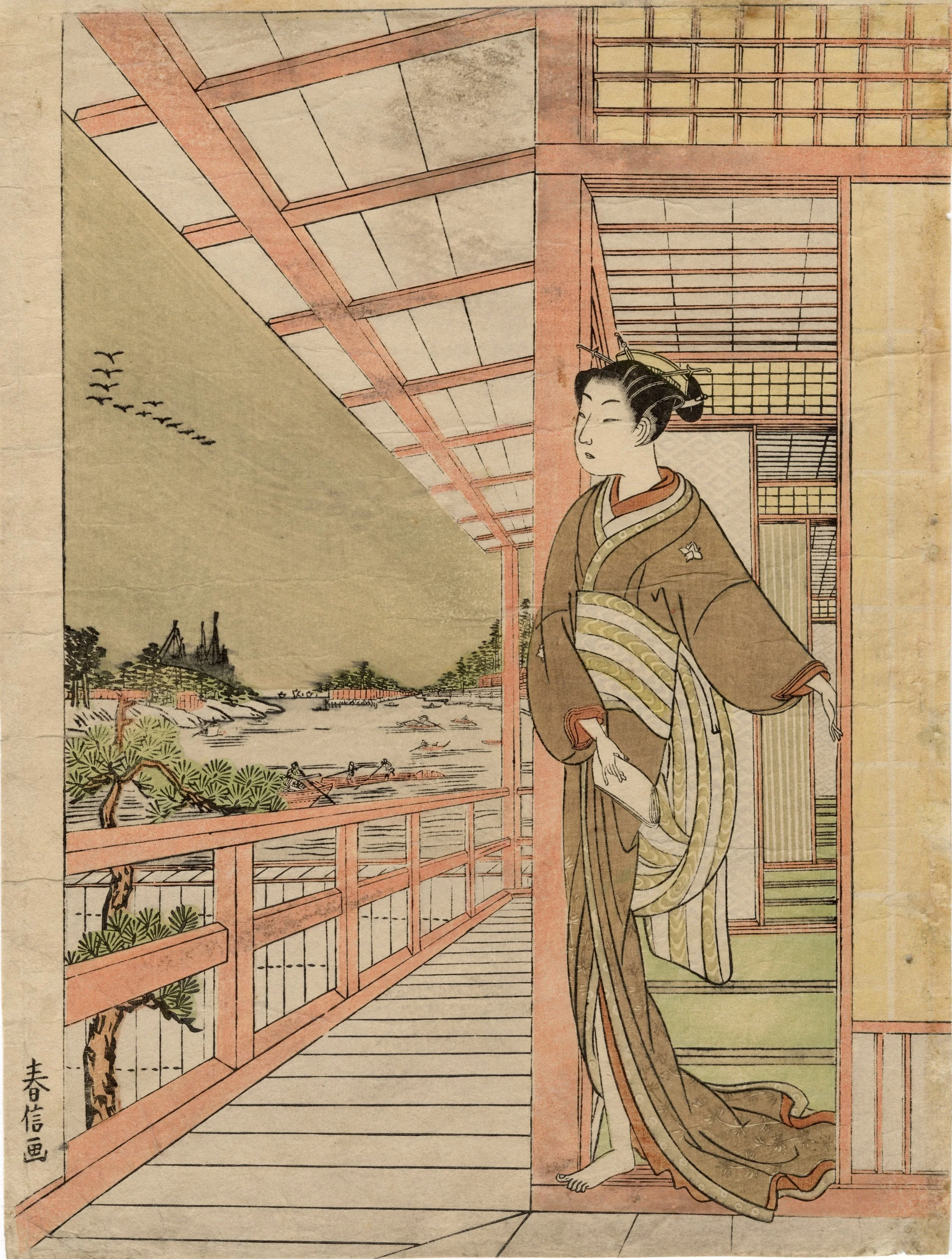 Image 1 of 2
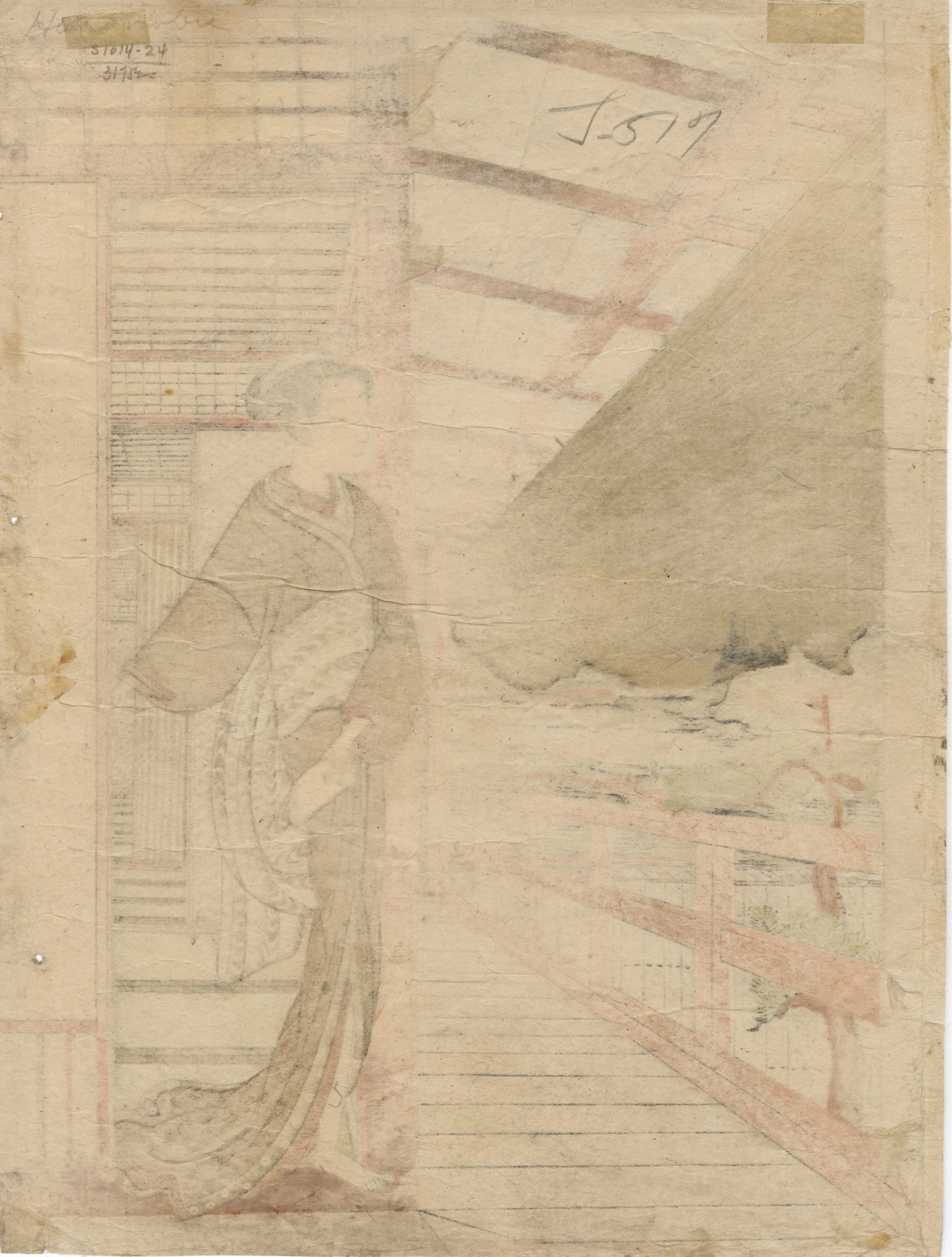 Image 2 of 2