
Ukiyo-e History · Chapter Three: The Golden Age
In the previous chapter, we saw how ukiyo-e reached its golden age. Bijin-ga evolved from the graceful young figures of Suzuki Harunobu to the elegant beauties of Torii Kiyonaga, before reaching its artistic peak in the expressive portraits of Kitagawa Utamaro.
Actor prints followed a similar path, from the bold style of the Torii School to the realism of Katsukawa Shunsho, before Toshusai Sharaku transformed the genre with his unforgettable – and almost comic -- large-head portraits.
Yet no artistic tradition remains untouched forever. In a rapidly changing Japan, with the Western powers circling the island nation with dreams of unlocked riches, ukiyo-e went through rapid change in subject matter and printing technology, reaching its zenith and almost as quickly fading, done in by modern visual technology such as photography that was imported from the west. For me, this is a bittersweet moment in history – the first print I bought was by Utagawa Kunisada, a star of this period, and he was my first love as an ukiyo-e artist with his bold, energetic and colorful designs. (More on him later.) In time, my eye would become more educated, more sophisticated, and I’d see the beauty in the refined elegance in the designs of Utamaro and Harunobu… but you know, we never forget our first love.
Now artists turned away from beauties and actors toward landscapes, current events, political satire, and scenes of war. Their works not only reflected history—they became part of it.
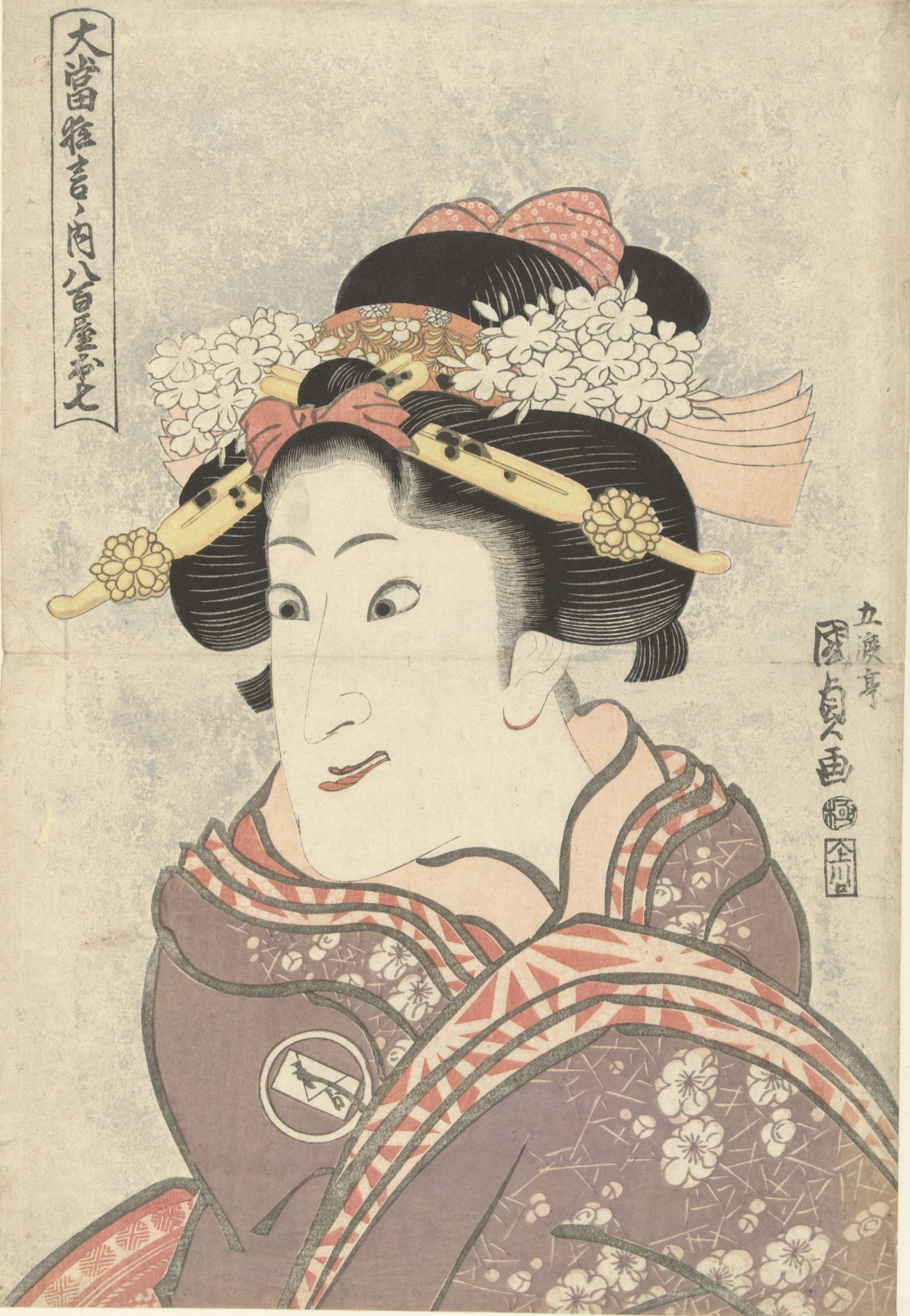
Actor Iwai Hanshirô as Yaoya Oshichi, from the series Great Hit Plays (Ôatari kyôgen no uchi); Utagawa Kunisada; 1812-1816; the Rijksmuseum
01. The Utagawa School
In the history of ukiyo-e, great craftsmen were never in short supply, but true innovators were rare. In the long peace of the Edo period, artists capable of fundamentally reshaping ukiyo-e appeared only once in a generation. In the late 18th Century, with bijin-ga perfected by Utamaro and actor prints transformed by Sharaku, such a force quietly emerged—the Utagawa School—founded by a truly bold visionary, Utagawa Toyokuni.
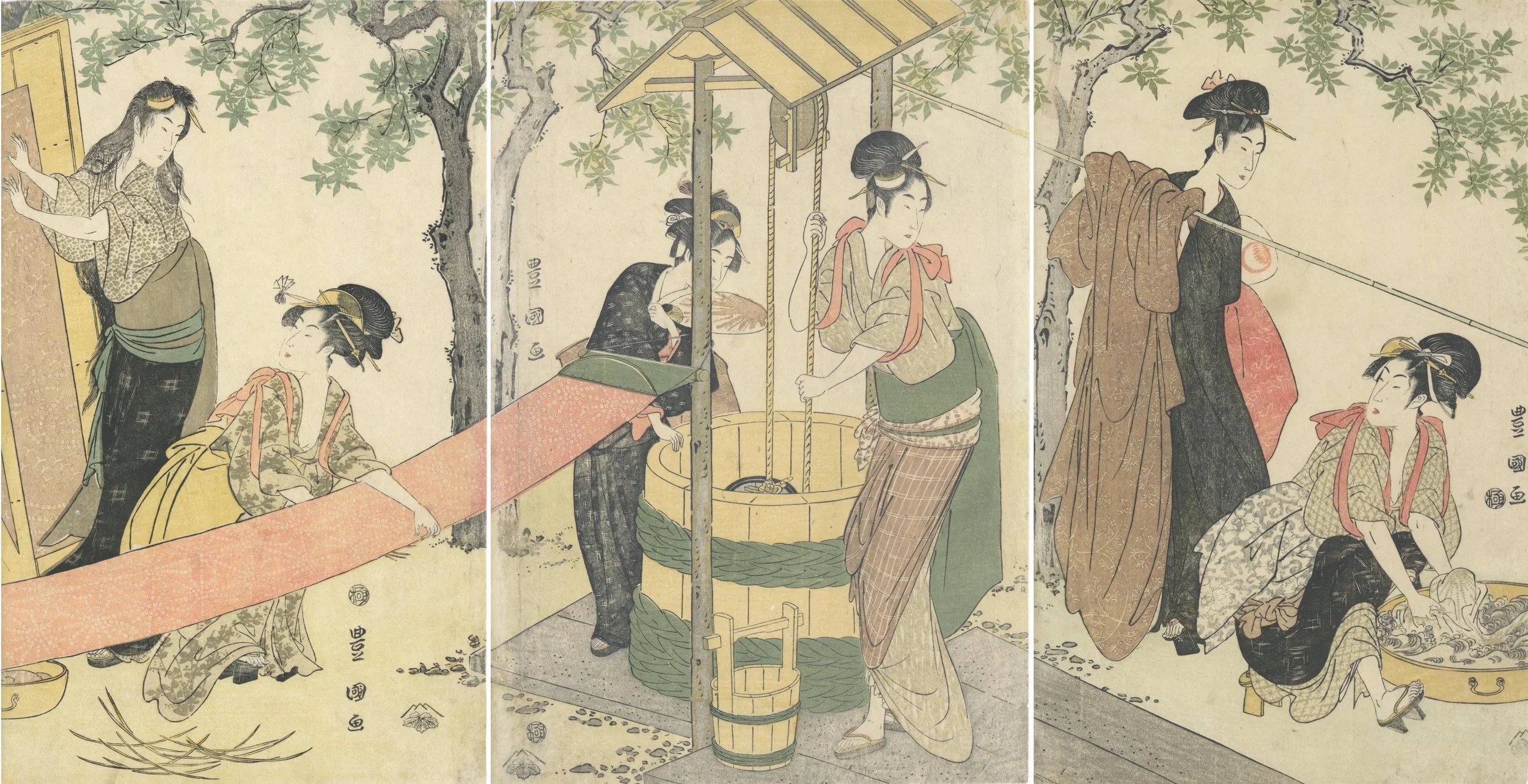
Women Washing and Stretching Cloth; Utagawa Toyokuni I; 1795; Art of Ukiyoe
Toyokuni was not celebrated for extraordinary originality like Torii Kiyonaga, nor did he possess the brilliance of Utamaro or Sharaku. While his actor prints were certainly elegant and approachable, his beauties graceful and refined, they were basically competent. But Toyokuni had something else -- an exceptional understanding of the market. He readily adapted his style to publishers' demands and worked closely with many of the leading writers of the day, including Kyokutei Bakin and Santō Kyōden. Commissions poured in, and his commercial success was unlike anything ukiyo-e had seen before.
Toyokuni's understood the changing tastes of Edo society. While other artists pursued personal expression, he built a workshop that welcomed and trained generations of students. Over time, the Utagawa School grew into the largest and most influential artistic lineage in ukiyo-e. By the end of the Edo period, the history of ukiyo-e had, in many ways, become the history of the Utagawa School itself.
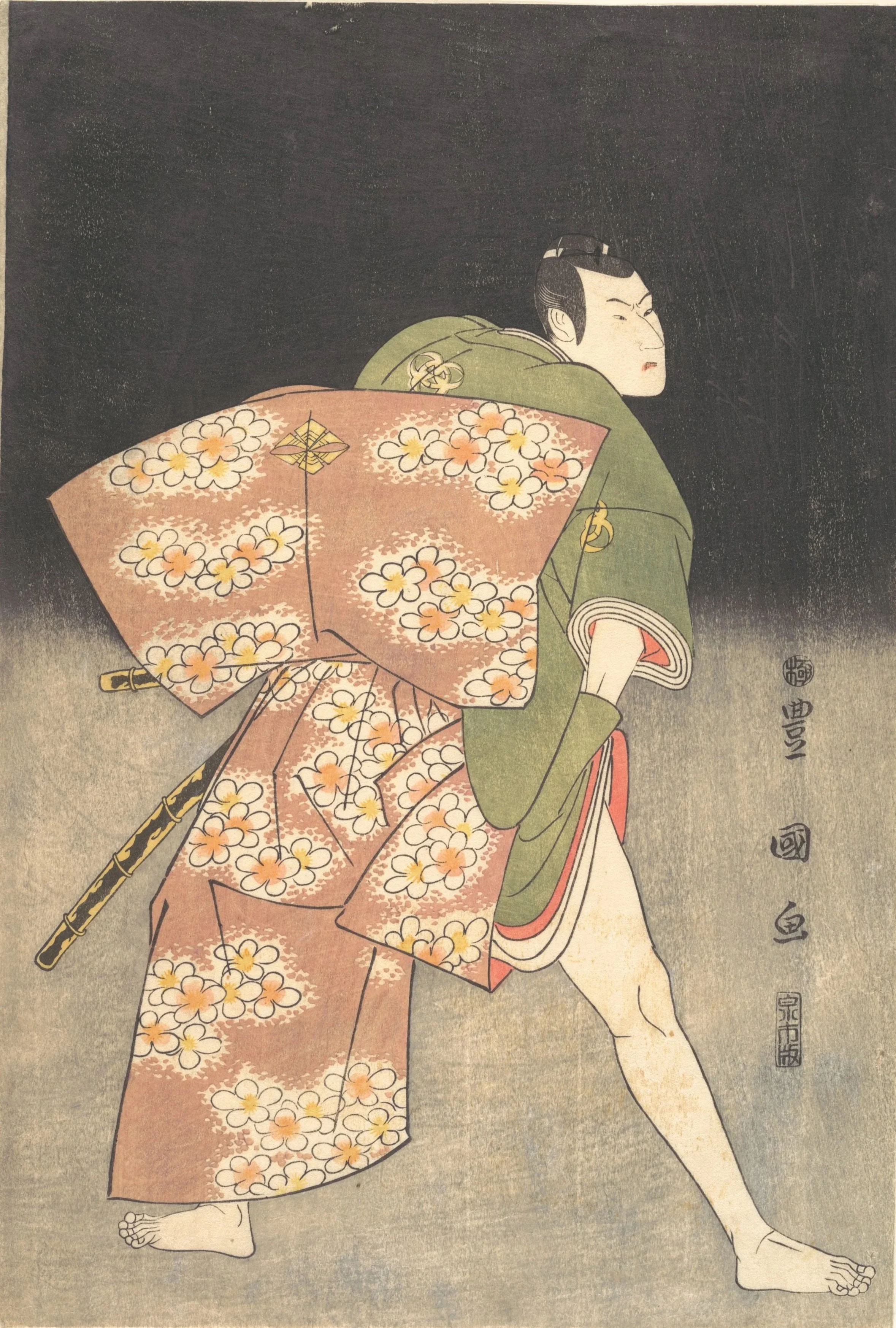
Bandō Minosuke (Mitsugorō III) in the Role of a Young Samurai; Utagawa Toyokuni I; 1796; The Metropolitan Museum of Art
One reason was the relentless pressure put on artists by the Tokugawa shogunate, which continued to impose restrictions on popular entertainment; ukiyo-e was among its frequent targets. Working under constant censorship, artists were often forced to create within narrow boundaries. As a result, beauty prints and actor prints became increasingly ornate, exaggerated, and theatrical, losing much of the freshness and vitality that had once defined them.
It was time for something new.
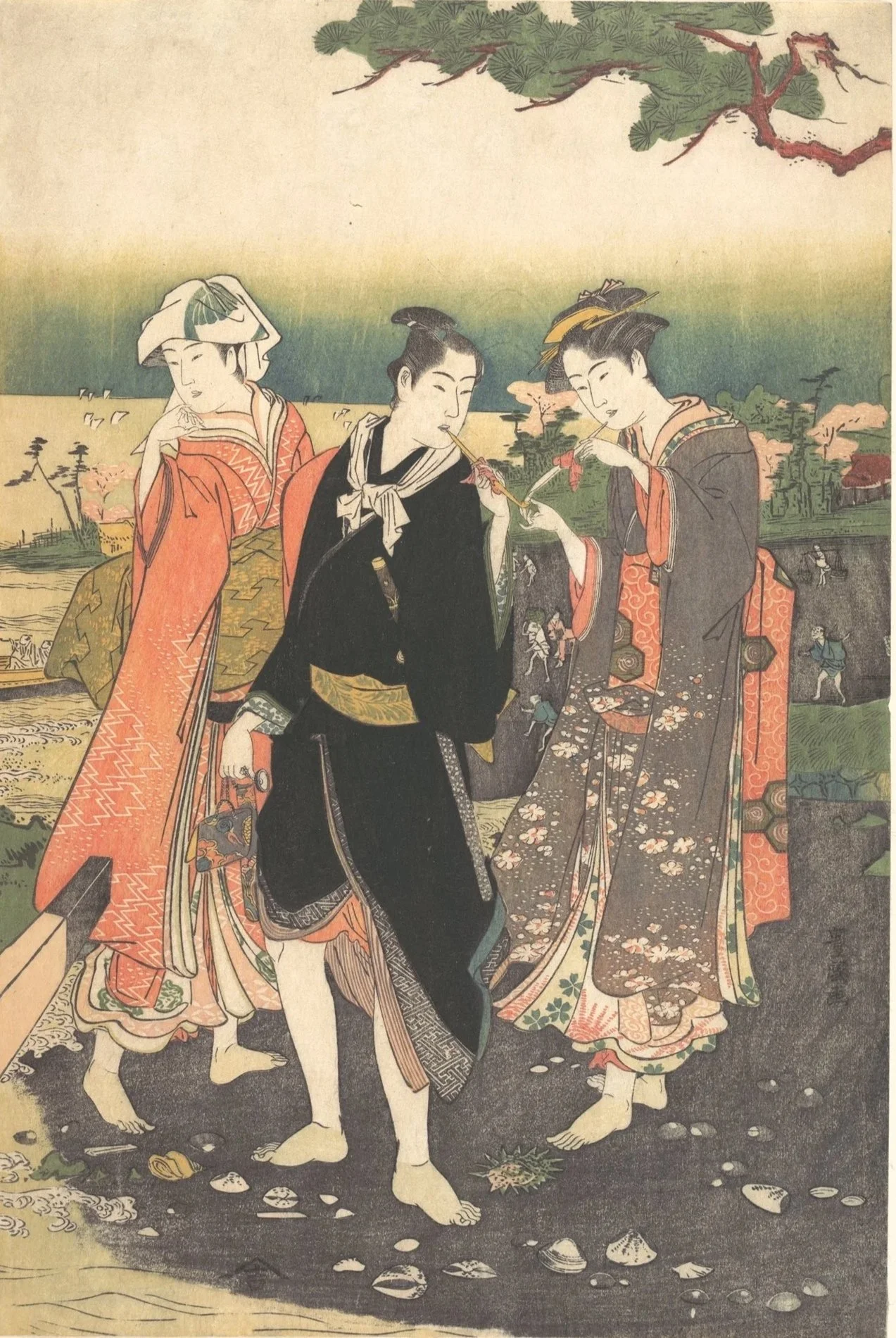
On Shinagawa Beach at Ebb-Tide; Utagawa Toyokuni I; 1769–1825; The Metropolitan Museum of Art
02. Utagawa Kunisada
Toyokuni founded the Utagawa school, but his successor, the great Utagawa Kunisada, was its leader for more than 40 years. While not as revered as Utamaro or Harunobu, who came decades before, he was without a doubt the most prolific ukiyo-e artist of the Edo period, and the quality of his work was remarkably high throughout his lifetime.
Kunisada’s life caught the tail end of the early golden age of ukiyo-e and ended during the final, halcyon days of traditional Japanese woodblock printmaking. His legacy lived on with many famous pupils. In between, he produced countless designs of bijin-ga, warriors, legends, Surimono, more bigin-ga, the Tale of Genji, actors, landscapes, Shunga, fan prints, and even more bijin-ga.
His work embraced a subtle elegance and simplicity, a timelessness, when other woodblock artists often favored busy energy. Except when it didn’t.
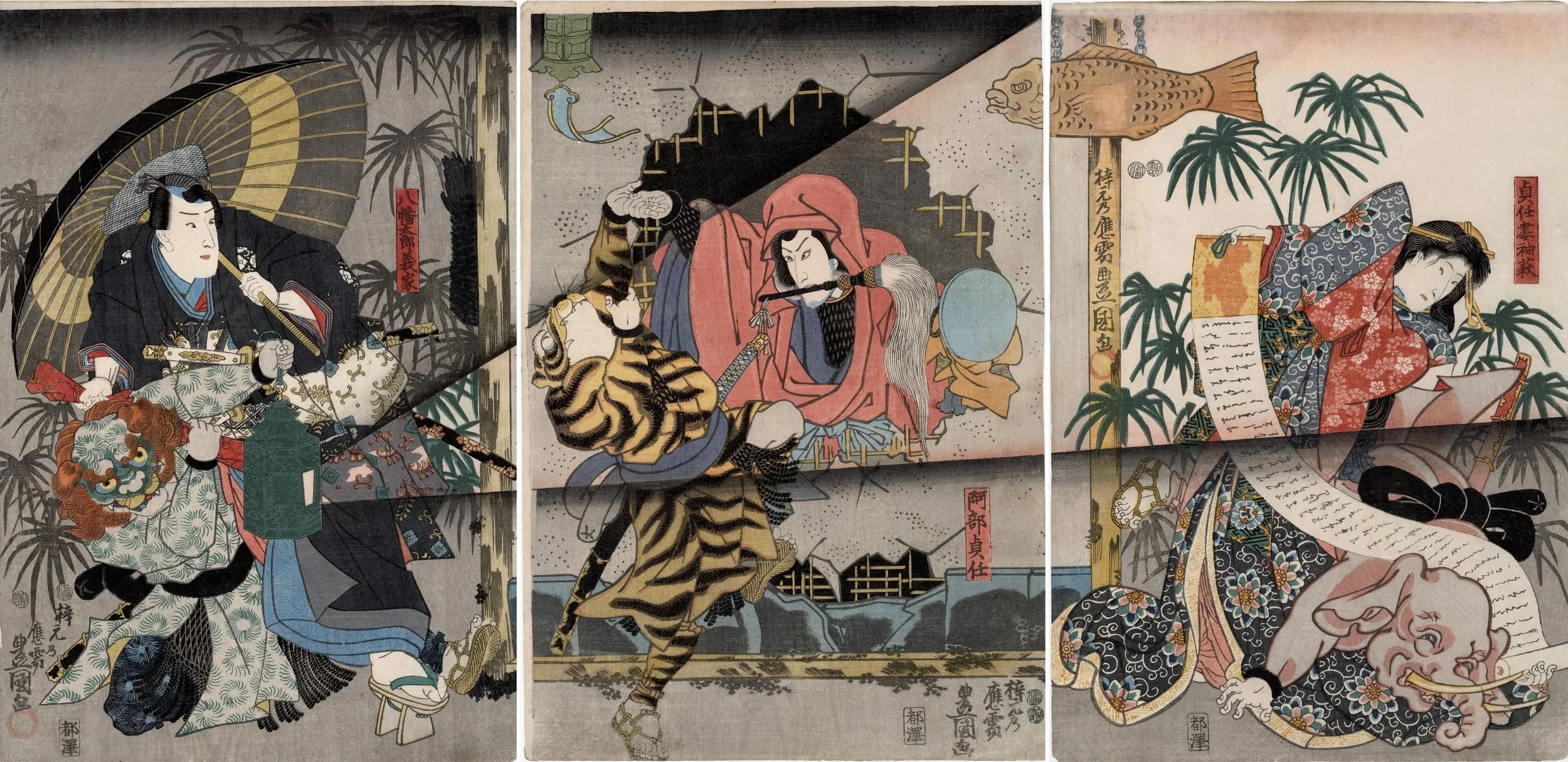
The Trio of Light: Oshu Heroes and the Array of Mythical Beasts; Utagawa Kunisada; 1847-52; Art of Ukiyoe
He was born in 1796 and always had a steady income from his family’s ferry business – making him unusual in the world of ukiyo-e, where so many struggled to make ends meet. He became a student of Toyokuni when he was 15. The master gave him the name Kunisada, using the tradition of a teacher starting a student’s name with the end of his own.
After getting his start doing book designs, Kunisada saw his first major successes in the 1820s. His initial specialties were beautiful women and warriors, as well as erotic books. He often put his subjects in well-drawn landscapes but rarely produced pure landscapes themselves.
Kunisada was generous with his students, many of whom went on to great success, including Kunichika, Kunisada II, Sadahide, and Kunihisa II. This last pupil, who among other projects designed the in-set landscapes in Kunisada’s wonderful “100 Famous Sights in Edo Matched with Beautiful Women” in 1857-1858, was a rarity among Ukiyo-e artists – a woman.
Kunisada died in 1865, just three years before the end of the Tokugawa epoch, leaving behind a body of work unmatched in his time.
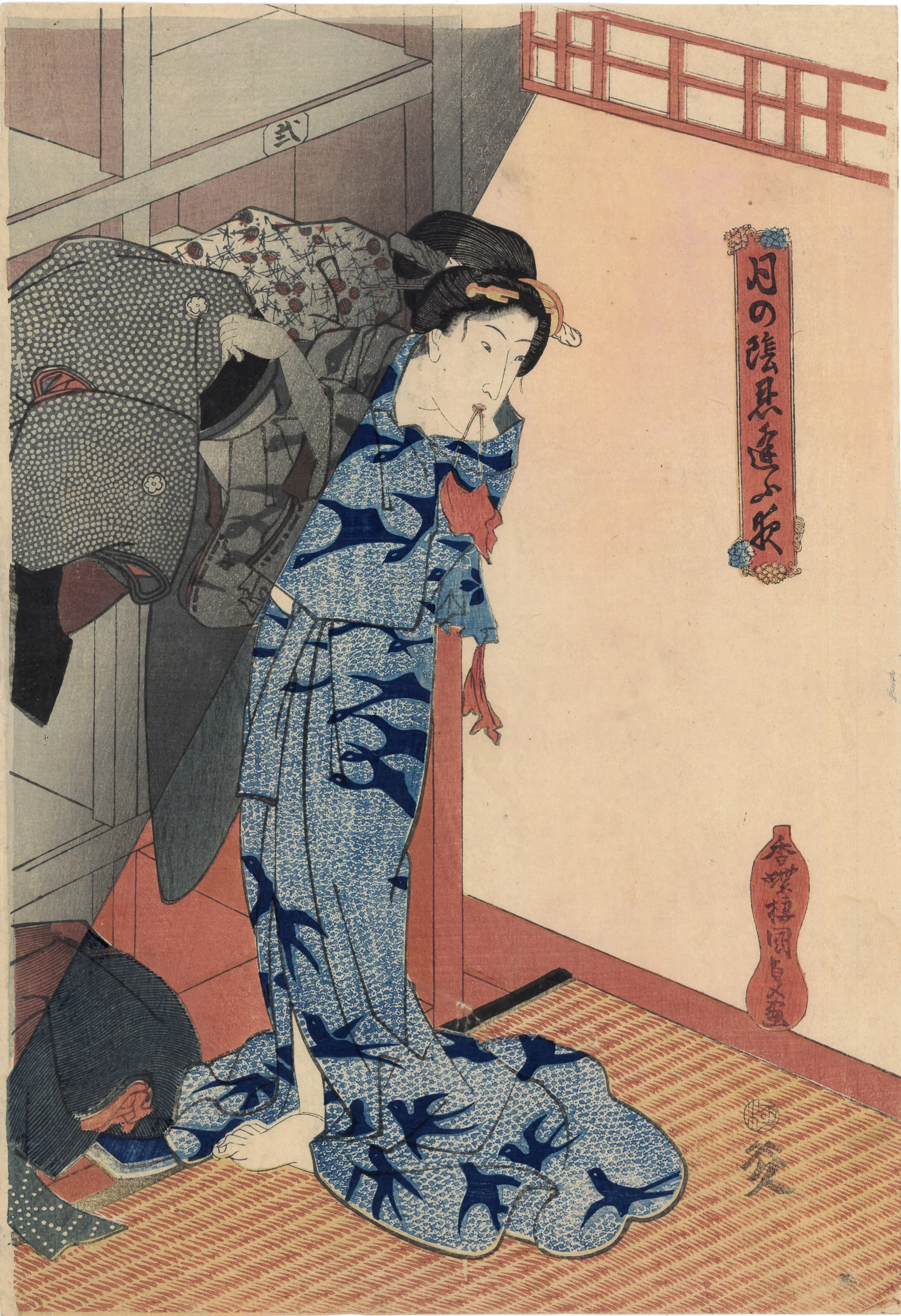
After Bath, Secret meetings by moonlight; Utagawa Kunisada; 1830s~40s; Art of Ukiyoe
03. A New Vision: Hokusai and the Birth of Landscape Prints
Now came two artists who almost invariably come to mind when people think of ukiyo-e today—Katsushika Hokusai and Utagawa Hiroshige. More than any other artists, they shaped the image of Japanese woodblock prints in the eyes of the modern world.
Hokusai may not have been a member of the Utagawa school – as Hiroshige and others would be – but he was unlike anyone who had come before him. And so to understand the pivot to landscapes, we have to first understand this fascinating man – or at least, try to.
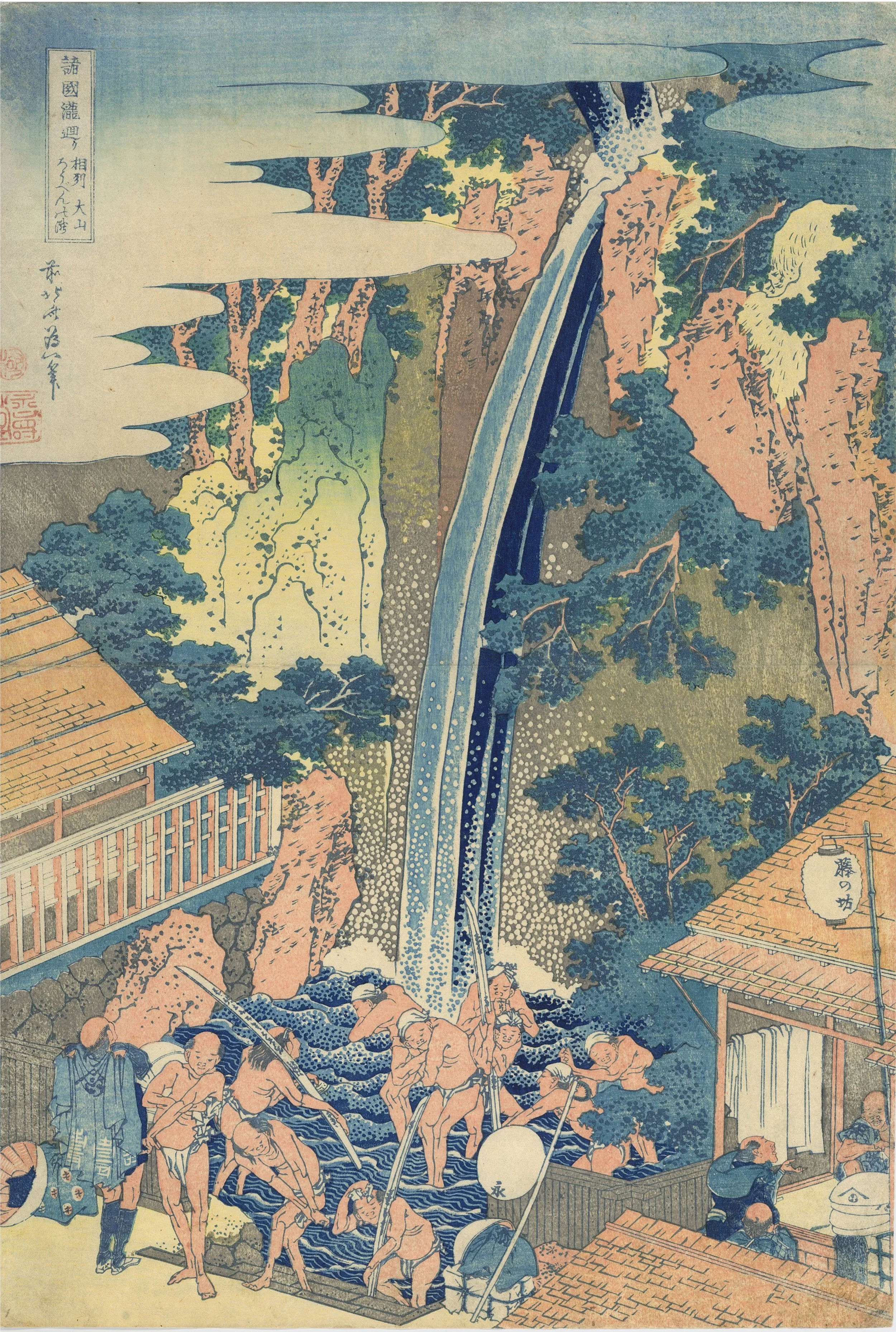
The Roben Waterfall at Mount Oyama in Soshu Province, A Tour of Waterfalls in Various Provinces; Katsushika Hokusai; 1833; Art of Ukiyoe
Born in 1760, he is said to have begun drawing at the age of six and entered the studio of Katsukawa Shunshō when he was nineteen. Restlessly curious and endlessly inventive, Hokusai devoted his life almost entirely to art. He constantly experimented with new techniques, new subjects, and new ways of seeing, paying little attention to convention or personal relationships. His uncompromising personality often brought him into conflict with fellow artists and publishers alike. After the death of his teacher, he eventually left the Katsukawa School and embraced the name by which he wished to be remembered—Gakyo Rojin, "The Old Man Mad About Painting."
Hokusai found his first success as an illustrator, producing an extraordinary range of illustrated books, the most famous of which was the multi-volume Hokusai Manga. Filled with sketches of people, animals, plants, landscapes, and everyday life. These books demonstrated both his astonishing powers of observation and his inexhaustible imagination. They also established his reputation as one of the most original artists of his generation.
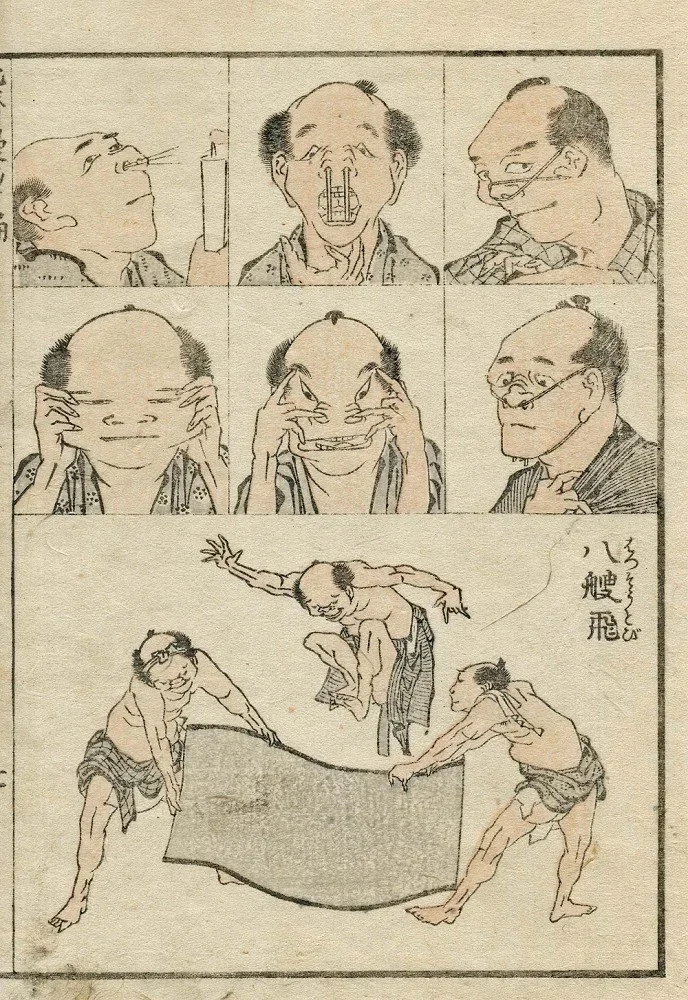
Hokusai Manga
Fascinated by Western art, Hokusai eagerly studied oil painting, copperplate engraving, linear perspective, imported pigments, and other techniques that had entered Japan through limited contact with Europe. Rather than simply imitating Western art, he absorbed these new ideas and transformed them into something unmistakably Japanese.
The result was one of the most celebrated masterpieces in the history of art: Under the Wave Off Kanagawa (“The Great Wave”), from the series “Thirty-six Views of Mount Fuji.”
For centuries, Mount Fuji had occupied a special place in the Japanese imagination. Revered as a sacred mountain and a symbol of eternity, it inspired countless pilgrims during the Edo period, when devotion to Fuji became a widespread popular movement. Mini Fujis were even created in Edo, including in Meguro City. Hokusai recognized this deep cultural connection and made the mountain the central motif of his most ambitious series.
Yet tradition alone did not make the series revolutionary. Hokusai combined dramatic Western-style perspective with bold geometric compositions, creating images of remarkable depth and visual power. He also embraced the newly imported pigment known as Prussian blue, whose brilliant color gave the prints a freshness unlike anything audiences had seen before. Through sophisticated printing techniques such as bokashi (color gradation), the deep blues of the foreground dissolve naturally into lighter tones toward the horizon, lending the sea an extraordinary sense of movement and atmosphere.
Every aspect of the series—its subject matter, composition, colour, and technique—felt new.
It became an immediate success throughout Edo.
Hokusai was seventy-two years old when he created it.
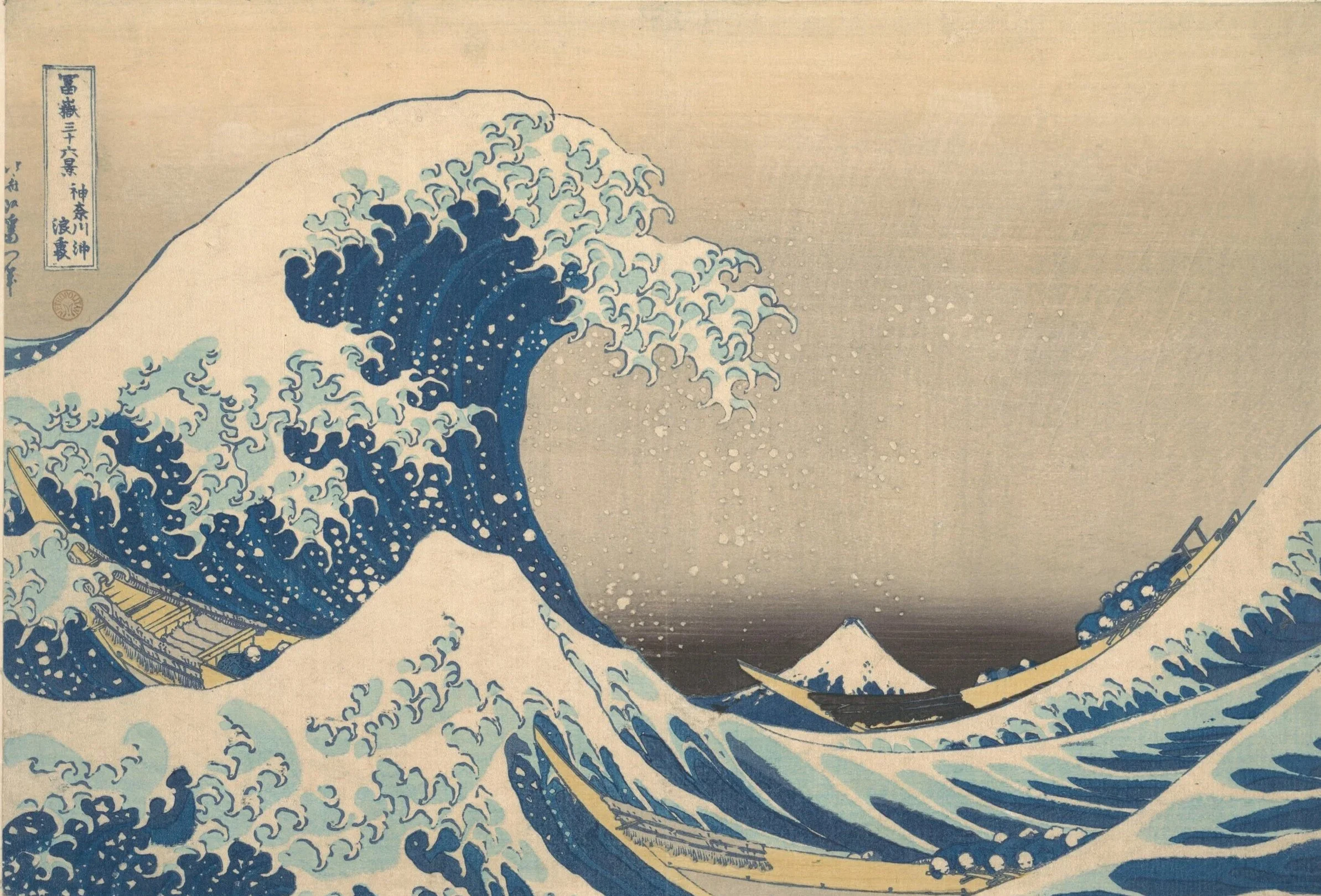
The Great Wave, from the series Thirty-six Views of Mount Fuji (Fugaku sanjūrokkei); Katsushika Hokusai; 1830–32; The Metropolitan Museum of Art
04. Another Master Emerges: Utagawa Hiroshige
Only two years later, in 1833, a new landscape series by Hiroshige captured the imagination of Edo. “The Fifty-three Stations of the Tokaido” would become one of the defining masterpieces of ukiyo-e.
The Tokaido was the famed seaside road between Edo and Kyoto – traveling it was a once-in-a-lifetime experience for many Japanese in those times. Beautiful views, local culinary delicacies and other carnal delights were available at the 53 towns – or stations – along the route.
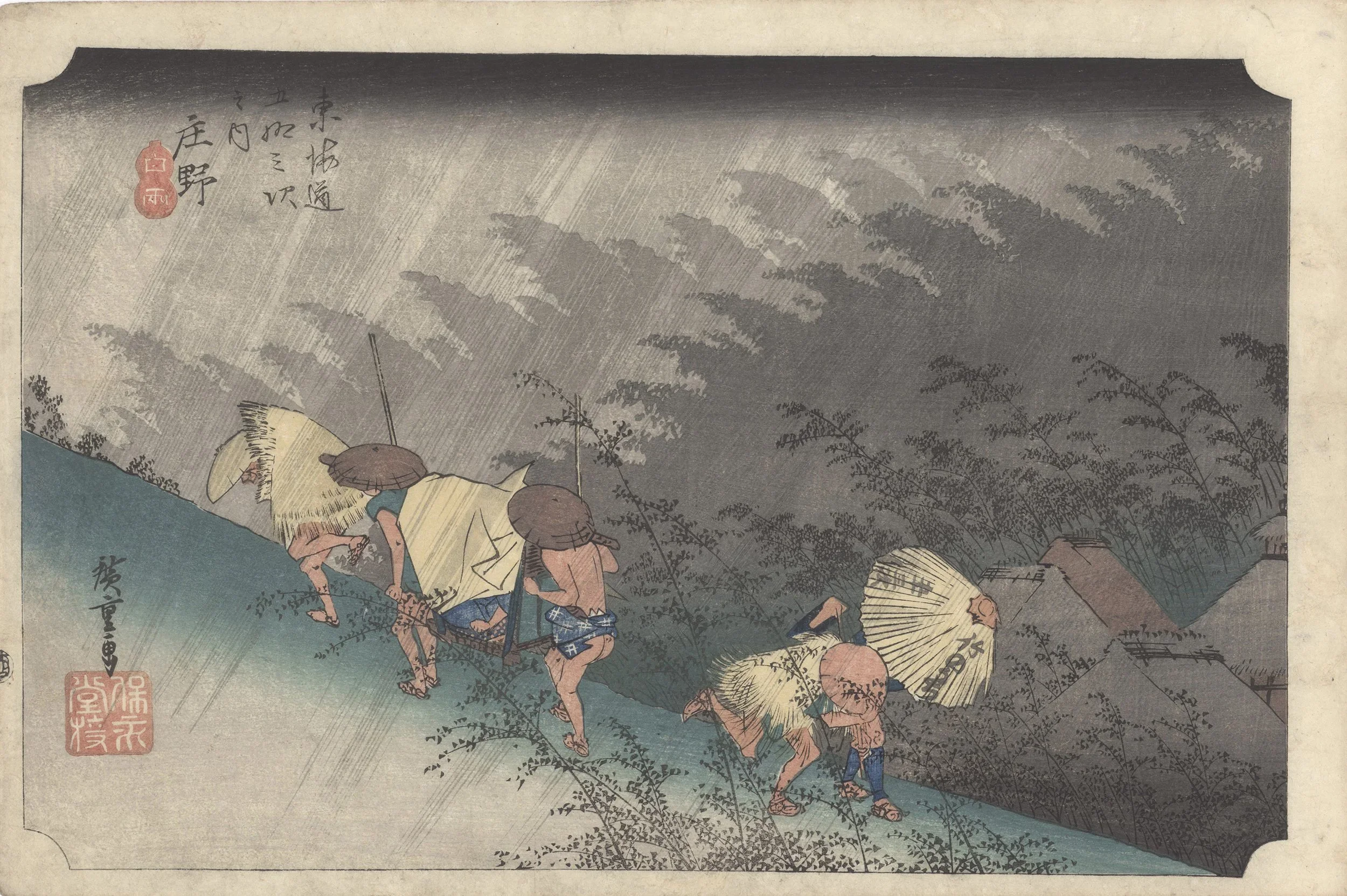
Shono, Travellers surprised by sudden rain, from the series of 53 Stations of the Tokaido; Utagawa Hiroshige; 1833; Art of Ukiyoe
Hiroshige, a student of Utagawa Toyohiro, depicted the landscape with palpable, poetic feeling, and was especially adept at showing how humans interacted with the natural world. Travelers resting at roadside teahouses, bridges disappearing into mist, sudden rainstorms, evening snow, and the changing seasons all became subjects worthy of artistic attention. Rather than recording famous places as monuments, Hiroshige captured the atmosphere of travelling itself.
Hiroshige also embraced Prussian blue. Yet the mood of his prints could not have been more different. While Hokusai's landscapes are often bold, dynamic, and monumental, Hiroshige's are quiet, lyrical, and deeply poetic. Influenced by the traditions of Japanese painting—particularly the naturalistic approach associated with Maruyama Ōkyo—he favored softer colors, gentler compositions, and a more restrained emotional language.
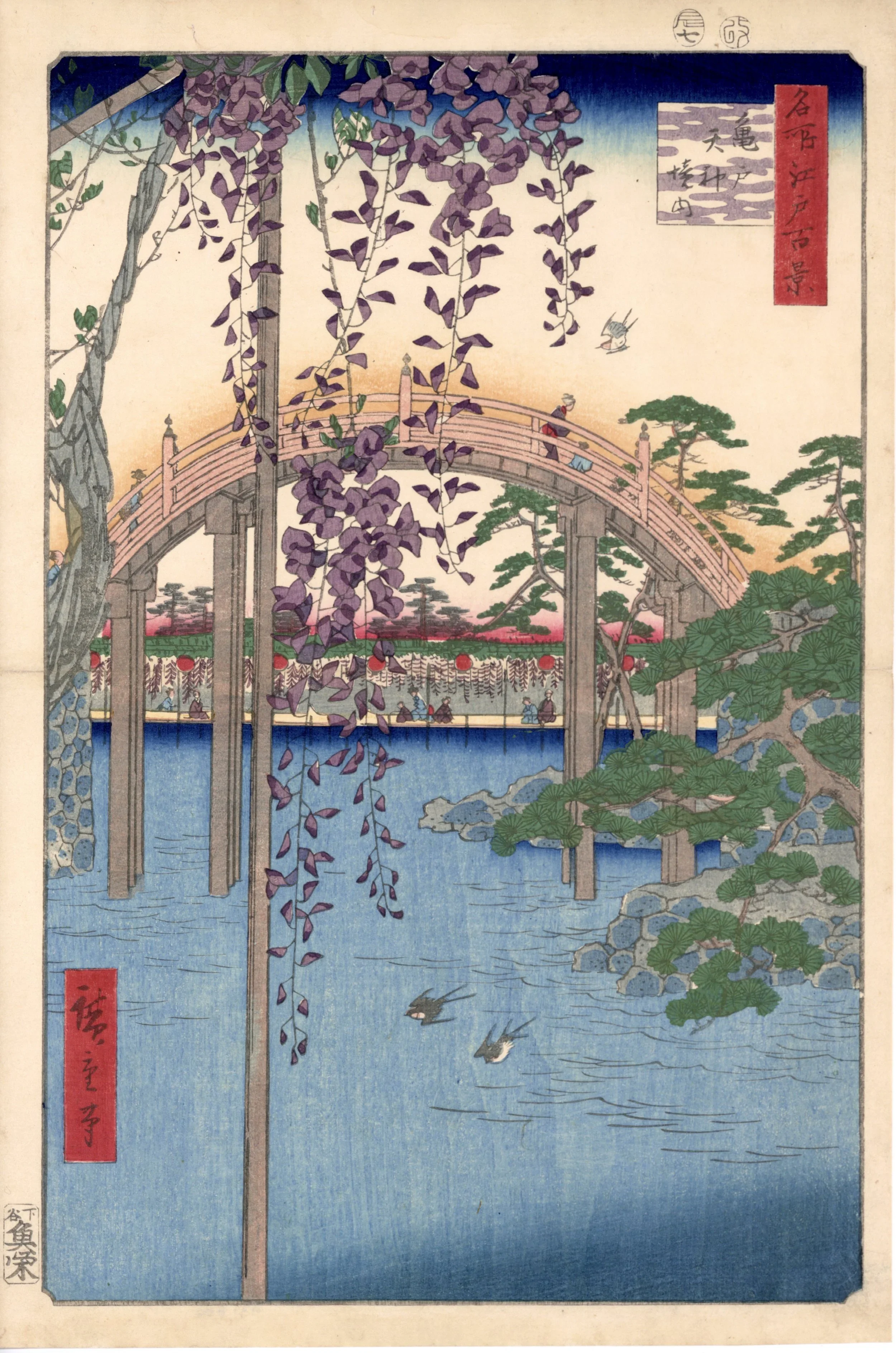
Inside Kameido Tenjin Shrine, 100 Famous Views of Edo; Utagawa Hiroshige; 1856; Art of Ukiyoe
If Hokusai invites us to marvel at the power of nature, Hiroshige encourages us simply to inhabit it.
Over the following decades, the two artists seemed almost to challenge one another through their work. Hokusai published series such as “A Tour of the Waterfalls of the Provinces,” while Hiroshige responded with masterpieces including Famous Places in Edo and later “One Hundred Famous Views of Edo.” Together, they transformed landscape prints from a relatively minor genre into the most influential branch of ukiyo-e during its final great flourishing.
This remarkable change was not driven by artistic innovation alone. It was also the result of profound social change.
Travel, once limited to a privileged few, had become increasingly popular among ordinary townspeople. Pilgrimages to the Ise Grand Shrine, for example, developed into journeys that combined religious devotion with sightseeing, and travelling itself became a fashionable pastime. Those who returned home often purchased landscape prints as souvenirs or keepsakes, while those who had never travelled collected them as windows onto places they could only imagine.
In this way, landscape prints came to embody the aspirations of late Edo society. They invited viewers not only to admire beautiful scenery, but also to experience the excitement of travel and the changing face of Japan itself.
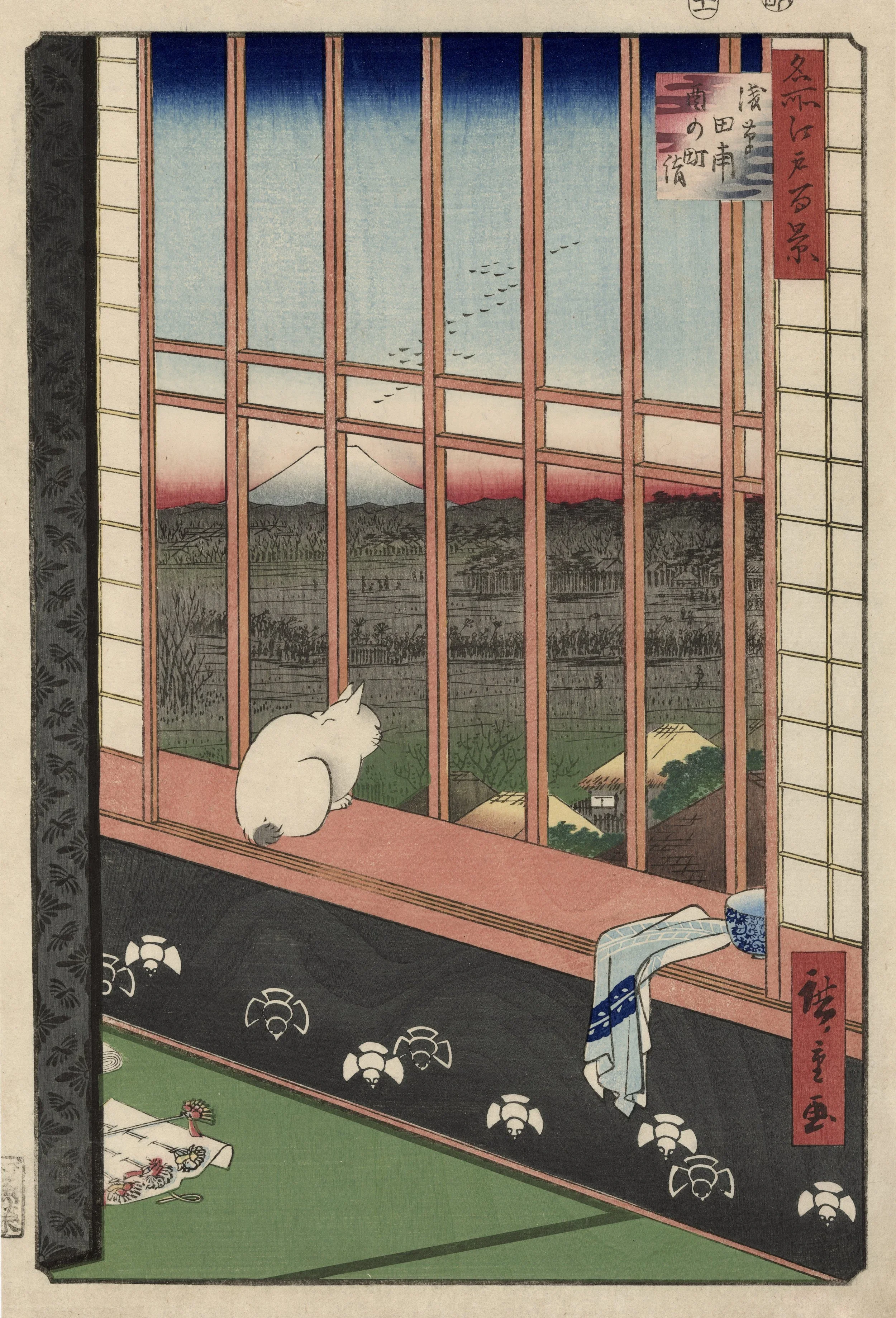
Asakusa Ricefields and Torinomachi Festival, 100 Famous Views of Edo; Utagawa Hiroshige; 1857-58; Art of Ukiyoe
Landscapes also brought the great leaders of the Utagawa school together. In the early 1830s, reacting to the runaway success of Hiroshige’s Hoeido Tokaido series, Kunisada began his own series that copied Hiroshige’s designs but placed a beautiful woman in the foreground. While Hiroshige’s prints were oban yoko-e (horizontal oban prints), Kunisada’s “copies” were smaller chuban-size prints, meaning two could be cut from a single oban-sized sheet. These little prints were phenomenally successful – as successful at least as Hiroshige’s – and eventually Kunisada was publishing his little Tokaido prints ahead of Hiroshige’s, and thus designing his own background landscapes.
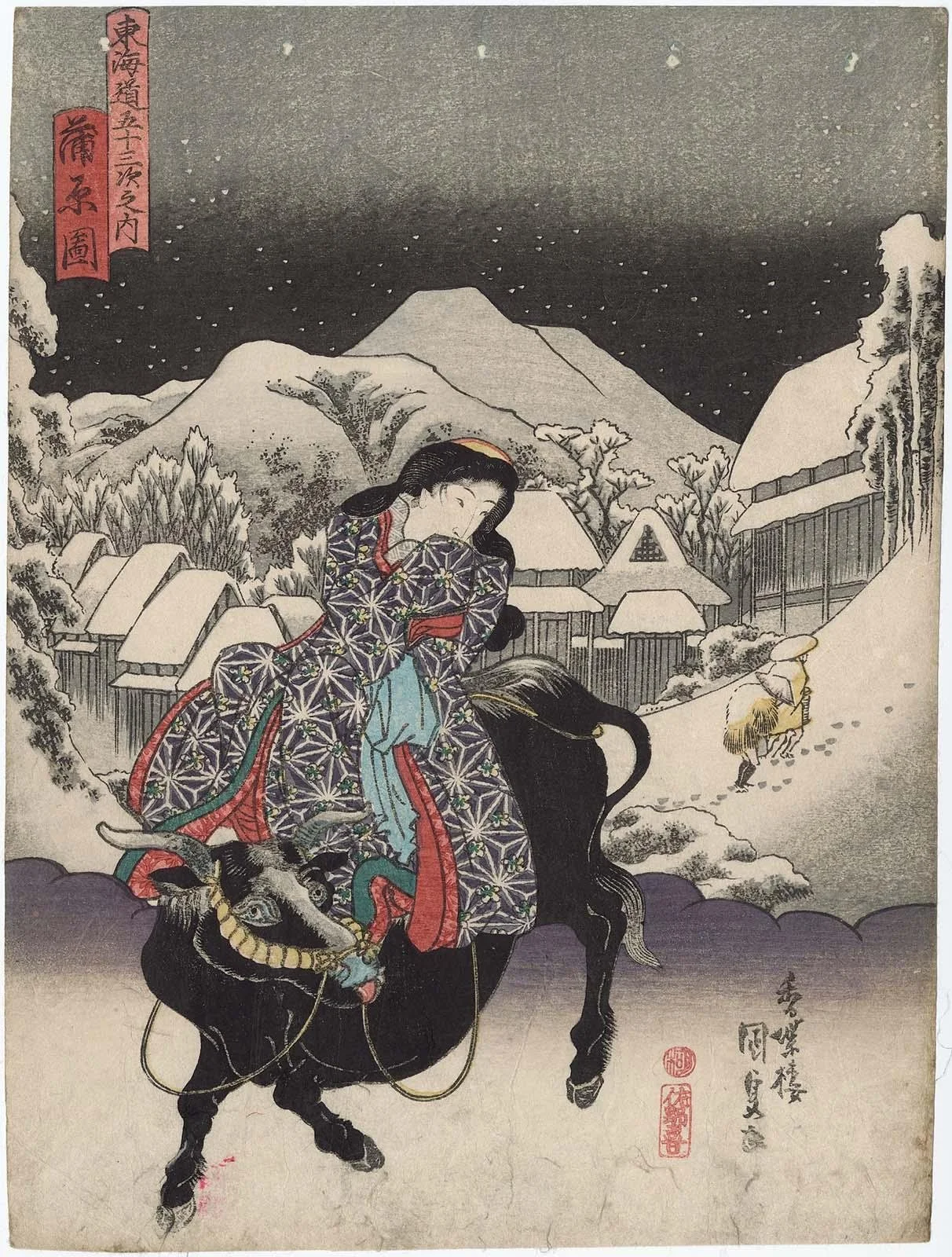
View of Kanbara (Kanbara zu), from the series Fifty-three Stations of the Tôkaidô Road; Utagawa Kunisada I; 1838; Museum of Fine Arts, Boston
Kunisada would later produce the “two-brush” Tokaido series with Hiroshige in the 1850s, in which he drew figures in the foreground while Hiroshige supplied beautiful little landscapes behind them. This was one of several notable woodblock print collaborations during his lifetime.
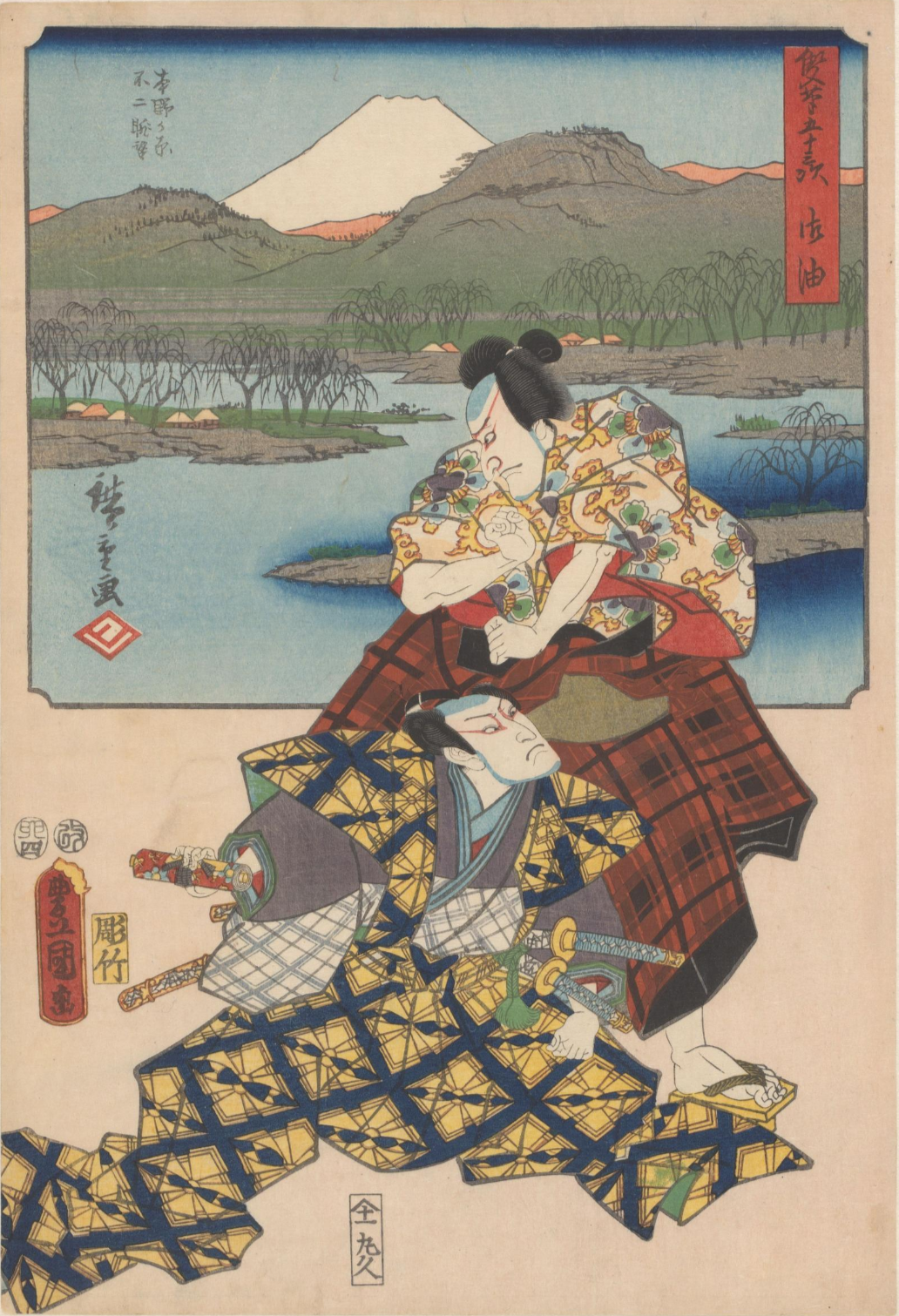
Goyu, from the series The Fifty-three Stations [of the Tôkaidô Road] by Two Brushes (Sôhitsu gojûsan tsugi); Utagawa Kunisada; 1855; the Rijksmuseum